- We mixed our drinks: Men, women and food and Anti-choice pickets hit London
- [trigger warning] Sian and Crooked Rib: Getting VAWG reported in the news - part 2
- Speaker's Corner: Caveman Psychology – a Real Thing
- [trigger warning] Guardian: 'Racist' UK policies blamed for deaths of 77 asylum seekers and migrants
- John Scalzi: Things I Don’t Have to Think About Today
- Resist Racism: Word substitution
- Chally at Feministe: Unreality and the politics of experience
- LGBT Asylum News: Great infographic shows where global refugees flee to and from
- Sparky at Womanist Musings: Spark of Wisdom: Praising someone for being a decent person
- Heg at Feminist Philosophers: How not to do an equality impact assessment…
- pinkpjs at Where's the Benefit?: 'Not really disabled' (and several other good posts)
- [trigger warning] Guardian: Humiliate, strip, threaten: UK military interrogation manuals discovered
- Polly at Too much to say for myself: Up in the air
- abby jean at FWD: Figuring Out the Actual Goal of a Policy
- [trigger warning] Too much to say for myself: A tendency to “over-react”
- Don Paskini at Liberal Conspiracy: How welfare cuts hit low paid workers
- Queen Emily at Socialism and...: Attacking the already vulnerable
- Guardian: No terror arrests in 100,000 police counter-terror searches, figures show
- Spark in Darkness: Mohammeds everywhere!
- Diane Shipley at FWD: Stuck and tired: How universities are failing disabled students (like me)
- Johann Hari: Protest works. Just look at the proof
Friday, 29 October 2010
Friday Links

Thursday, 28 October 2010
Suffrage and successes that stick
At the Museum of Edinburgh is an exhibition commemorating the women's suffrage campaigns in the UK.
There was this interesting poster there:
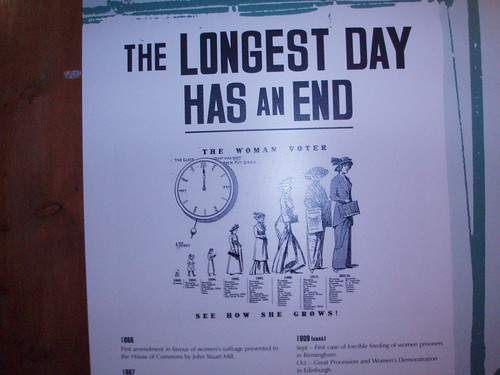
The poster has the slogan "The longest day has an end" prominently at the top. Below that on the left is a clock set to midnight. Below that, and rising to the right of the clock, is a timeline running from 1869 to 1913, detailing the countries and sub-national regions that allowed at least some women to vote, graphically illustrated by sketches of a woman growing older and taller from a tiny baby (waving a flag) in 1869 to a full-height woman in 1913.
Reformatted for the web, here's the timeline:
| Year | Countries/Regions with at least some women allowed to vote |
|---|---|
| 1869 | Wyoming |
| 1893 | Wyoming, New Zealand, Colorado |
| 1896 | Wyoming, New Zealand, Colorado, S. Australia, Utah, Idaho |
| 1902 | Wyoming, New Zealand, Colorado, S. Australia, Utah, Idaho, W. Australia, New South Wales |
| 1907 | Wyoming, New Zealand, Colorado, S. Australia, Utah, Idaho, W. Australia, New South Wales, Tasmania, Queensland, Finland |
| 1908 | Wyoming, New Zealand, Colorado, S. Australia, Utah, Idaho, W. Australia, New South Wales, Tasmania, Queensland, Finland, Victoria, Norway |
| 1911 | Wyoming, New Zealand, Colorado, S. Australia, Utah, Idaho, W. Australia, New South Wales, Tasmania, Queensland, Finland, Victoria, Norway, Washington, California |
| 1912-1913 | Wyoming, New Zealand, Colorado, S. Australia, Utah, Idaho, W. Australia, New South Wales, Tasmania, Queensland, Finland, Victoria, Norway, Washington, California, Oregon, Kansas, Arizona, Alaska |
Below the timeline is the second slogan "See how she grows!"
The whole exhibition - if you happen to be able to get there before it closes, and find it in the museum (accessibility is not universal) - is worth seeing.
One of the points being made by the timeline is that no area that granted women the right to vote had since revoked it, and I think this point provides a useful division of social justice issues.
For some issues, like suffrage, or the right of LGB people to serve in the military, there is a clear point. It may take decades or centuries of difficult struggle to argue up to that point, but once there the gains are relatively safe - once the critical threshold has been passed in a particular democratic jurisdiction, the idea fairly rapidly passes into general acceptance, to the extent that even those who opposed it before move to support it, at least in public.
The gains are reversible - any violent or otherwise sudden overthrow of the system of government, from within or without, might reverse them - and that they're otherwise unlikely to be reversed of course doesn't imply that there doesn't remain a significant minority of people who believe that they're nevertheless wrong. There are still people in the UK who believe that women shouldn't have the right to vote.
For other issues, there's no such critical threshold. The level of rights available can go backwards and forwards across a wide range over the decades, as different opinions gain and lose dominance in governments and in the wider population. Access to abortion has changed back and forth quite a bit in many countries. It's still, just about, a fringe view in the UK Parliament that it should be outlawed entirely - but of course that's a fringe that will grow as erosions are made to the existing rights. Attitudes - and legislation - towards immigration has also varied back and forth a lot. Any gain made with this sort of issue needs to be heavily defended just to make it into a new baseline against the counter-attempts of privilege.
What's not at all clear to me is why an issue falls into one or other type. It's not just about it being a binary divide or not - in the UK women's suffrage proceeded in stages, while the binary issue of defendant anonymity in rape cases has changed back and forth and remains contentious today.
It's also not, as far as I can tell, about differentials between public opinion and government opinion. Sometimes the government lags far behind public opinion on the matter - as the UK government is doing on same-sex marriage - and sometimes it introduces legislation that leads the way and public opinion follows (as happened with the abolition of the death penalty).
It seems like it would be useful to know why some successes stick and others don't, and perhaps how a success could be made to stick when it otherwise wouldn't, but I don't know of much that's been said on that.
Monday, 25 October 2010
Season's Greetings
Season's Greetings! Happy Northern-Hemisphere temperate autumn to you all!

Taken at the Royal Botanical Gardens in Edinburgh. Some other photos from the gardens are on Flickr (not all of them particularly autumnal in tone).
Monday, 18 October 2010
The Browne Review of Higher Education
Ten-second summary: not as bad as it looks, at least, not for the reasons that are getting the most press.
The Browne Review of Higher Education funding has been published. In what comes as a surprise to absolutely no-one, it advocates removing the current cap on university tuition fees.
Also unsurprisingly it's been met with heavy criticism, with people claiming that it will double or triple average student debt, and put off people from "middle-class" backgrounds from going to university.
There is a lot to criticise in the review, but the fees model is actually a pretty good deal for students and universities, and the reason is in the unusually favourable terms under which student debt is repaid.
The student finance terms
The Browne Review recommends that all students be given a £3,750 annual maintenance loan, with up to a £3,250 annual grant for those students from less rich families. "Less rich", in this case, starts at £60,000 annual family earnings, with the full grant being available at £25,000 annual family earnings or lower. It also recommends extending provision of loans and grants to part-time students. £7,000 a year isn't a lot of money, but it's enough to fund the typical cheap student lifestyle.
There remain problems here with students whose families are rich enough to be expected to support them, but for whatever reason - LGBT students are often vulnerable to this - don't do so, but the review is unlikely to make these problems worse. There are also problems for students with disabilities, or with dependents, who will have much higher costs than the typical (mostly-privileged) student, but the extension of financial support to part-time study does at least increase their options.
Tuition fees, likewise, will be paid by the government on the same terms as the maintenance loan, as they are now. The difference is that whereas now there is a cap just over £3,000 on fees, this is removed by Browne. Direct government funding for teaching will be mostly withdrawn, so universities are expected to need to increase their fees into the £6,000 - £7,000 range for most courses (comparable, incidentally, to the fees already charged to international students coming to the UK to study).
So, the headline figure is probably about accurate. £7,000 annual fees, plus £3,750 maintenance loan, gives a student debt of over £30,000 for a typical 3-year course. That's really quite a big number. Furthermore, Browne recommends that the interest rate for this debt be the government borrowing rate of 2.2% above inflation, rather than the current inflation rate.
Fake debt
I said this was good news for students, didn't I? The good news comes in from the repayment terms. Student debt is not like normal debt. The repayment rate is not connected to either the size of the debt or to the interest rate - instead it is 9% of any income over £21,000 - and any unpaid debt after 30 years will be written off. Furthermore, the non-inflationary portion of the interest rate only applies to the extent that it does not increase the real (i.e. inflation-adjusted) debt owed. These continue to be incredibly generous terms.
They also give a very odd incentive at a certain point. Because the debt gets written off after 30 years, regardless of its remaining size, there's no difference between a debt that after 30 years has £2 remaining in it, and a debt that after 30 years has £20,000 remaining in it - you pay exactly the same in repayments either way.
So, at the point at which you calculate that your likely future earnings will be insufficient to pay your current debt, there is absolutely no penalty to accumulating any more, which means that you might as well do so. (This is not strictly true: you might become unexpectedly rich, and so end up making more payments than you expected - in which case, you're now rich, so that's fine too).
The key thing about the Browne plans is that the point at which additional debt becomes "free" is actually very low. If your browser supports Javascript, have a play around with this calculator.
Some examples
The expectation is that universities will need to charge £7,000 annual tuition fees just to restore the government teaching funding they'll be losing under the Browne model. Without taking any career breaks in those 30 years, a graduate would need to start on a marginally above-average graduate salary of £25,000, with an average real-terms increase of £1,000 each year, to repay the loan resulting from a three year course. That gives a final real salary of £55,000. Very few people - graduates or otherwise - currently earn that much.
Let's take another (well-paid) example. A student of chemistry, on a 4-year MSci course. They then do a PhD, for another 4 years (so no significant income there), before starting as a post-doc at a university on a salary of around £23,000. After another 25 years, they've managed to become a professor on a generous salary of around £80,000 (but let's say that she took a year of maternity leave somewhere in the middle of this, for five years of career break in total). If the tuition fees for their course were over £8,726; annually, then even this extremely well-off graduate will not repay them all.
A less well-paid example: After a three-year degree, they start work at a salary of £20,000. After five years, in which they only get inflationary rises in pay, they go to part-time work to look after their children, and remain part-time (earning well below the repayment threshold) for the next fifteen years. Once their children are old enough to let themselves back in after school, they go back to full-time work, and get lucky with an (inflation-adjusted) salary of £25,000, which then increases by an impressive £2,500 a year as they quickly rise up through the company. Actual debt repaid - around £14,000, which means any tuition fees over £1,000 are essentially free money. Put a more likely - and lower-paid - job in, and the university has to start paying them for the pleasure of teaching them.
The effect of this should be fairly clear. If, in practice, almost all graduates - even the well-paid ones - will not clear their student loan before it gets written off, at relatively modest tuition fee levels, then the cost-benefit curve actually starts going backwards for a while. If given the choice between a university offering a course at £6,000 tuition a year, and a different university offering the same course ay £12,000 tuition a year, then given that it is unlikely to make a difference to the actual amount of money repaid, it makes sense to pick the more expensive one (which presumably is spending at least some of the difference on providing a better degree).
Breaking cost-benefit
The effect of that, of course, is that if there's no economic incentive for students to choose the cheaper universities, there's no economic incentive for universities to choose to be a cheaper university.
So, every university puts its tuition fees up to £12,000 or more. The Browne review recommends that there be no cap at all1, but that an increasing proportion of fees taken above £6,000 annually must be paid back to the government to compensate it for the risk of non-repayment. There's still no incentive for either university or student not to go up to whatever the cap is, though.
The end result is that for 30 years after graduation, graduates essentially get an extra income tax band that appears at £21,000.
Browne's proposals have been criticised quite heavily, with a graduate tax often being suggested as a better alternative. In practice, this looks very much like a graduate tax, but on far better terms than are usually suggested for graduate taxes...
So, universities are happy, and once students understand that their giant debts are mostly fake, they should be happy too (explaining this in a way that overcomes the general aversion to running up five-figure debts will take a little doing, but should be relatively easy to do).
The government, which is left holding the actual money that backed up the fake debt, on the other hand, is not going to be happy. Or perhaps it is - the amount of money it puts towards funding universities is not going to change that much, but it's now much less obvious that it's being funded by general taxation because in theory it's being paid back by the graduates (who will - in a graduate tax way - pay more towards this repayment than non-graduates).
As with the current system, it's the potential students who don't have the repayment mechanism explained to them who lose out.
Politics
The chances of the Browne review actually being adopted wholesale are relatively small, of course. The ministers are already talking about a £7,000 cap on fees, which, if they implement the rest of the review's proposals as-is, will definitely result in every university charging that for every course.
The Lib Dems, of course, all signed up to an NUS-sponsored promise to vote against tuition fees. Back then, they probably didn't expect to end up in government having to implement it, so putting in a low fee cap makes political sense for them - "look, it wasn't as bad as it could have been", they can say.
Stealth recommendations
The big change as a result of Browne is not going to be in the fees - which even at £7,000 run to the level of "fake debt" for most students - but in the less-discussed recommendation that regulation of student numbers is removed. At the moment, universities are given an annual quota of UK-origin undergraduate2 students. Universities that under-recruit lose funding because they don't have as many students. Universities that over-recruit also lose funding, firstly because they only receive government funding for the allowed students, and secondly because the government takes even more back as punishment.
Combine this with most applications being made before the student or the university knows whether the student will get the grades to meet the offer, and it's a tense time in university admissions trying to guess how many offers to give out to hit the narrow window around the quota.
Not being required to hit a narrow window like that will certainly help universities plan, but it also allows many universities to offer far more places than they currently do. The only limit becomes the size of their facilities and the population of applicants. (The housing availability in the surrounding area also becomes a consideration, but not one that the university has to directly manage).
This deregulation is likely to be a much more significant and disruptive change to the higher education sector in England than any of the fees questions, and so far, it has received relatively little attention - it doesn't come with big numbers, and the intricacies of student admissions processes are not well known.
It's a natural consequence of the fees change - if the government isn't providing funding for students (except via the oblique student loans mechanism) then there's no need for it to enforce particular levels of student numbers. The long-term effects of it, though, are extremely complex, and I expect several universities to end up collapsing or merging as a result.
Feetnotes
1 In practice, at some point, the government is going to have to put a hard cap in place, because otherwise a university can charge £1 billion in fees. Sure, most of this gets taken back by the government, but the university still gets £100,000 per student, and the student's debt is almost entirely fake. Universities start competing on fees measured only in scientific notation, and the economy collapses into massive hyperinflation. So, there's going to be a cap at some point, and probably a relatively low one.
2 There is already, because the government does not fund these places - or at least not in the same way - no quota for postgraduate students or for international undergraduate students. Universities that have reached their UK undergraduate quota have been focusing their recruitment and expansion on these areas instead, which are generally more profitable for the university. Expect the universities that have done well with this area of recruitment to also do well in an deregulated UK undergraduate market, and vice versa.
Friday, 15 October 2010
Friday Links
- Lisa at Where's the Benefit?: Destination Unknown
- Jender at Feminist Philosophers: More mistreatment of immigrants
- Holly Combe at The F-Word: Misrepresentation of Netmums survey result
- Zero at the bone: Relative to What? Part One
- Modus Dopens: What your ancestors fought for
- Guardian: More black people jailed in England and Wales proportionally than in US
- Queen Emily at Questioning Transphobia: On Modification
- Melissa McEwan at Shakesville: Where we stand
- Simon Woolley at Operation Black Vote: The Apprentice: in defence of Joanna Riley
And from the late 70s, this paper by Paul Krugman on The Theory of Interstellar Trade merges economics and special relativity. (Unfortunately, it's only available as a scanned PDF, so not especially accessible)
Friday, 8 October 2010
Friday Links
- Earwicga: UK tortures torture victims
- Zero at the Bone: Taking a sickie
- Paul Krugman: Authenticity
- RMJ at Feministe: Objectivity and Neutrality
- s.e. smith: Faith and Respect and [trigger warning] False Accusations and Rhetoric and WEIRD Psychology: US-Centrism and Unintended Consequences
- Quixotess: Don’t understand why anyone
- Renee at Womanist Musings: Class and Pet Ownership
- Beppie at Hoyden about Town: Intersectionality and Privilege: Addressing the Squishy Bits
- Flash Bristow at Where's the Benefit?: DLA and work? Who is confused here?
- [trigger warning] Anna at FWD: Record of the Dead
And finally, the American Library Association has produced a list of the top-100 banned or challenged books for 2000 to 2009. Fahrenheit 451 by Ray Bradbury, is 69th.
Wednesday, 6 October 2010
Semi-Equality Act: EU directives, and views from the Minister
So, the message from the Equalities Office referred to four European Directives, claiming that they meant that the harassment protections were necessary to implement EU law - with the nasty implication, of course, that if it weren't for those directives, it would be legal to harass people in a racist, sexist or disablist fashion, provided that it didn't constitute direct or indirect discrimination.
- 2000/43/EC: article 2, paragraph 3 defines harassment as a type of discrimination, and article 3 sets out various areas in which it applies.
- 2000/78/EC: article 2, paragraph 3 again defines harassment, with articles 1 and 3 setting out that this applies to age, sexuality, disability and religion or belief, in contexts relating to employment only.
- 2002/73/EC: this is similar to 2000/78/EC but for gender discrimination and harassment in employment. It states that sexual harassment is to be considered harassment and that marital and family status cannot be used as 'covers' for discrimination.
- 2006/54/EC (PDF): extends 2002/73/EC slightly.
The Equalities Office's claim is that because of these EU regulations, the prohibitions on harassment are not redundant as they implement EU regulations.
However, the Equalities Act rightly goes beyond the requirements of the EU regulations - it forbids harassment on the grounds of gender, age and disability in many contexts other than employment.
There seems little point in raising this with the Equalities Office itself, however. It's fairly clear that their job is to defend the existing law as if it were perfect, until such time as it is changed by Parliament into another perfect form. To an extent that's even a reasonable requirement to place upon the civil service, but it does mean that getting answers to "why" questions out of them is near-impossible.
Meanwhile, the Equalities Minister, Lynne Featherstone MP (Lib Dem, Hornsey & Wood Green) was celebrating the Equality Act becoming active on 1 October. There were several comments criticising the reversals in equality for trans people that the Act caused, which she promised to look into, while expressing doubt (like her office: in opposition to what the Act's own text and Explanatory Notes says) that the Act actually would have that effect. Hopefully there she'll get some good legal advice and be in a position to repeal1 some of those exemptions, which are designed to allow the provision of a service for transphobic individuals at the expense of trans people.
On the harassment exemptions her comment was:
Yes – Evan [Harris, then-MP for Oxford West & Abingdon] and I fought very hard over the differential discrimination in terms of LGB at school – and Labour took no notice. EU is looking at this too at the moment. Will say more when I know more.
So it looks like the EU route may be the best way to get these provisions repealed1, though not a particularly quick one.
1 Her Conservative coalition partners are planning a "Great Repeal Bill", though repealing clauses of legislation for the purpose of strengthening it - especially equality legislation - is probably not what they have in mind. Still, once that bill gets to first reading I'll suggest it.
Thursday, 30 September 2010
Incompatible views on equality legislation
Those following my correspondence asking of the Equalities Office why the exceptions in the Equalities Act were there might like to see how it ends. This is the reply to the last message I sent, and further follow-ups to them don't seem productive as I think we're talking at cross-purposes. (I do have another plan)
I've cut the reply up, because it's a long message.
In reply to your further e-mail, I should say at the outset that the Equality Act 2010 is not drafted in terms of exceptions to harassment protection, so my reply does not use that terminology. Rather what certain provisions in the Act do is to disapply the protection from harassment as provided for in section 26 of the Act.
I am not at all sure what the legal difference between an "exception" and a "disapplication" is, but okay.
It may be helpful if in answering your questions, I first provide some background to why there is any specific protection from harassment in our discrimination law at all.
The Equality Act 2010, as with the discrimination law currently still in force, contains a patchwork of protection against conduct which would be considered to be harassment. This has happened as a freestanding right not to be harassed has been introduced gradually into domestic law to comply with our European legal obligations in relation to specific fields and specific protected characteristics.
Prior to the introduction of the freestanding right, behaviour which amounts to harassment was outlawed by the prohibition on subjecting an individual to a detriment, which is one method of committing direct discrimination. Therefore the detriment provision covered most acts of harassment related to all relevant protected characteristics - certainly in the sense that the word is commonly understood. The detriment provision remains part of the law, which means that where a victim of harassment cannot bring him/herself within the definition of the freestanding right, that individual can nevertheless argue the offending behaviour amounts to a detriment.
It is for this reason that there is not blanket protection from harassment in the Equality Act. This explanation of the current position in domestic discrimination law addresses your questions 1 to 3.
This particular reasoning strikes me as rather backwards, but I'll look at it in more detail later.
Returning to the first part of your e-mail, this deals with the practical application of the law. With regard to how the law has been working in practice, since 1986, there have been successful tribunal cases where victims of sex-related, sexual and race harassment at work were found to have been subjected to a detriment. However, we are not aware of any cases of this nature outside employment (which includes schools) reaching the courts since the introduction of the Sex Discrimination and Race Relations Acts in the 1970s, nor since specific protection was first introduced into domestic discrimination law in 2003. So the evidence suggests that pupils are not looking to discrimination law to deal with these issues.
It never even occurred to me, when I was being bullied at school, that there might be a provision in the law that prevented it. Certainly, applying the letter of the law to school bullies is something that gives confusing results. I can't imagine that there would have been any support should I have decided to pursue either a civil case for damages or a criminal case against the bullies at my school, nor could I have afforded a sufficiently good lawyer on my pocket money anyway.
In the case of LGB and/or trans pupils, who might not be out to their families, legal action (or any form of official action) takes on even more difficulties.
At any rate, this seems more to be an argument for not applying any harassment protections to pupils (or indeed any legal rights at all, if you take the argument much further), not for specifically excluding homophobic, transphobic and religionist harassment.
I shall turn now to why we believe the provisions in the Equality Act are adequate. We recognise that the detriment protection would not cover cases where the employer treats everyone equally badly, for example where he or she subjects both men and women to sex-related verbal abuse but only a woman finds this particularly offensive. However, there is no evidence that this is the sort of situation which lesbian, gay, bisexual and transgender (LGB and T) people are concerned about outside employment. What people are worried about are homophobic bullying and harassment which would be covered by the detriment protection because it is only LGB and T and not heterosexual people who would be subjected to such abuse. Similar arguments apply in relation to instances which might be considered to be harassment-like conduct related to religion or belief.
Nope, no evidence at all that trans people are concerned about this outside employment. Definitely none. They got a lot of letters about this at the time, and amendments were tabled in Parliament (though they sadly didn't get scheduled for debate).
The idea that people who are straight and are known to be straight are not subjected to homophobic slurs is also in obvious denial of the facts. This happens all the time. It's indisputably nowhere near as serious in effect as the same slurs being used against LGB people, but it's still not right. Anyway, the Act provides the same (lack of) protection to heterosexual people.
We do not therefore think there is a gap between the LGBT harassment protection offered by the detriment approach and the protection offered by the freestanding right. We are clear however that in every case we can envisage, such acts would constitute less favourable treatment or detriment and therefore be covered by the direct discrimination provisions in the Equality Act.
As for the intent of the Act, what both the Act and the Explanatory Notes say is effectively that where a person is subjected to harassment-like conduct, they can bring a claim of harassment, where there is express harassment protection or a claim of direct discrimination where express harassment protection does not apply, but a claim cannot be made for both harassment and direct discrimination on the same facts.
Turning to your question number 4, the harassment provisions in the Act give effect to specific obligations in certain European Directives, namely Directives 2000/43/EC, 2000/78/EC, 2002/73/EC and 2006/54/EC. The harassment provisions in the Act are therefore not redundant.
This still doesn't make sense. If the provisions in the Act aren't redundant because they're needed to implement European Directives, then this means that they provide some protection over and above the direct discrimination protections, even if the Equalities Office has a self-admitted lack of imagination in this area. In which case, why not protect against all forms of harassment in this way?
Furthermore, "we're only protecting people against harassment because the EU says we have to" doesn't strike me as the best attitude for an Equalities Office to have. I would expect - of all offices of the government - them to be taking the most proactive approach. (More worryingly, they probably still are).
There seems to be a major difference in approach here - I think discrimination on unfair grounds should be illegal in all its forms. The government seems to think that only certain forms should be illegal, those that have received the most complaints in the past (trans people are going to lose that numbers game every time, of course), regardless of what this says about the actual amounts of discrimination occurring, or whether even a small amount should still be illegal.
At any rate, this seems to be the answer to the question - to get harassment protections extended to LGBT people and religious groups will require an EU Directive to give the government no choice.
I have three MEPs, one from each major party, so that seems like a good place to start. More on this once I've drafted the letters...
Friday, 24 September 2010
Friday Links
- Too much to say for myself: UK Home Office goes tabloid
- [trigger warning] Mind Blog: Another assault
- Jess McCabe at The F-Word: US suffragette parodies the opposition
- Simon Woolley at Operation Black Vote: McCarthyism + unregulated press = Rampant Islamaphobia
- sarahlizzy at Questioning Transphobia: Ben Summerskill of Stonewall UK Loses the Plot on Marriage Equality
- [trigger warning] Melissa McEwan at Shakesville: Well, Gee, I Hope He's Okay!
- Sunny Hundal at Liberal Conspiracy: Save a family from deportation to Iran!
Thursday, 23 September 2010
You wouldn't discriminate against someone else like that
It's very common for people faced with one form of discrimination to say something like "you wouldn't say/do that about/to [other group]". In practice, the other form of discrimination used in the comparison is almost always racism. Here's a recent example from Stonewall UK (The F-Word have a screenshot and some more context).
It's a terrible argument.
The basic assumption behind the argument is that racism is taken more seriously than homophobia (since the recent example is those two, I'll use them in this post, but this all generalises to any form of discrimination). The evidence presented for this is generally that the use of racial slurs is condemned, but the use of homophobic slurs is not condemned (or at least not as strongly)
Oppression Olympics
The first thing wrong with this is the standard "Oppression Olympics" problem. The nature of oppression means that it's not meaningful to ask which is worse. This does not mean that in a particular society all oppressions are equally bad, just that they're all linked together in such a complex way that even determining where one sort begins is tricky. Weighing up the effects across society of two sorts to determine which is "worse" becomes impossible. Even if it were possible, there wouldn't be a lot of point to doing so - once you know "severe, sometimes fatal", it's usually a waste of time to go around putting more precise numbers on it.
When you go from effects on society to effects on the individuals that make up society, the "which is worse" question gets even more absurd.
The line of argument of course generally ends up erasing people who are both BAME and LGB - if the response to "you wouldn't do that to a black person" can be "but I just did" the argument clearly doesn't work, but often the people using the argument assume that people can only be one or the other.
An argument that generalises to "You wouldn't discriminate on one ground in exactly the same way that you discriminate on other grounds" might be true but it's not particularly useful, since of course there are differences between oppressions beyond exactly which part of humanity is on the sharp end.
Only true if it isn't
A second problem is that the argument relies for its effectiveness on the basic assumption being true, but relies for not being obviously absurd on the basic assumption being false. Let's swap out racism for something that really is generally considered unacceptable in this country. "You wouldn't steal from a charity, so why do you use homophobic slurs?" or "You wouldn't insult people for their eye colour, so why do it for their sexuality?"
Or keep it as racism, but use an archaic slur - "You wouldn't say [obscure 15th century racial slur], so why do you use [homophobic slur]". It still doesn't work as an argument, because the whole force of the argument is in the instant shock value and familiarity of the racist slur.
But if the racist slur actually has shock value, then that's because racism is a problem. And if racism's a problem (which it is), the first half of the argument that "you wouldn't use a racist slur" isn't actually generally true. And, of course, using a racist slur purely for its shock value is exactly the sort of behaviour the argument is saying is unacceptable.
It's right about the "unacceptable" bit, though it'll be a while before that's generally agreed on.
A low standard
A third problem is that since racism is still a serious problem within society regardless of the exact severities of its various manifestations. A campaigner against homophobia really does not want to have "Why don't you discriminate against us more like you discriminate against BAME people" as their argument.
This brings out the assumption behind the argument - that because you "can't say X any more", racism is over or at least substantially weakened. It's not a good claim.
Tuesday, 21 September 2010
In praise of unreasonableness
So, the Pope recently visited the UK, though thankfully not Durham, and there were numerous protests. As head of the Catholic church he's said a large number of extremely unpleasant things, and endorsed many anti-women and anti-LGBT views. Then there's the church hierarchy's treatment of numerous abuse cases across the decades. The protesting was hardly surprising.
One of the consequences of this, as well as the general justified sentiments against the Catholic church hierarchy and the Pope personally based on their roles in covering up abuse, recommending discrimination, and so on, has been various criticism of Catholicism and religion in general, and then from that general attacks on the idea of people believing in anything "supernatural" (including deities). There's a very short slippery slope from criticising the genuine problems with the Catholic hierarchy to anti-religious discrimination (protests are not a good place for fine distinctions like that, either, unless you're very careful).
The atheist criticism of religious belief is - in their1 own words - that it is "not reasonable", "not rational" or "not based on the evidence". The three phrasings are given much the same meaning in practice, and the disablist connotations of irrational (and the general insult of unreasonable) are generally desired.
I entirely agree that there is not sufficiently strong scientific evidence for the existence of anything that could reasonably be described as a deity, but that's really besides the point, and the use of "not reasonable" or especially "not rational" as shorthands for "not based upon scientific evidence" is extremely problematic.
I'm going to use "unreasonable" (note the quote marks) as a shorthand for "not based on scientific views of evidence and logical conclusions from that evidence" to save space, because even though that's not quite the normal meaning of the word, it's the meaning given to it in these debates. It's true that given that definition, belief in any deity or non-deific supernatural2 occurrence is "unreasonable". The problem is that so are rather a lot of other things that are commonly held beliefs and take place entirely within the natural realm.
Ethics and morals
Ethics and morals are unavoidably "unreasonable" (this is why straw-atheists don't have them). It is not possible to prove solely by the application of evidence and logic that a particular moral stance is superior to another stance.
Once you make some assumptions about what the purpose of having morals in the first place is - to keep society intact, or to maximise some measure of happiness, or to prevent certain behaviours, or whatever - you can then "reasonably" use evidence and logic to make a decision about the best ethical and moral decisions to achieve that purpose. But since your purpose was selected arbitrarily, and in practice based on socialisation and other factors external to your "reasonableness", it is itself "unreasonable".
Anything else that involves a values judgement - aesthetics, what to have for breakfast, etc. - ends up with the same situation.
The scientific method
The scientific method - in extremely concise outline - is that you make a theory to explain an aspect of nature, carry out experiments to test the theory, and refine or abandon the theory according to the results of the experiments. The idea is that over time the incorrect theories will be contradicted by experiment, and the correct ones won't, and the accuracy of the set of all current theories will therefore on average increase over time.
There's lots of added detail in practice to make sure that you don't throw out correct theories, or hang on to incorrect ones, in an attempt to get to the real right answer faster, but that's not really relevant here.
The scientific method is something I personally have a very strong belief in (the basic principle, anyway - I have quite a lot of criticism of some of the details of implementation, especially in some fields of study). It is, however, an "unreasonable" belief - I cannot prove, from the evidence, that the scientific method works.
I do have a straightforward circular argument in favour of the scientific method (summarised: "it seems to have worked so far"), but it's generally not considered "reasonable" - or indeed reasonable - to use circular arguments.
Free will
This might fall within the scope of "supernatural" for some people, but it need not. I believe that I have free will, and that so does everyone else. I don't even think it's philosophically interesting to discuss alternative situations where free will does not exist because I don't believe there's a self to exist without the existence of free will - there's just particles moving along their probabilistic paths.
I have no evidence of a scientific sort for this, and only a circular argument similar to Descartés "I think therefore I am" for non-scientific evidence. It's not a "reasonable" belief, but I think it's an entirely reasonable belief given the alternatives.
So, in praise of unreasonableness
The "sceptical atheist" community is right that religious beliefs and faiths are not "reasonable". Where they're wrong is the giant leap many of them take from that to "and therefore a sign of lack of intelligence / moral inferiority / mental illness / closed-mindedness / other insult of choice." and in the implication that one can get by entirely on "reasonable" beliefs.
This results in the usual problems that happen when one group of people believes another group to be inferior to it. These are all of course criticisms that can be applied to religions too, but atheists claim to be above the "irrational" actions of religion.
Firstly, while in the UK atheists don't have the structural power to discriminate against the default religion of Christianity (whatever the Pope might say), they are by a significant margin the second-most powerful belief group and so can quite happily contribute to the oppression of believers in religions lower down the local kyriarchy. See also France and the way an aggressive anti-religious message (masquerading as secularism) has been mixed with racism for a wholly counter-productive ban on Islamic veils.
Stereotyping the extremely diverse beliefs of a billion co-religionists to their most extreme members lends itself to being a cover for other forms of bigotry (most directly racism and disablism, and a claim that one is being "unreasonable" or "irrational" is an extremely common silencing tactic everywhere).
I don't want a situation where atheists end up at the top of the pile instead. This isn't going to happen any time this century even in a secularish country like the UK, but it shouldn't even be a goal - the goal should be to end religious privilege and discrimination, but that's a goal that many atheists would reject as treating "unreasonable" beliefs as valid.
Secondly, it makes it more difficult to get co-operation between atheists and religious people on mostly unrelated social justice matters. This also makes it harder to work together on matters related to the conduct of religious organisations where, to return to the start of this post for an example, the majority of both atheists and UK Catholics have serious disagreement's with the Catholic hierarchy's decisions on abortion, contraception, LGBT rights, women's rights, and so on.
You end up with the usual problem of intersecting oppressions, though perhaps with the default in the other place, where the existence and experience of Catholic LGBT people gets erased by both their own religious hierarchy and by their supposed allies, or action within religious communities in favour of women's equality is dismissed as irrelevant because it takes place within a religious setting.
There seems to be an attitude that because religious people have an "unreasonable" belief in one area, there's no point in trying to work with them in other areas despite this disagreement, but instead one must convince them of the truth of atheism first. This never ends well. It can also lead to an approach where people try to find scientific justifications for ethical decisions, and I've looked at one example of the problems with that approach before. Science is a valuable tool for humanity, but it's not supposed to be used for everything.
Thirdly, as I've said above, it misses the point. I don't believe in social justice because I have scientific standards of evidence that the world would be a better place without the kyriarchy - I don't even know what a non-kyriarchal world would look like in practice - but because I have what would be insultingly dismissed as "faith" that it would be better (according to my own ethical values) than what we currently have. I'm happy to hold that "unreasonable" belief and work towards it. Having decided "unreasonably" that this is a goal, my approach is going to be at times very much based on scientific evidence, of course, but that doesn't make the goal itself scientifically "reasonable".
Let's be "unreasonable", because there is too much that is important that cannot be dealt with "reasonably". Let's let other people have their own "unreasonable" beliefs, if they don't cause harm; and let's focus on the harm caused, not whether that harm has a scientific or an "unreasonable" backing3, if they do.
Footnotes
1 While my personal beliefs in deities and other supernatural things are very similar to those of a sceptical atheist, and while I agree that there is no scientific evidence for deities and the supernatural, I don't at all agree with the conclusions generally drawn from this, so I'm not using "our" here.
2 The definition of "supernatural" versus "natural" is hardly the dichotomy that it's made out to be - see Clarke's Third Law. Determining whether a "supernatural" event is really "outside nature" or just a sign that some previously reliable theories need refining would in practice keep people busy for centuries or longer. Meanwhile, by definition, anything genuinely supernatural would not be amenable to scientific study.
3 People asserting a scientific backing for their claims, when their claims do not meet general scientific standards, should be criticised for this, of course, and claims that are purported to be scientific can of course be meaningfully analysed by scientific methods.
Friday, 17 September 2010
Friday Links
- Dani Alexis at Smart Angry Women: “It’s Not That Bad,” Except When It Is
- [trigger warning] Cara at The Curvature: U.S. Border Patrol Agents Charged with Rape, Assault, and Torture
- Wildly Parenthetical at Hoyden About Town: Sexting and Slut-Shaming
- Helen G at Bird of Paradox: Dual-gender ID cards update: no, the scheme’s still not been scrapped
- Same Difference: Diplomat Denied Overseas Job Because Lip Speakers Are Too Expensive For The Foreign Office
- Lisa at Sociological Images: Media Treatment of Waterboarding: Is it Torture?
- Richard Sudan at Operation Black Vote: Demands for inquiry after new police restraint death
- Where's the Benefit?: Cuts to DLA 'The easiest bit of welfare reform to sell'
- Stuart White at Next Left: Nick Clegg on welfare: is this liberalism?
Coalition continues not taking rape seriously
[trigger warning]
The government has shelved a study into police handling of rape cases, to "save money". The total expected cost of the study was £441,000.
Meanwhile, Essex Police have been strongly reprimanded by the Independent Police Complaints Commission for, essentially, doing absolutely everything wrong when investigating a rape case. In summary: a woman reported twice - several months apart - that someone had broken into her house and raped her. On both occasions, the police reported that "no offence had occurred", without checking for actual evidence, because they were sexist ablist bigots (or as the IPCC puts it were "adversely influenced by the woman's mental health history"). When the suspect was finally arrested he admitted to the crime.
But I'm sure there's no need for an actual investigation into police handling of rape cases and consequent steps to get them to consistently do it properly. Baroness Stern's report pointed out that actually following the existing guidance would be a very good start, of course, but I doubt that £441,000 - a tiny amount in the context of government spending - will be going towards that either.
Meanwhile, the report the government was promising on "why anonymity for suspects is a good idea" has been delayed yet again, until October. This is hardly surprising, of course, given the lack of evidence there actually is for this claim, and the fact that - when I asked in August - the ministry had no evidence at all regarding the number of suspects their current proposal would affect or the likely effect on media reporting their proposals would have.
It was fairly clear right from the start that they didn't actually have any evidence backing up their proposal, but it's always useful to have more official confirmation of this.
Thursday, 16 September 2010
Harming fat people: why the government thinks it's okay.
After asking for some more details about the research behind the National Child Measurement Programme (NCMP), I got back some research papers.
Here's the papers I got. Full-text availability is variable.
- Parents often do not recognize overweight in their child, regardless of their socio-demographic background (full text free)
- Telling Parents Their Child's Weight Status: Psychological Impact of a Weight-Screening Program (full text free)
- Recognition and management of childhood overweight and obesity by clinicians (full text requires subscription)
- Can we recognise obesity clinically? (full text requires subscription)
- Health consequences of obesity (full text requires subscription)
The second paper essentially describes the pilot study of the NCMP, and is an interesting read. One of the points made in the abstract, of course, is that "However, a minority of participants found it distressing, which highlights the importance of managing the process sensitively, particularly for families with overweight children.", and it's fairly clear from the news reports that the process has not been managed sensitively.
The first, third and fourth papers are all various ways of saying "Oh no! Not everyone is panicking enough about the obesity crisis! Even some doctors are relaxed!".
The fifth paper is the only one that attempts to show that "childhood obesity" is actually a problem - the other four proceed from the assumption that it is - and it's not a good paper (by which I mean it meets the internal standards of the field perfectly, but those standards are so bad that the paper is still terrible).
It shows a lot of correlation, but doesn't then go on to even consider the question of causation. The best example of this is probably the first area it looks at - psychological problems.
[...] We can conclude that obese children are more likely to experience psychological or psychiatric problems than non-obese children, that girls are at greater risk than boys, and that risk of psychological morbidity increases with age. Low self-esteem and behavioural problems were particularly commonly associated with obesity. [...]
Further on, in a section on long-term socio-economic effects of childhood weight:
[...] that obesity in adolescence/young adulthood has adverse effects on social and economic outcomes in young adulthood [...] For example, British girls born in 1958 who had BMI >90th centile when studied at age 16 had significantly lower income than girls with BMI <90th centile (by 7% on average) at age 23 [...]
Well, there's a surprise. It turns out that bullying and harassment, exacerbated in girls by the intersectionality with gender of appearance policing, and relentless social messages about the inferiority of fat people, will give fat people low self-esteem, with increasing likelihood as they get older and so live through and internalise more of this. When they get to adulthood, widespread discrimination in society then creates a noticeable pay gap.
Their solution is not to try to end this psychological assault but to reinforce it by blaming the victims for not being thin enough.
Given that they've entirely missed the obvious here, I'm not convinced that the claimed causation of other health conditions by "obesity" really holds either, especially since they admit that the evidence they review has weaknesses, and that the psychological impact is "likely to be the most widespread" consequence in childhood.
So, that's the quality of the evidence that the government is using. It's either terrible, or relies on assumptions for which the evidence is terrible. There doesn't seem a lot of point in writing back to point this out, though.
A quick follow-up
So, two follow-ups on previously-mentioned matters:
- The good one first: Croydon Rape Crisis is no longer having all its funding removed. There's been a cut, which was somewhat inevitable given the national climate, but the pressure has made a difference.
After thinking about racism and benefit claims, I asked the Department of Work and Pensions, that deals with many of the more discretionary benefits, for top-line figures on acceptance, appeal and rejection rates for various benefit types, broken down by race and gender.
I wasn't expecting there to be sufficiently many aggressively racist DWP employees that there was a significant difference in the breakdowns, but it seemed worth checking. The DWP doesn't share that opinion: their systems don't collect this information in the first place, so it's not possible to know whether there's any large-scale racial bias.
Subscribe to:
Posts (Atom)