Showing posts with label lgbtqia. Show all posts

Monday, 19 September 2011

"Genuine and continuing"

In my earlier post on consultations, I found one by the UK Borders Agency on family migration.

If you're interested in that area, and would like to encourage the government not to put too many additional barriers in the way of bringing families together (family values, right?), then it's worth completing the consultation if you have time.

The first question is complex enough in itself. From the consultation document, emphasis mine:

2.8 Migration based on marriage or partnership must be based on a genuine and continuing relationship, freely entered into by both parties. It must not be based on a marriage or partnership of convenience, entered into in an attempt to gain immigration advantage. And it must not involve coercion.

This seems all very well, but the problem that arises is what does "genuine and continuing" actually mean, beyond an "I'll know it when I see it" definition that varies depending on the views of the immigration officer in question. In practice there's a risk that relationships sufficiently different to a "default" relationship will be excluded, depending to at least some extent on the privilege and heterocentrism of the immigration officer.

So, it's understandable that the government wants to have a more formal definition1 of "genuine and continuing", and there would be benefits in the transparency of the process if they did - but of course I don't really trust them to get the definition right2.

The current rules significantly privilege people who are either married or in a civil partnership, or intend to do so in the UK. Coming to the UK to live together but not marry or enter a civil partnership is more difficult.

Existing marriages and civil partnerships are taken into account - but of course, there are relatively few countries where same-sex marriages are allowed at all, and many of those are inside the EU anyway.

If the applicants are not civil partners or married (or intending to become such), then they must have lived together "in a relationship akin to marriage" for at least two years, already in the UK.

"Akin to marriage" is an interesting term. In practice, it implies an exclusive monogamous relationship. Again, this gives an unusual inconsistency - someone could be in a poly relationship and able to sponsor a partner to whom they were married but who had been outside the country for years to come to the UK, but not a partner to whom they were not married but had spent several years living with in the UK.

A codification of the existing rougher standards would be very problematic. On the other hand, a codification of a broader standard could be very useful to families wishing to move to the UK.

The first consultation question asks how they could go about making a written standard for "genuine and continuing" relationships. I wasn't able to suggest an answer to that - how do you write a standard that isn't exclusionary? - but I did recommend some areas not to include in the definition, and that if they did make a definition, that was itself put to further consultation.

Footnote

1 This of course doesn't just affect migration - if the codification of a definition of "genuine and continuing" appears "successful" to the government when used there, it may well be extended to other areas of government work.

2 And in the current anti-immigration political climate, they have quite a bit of incentive to get it wrong.

Saturday, 20 August 2011

Allowing religion as an excuse for discrimination: consultation response

Spark in Darkness highlights an Equality and Human Rights Commission consulation (Word document) on its intervention in a number of religious discrimination cases.

As pointed out by Sparky, the consultation wording is pretty bad, and seriously downplays the discriminatory nature of the inactions that two of the plaintiffs were rightly barred from. The consultation also makes it quite difficult to find the details of the cases - they give you a link about six steps out in the convoluted court website, and then approximately describe the first two steps needed to find them (one of which no longer works as described). As linked below, there are perfectly good1 direct links to the case descriptions!

The cases in question are:

  • The two cases Eweida and Chaplin, in which the plaintiffs were forbidden from wearing particular visible Christian symbols as part of their work uniform.
  • The two cases Ladele and McFarlane, in which the plaintiffs hold that requiring them to carry out all aspects of their jobs with all clients was discriminatory, since heterosexist discrimination is part of their religion.

In all four cases, the UK courts have decided that the plaintiffs were not subject to unfair discrimination.

Currently the EHRC's position is that the UK courts were wrong in the first two cases, and correct in the last two. They also ask if a concept of "reasonable accommodation" should be applied to religious discrimination.

It is crucial, of course - to prevent religious exemptions and "conscience clauses" from making equality laws useless - that the European courts uphold the decisions against Ladele and McFarlane. It's also therefore important that the EHRC does not ask those courts to rule in favour of Ladele and McFarlane. Please send a response to their consultation if you have time (contact details on the final page of the consultation document, deadline 5 September.

Here's my response:

Regarding your consultation on intervention in four religious discrimination cases before the European courts:

Response to question 1:

In the case of Eweida, I believe that the courts probably made the correct decision based on current law, given that "In the interim, British Airways had offered to move the applicant without loss of pay to work involving no public contact, but the applicant had chosen to reject this offer and instead to stay away from work and claim her pay as compensation.".

Whether or not this decision was correct would depend in my view on whether the alternative work offered was at a similar standard - not just in pay but in working conditions, opportunities for promotion and skills development, fit with the plaintiff's skillset, and so on - to the original work. If it was - and the UK courts appear to have found that it was - I can see no reason for BA to make payments based on the plaintiff not taking up this offer.

In the case of Chaplin, I believe that the court's response was also correct. The hospital's uniform policy was designed to minimise risk of infection and preserve health, and so requiring employees to follow it should be considered a legitimate restriction "necessary in a democratic society in the interests of public safety, [and] the protection of [...] health".

Response to question 2:

In both of these cases I believe that the domestic courts made the correct decision. Both plaintiffs were required to carry out particular tasks as part of their jobs, without discrimination based on the sexuality of their clients. This is not a case where the religious discrimination claimed is largely unrelated to the performance of their jobs, but one where their religion is definitionally incompatible in their view with the duties of their job. In this case, there should be no responsibility upon the employer to vary the duties, especially where such variance would require discrimination against other protected groups. Protection against religious discrimination should not extend to being able to pick and choose which aspects of ones job should be carried out.

Response to question 3:

A "reasonable accommodation" test for religious discrimination would seem - on the basis of the four cases presented - to be superfluous with current law.

In Eweida, the employer attempted to make reasonable accommodations - firstly by offering a job in which the contested restriction would not apply, and secondly by amending the contested restriction. This was found under current law to be sufficient, and so an explicit "reasonable accommodations" law would have been unlikely to make a difference to the outcome.

In Chaplin, Ladele, and McFarlane, the cases fall outside the scope of "reasonable accommodation". The actions requested by the plaintiffs were incompatible with the duties of the job, and so no "reasonable accommodation" could have been made. Furthermore, in the cases of Ladele and McFarlane, no accommodation of the plaintiff's stance could have been provided without harming the employers' provision of service towards LGB people. Again, a "reasonable accommodations" law would have been unlikely to have made a difference. (Had, in Chaplin, a way of displaying the crucifix been available that was compatible with infection control and health and safety requirements, it seems unlikely that neither the employee nor the employer would not have suggested this at some point in the dispute)

The "reasonable adjustments" part of disability law is in my view to reflect that the infrastructure of society is generally set up by default in a way that is not accessible to people with disabilities, and so it may not be possible - especially for a small business or organisation with a very limited budget - to provide a fully accessible environment. There is therefore only a requirement to do what is financially and physically possible unilaterally, rather than requiring a multilateral rebuild of social and physical infrastructure to truly eliminate environmental disability discrimination.

There is not an analogous situation with religion - no buildings need be completely rebuilt, no tools need to be completely redesigned, and so on - and therefore the concept of "reasonable adjustments" seems unnecessary.

Footnote

1 Well, in so far as the court website itself isn't particularly accessible or user-friendly.

Tuesday, 26 July 2011

Rape prevention: response from Education

[trigger warning]

Here's the reply from the Department of Education, which I received yesterday, on rape prevention (with minor edits for readability on the web, that do not affect meaning, and contact details removed)

Thank you for your email dated 4 July 2011 asking for information about the department's role in safeguarding teenagers from abuse. I have been asked to reply.

The Department for Education is committed to making a strong contribution to the cross government Action Plan on Violence Against Women and Girls which is led by the Home Office. This reflects our responsibility for safeguarding young people and our strategic leadership of the education system.

The Department`s actions include:

  • Taking forward recommendations from the independent Reg Bailey report on sexualisation and commercialisation of young people.
  • Considering the teaching of sexual consent within the Personal Social and Health Education Review. The issue of consent is already covered within the Department's guidance on sex and relationships education (SRE) which can be viewed from our website.
  • Anti bullying and behaviour - every school must have measures to encourage good behaviour, respect, and to prevent all forms of bullying amongst pupils. These measures must be part of the school's behaviour policy. Following consultation a final version of guidance for school leaders and governors will be published at the end of July 2011.

They also suggested I contacted the Ministry of Justice, which I'd already done.

The guidance is fairly sparse on consent, as it happens. There's a couple of bullet points on helping people 'avoid being abused' (which is not great wording), half a bullet point on "avoiding [...] exploiting others".

The concept that school children might be committing rape is entirely ignored, though the document does contain a fair amount of information on the possibility of them being victims.

The guidance (2000) predates the repeal of the heterosexist "Section 28" (2000 in Scotland, 2003 elsewhere), so contains the bizarre phrase "There should be no direct promotion of sexual orientation." which I'm fairly sure is universally interpreted as "only directly promote monogamous heterosexuality".

There's also a note about what the National Curriculum contains on the subject, which is mainly about the biology of sexual reproduction, and the enforced requirement to learn some oversimplified rubbish about "sex determination" in humans that very harmfully erases the existence of trans and intersex people (and so makes it harder for people to accept their existence later on). I understand why topics need to be simplified for school, but there's "simplified" and there's "outright wrong".

It'll certainly be better than whatever it replaced - I went through SRE well before this guidance was introduced, and I don't recall consent being mentioned at all. (In fact, they tried very hard to avoid mentioning that sex might involve people1) - but it definitely needs some significant updating.

Here's the review they mentioned - they opened a consultation on it on the 21 July. I strongly recommend that anyone with an interest in improving teaching about consent replies to the review (which will be open until the end of November 2011) to make their points. If you have relevant evidence and research papers, especially recent ones, make sure that you include them in your response (and share them here, too, if you like, so that other people can use them too).

Many of the questions in the consultation are asking about case studies from schools, but they explicitly say you don't need to answer every question - many of them are more general and can be answered by people other than PSHE teachers.

I'll post my own response to the consultation once I've written it.

Footnote

1 Not in a pro-masturbation way (that wasn't mentioned at all), in a "this is an abstract rather than physical activity" way.

Thursday, 2 June 2011

Scapegoating refugees for political advantage continues

[trigger warning]

So the news today is reporting that the Home Affairs Committee has described the news that 40% of asylum cases since 2006 have been given leave to stay in the UK as an "amnesty".

Well, of course they do. The idea that it's even remotely possible that anywhere near 40% of asylum claims might actually be justified is hardly going to be considered by politicians who view "immigrants" as a convenient scapegoat for all the country's ills.

Cue the usual comments from the usual suspects about "illegal immigration" and "overstaying visas" - none of which apply to asylum claims that are pending a decision, but it's useful to that argument to pretend all immigrants are coming over here to take our jobs and claim our benefits - and how the government hasn't yet succeeded in building a ten-mile high wall around the country to keep those nasty foreigners out. Except the white English-speaking ones, of course.

The idea that people might actually be claiming asylum because they face persecution and possibly death in their original country seems irrelevant - and with large parts of the world being unstable - indeed, with the UK playing its part in keeping large parts of the world unstable - the idea that 40% or more of claims might be justified doesn't seem unreasonable.

Given that the [trigger warning] deportation of LGB asylum seekers back to Uganda and other unsafe countries continues, despite assurances from the government that it wouldn't, it seems there's a very strong case that the UK isn't being generous enough when it comes to saving people's lives.

Wednesday, 11 May 2011

More bad education policy, more misguided criticism of same

Education funding policy is back in the news again after journalists noticed that David Willetts MP (Conservative, Havant, Minister for Universities and Science) had suggested that in addition to the publicly-funded places, universities should be able to offer unfunded places to UK students, with the fees payable up front.

Cue massive misplaced outrage about the rich being able to buy university places.

The proposals had a lot wrong with them, and they appear to be being either quietly dropped or quietly hidden for a few weeks. That they let the rich buy university places was not one of the problems.

A quick recap

Undergraduate places available to UK applicants are subject to a strict quota, with universities facing harsh penalties to either under- or over-recruiting to that quota1. Since the universities have to make offers to most potential undergraduates without knowing if those undergraduates would make the grade, this causes a lot of tension among admissions departments, since making the wrong number of offers is a very costly mistake.

On the other hand, if there wasn't a penalty, then the government could be required to pay for far more places than it had budgeted for (yes, they're going to end up doing this anyway)

Places for international undergraduates are not subject to any direct2 quota - universities can recruit as many suitably qualified applicants as they can attract. However, there is no UK public funding for these students (though some may obtain grants from their home country's government, of course) and so they must pay the full costs of their degree - which can be whatever the university declares them to be.

The proposal would allow (or rather have allowed) universities to also supply "off-quota" places to UK students, on the same terms. This would quite clearly not have worked.

Why it was (yet another) doomed idea

Students needing these places are the ones who have failed to successfully compete with the other UK undergraduates for the publicly-funded places. That doesn't make them underqualified - universities reject plenty of straight-A students - but it does mean that they're unlikely to do any better competing against the international undergraduates for the off-quota places.

While there's no externally-imposed limit on how many off-quota undergraduates a university can take, there are plenty of internal limits. Lecture theatre capacities, availability of academics to teach, and for some universities the availability of accommodation for students are all limiting factors. Being willing to pay the off-quota fees doesn't avoid competition - it just gives a second chance.

Since the students who go to study abroad tend to be the best a country has to show, getting a place on this second chance is probably going to be even harder than getting one of the publicly-funded places.

The idea was that the fees would be paid from corporate or charity sponsorship, rather than directly by the student - but what company3 is going to sponsor someone to go to university who couldn't get an offer the normal way? Far more cost effective for them to provide some living-cost grants to several students who did get in.

The number of UK students who actually took an off-quota place - and bear in mind anyone rich enough to do this could study abroad instead - would be tiny.

Like many of this government's policy ideas, it seems to be a way to generate controversy, reinforce their reputation (both constituent parties) as a party for the default, and not actually help any of the people they were nominally supporting.

Not buying places for the rich

What this outrage basically ignores is that the ultra-rich can and do already buy university places for their children.

The admissions processes of universities try to be fair and judge each candidate on their merits. This just isn't possible from a few expected grades, a short personal statement, and maybe a 10 minute interview - especially not with the number of applications that need processing - but universities generally do their best.

The problem is that - as with everything else - a context-free equality of treatment just gives the advantage to those who already have privilege. Rich families can give their children many of:

  1. A home environment focused on academic learning4
  2. Private schooling
  3. Interview practice (especially for Oxbridge)
  4. Private tutors
  5. Access to expensive extra-curricular activities, including gap years, that look good on a personal statement

Middle-class families can give their children enough of those privileges to give them a good chance at a place as well, which is why there's not much wider complaint about this arrangement.

Being outraged that the rich would be able to buy their children university places at market rates rather than subsidised rates is rather strange, in that context - I'm sure that if a "left-wing" group had proposed means-testing fees support so that the ultra-rich weren't entitled to any and had to pay up front, there would have been very little complaint5.

Footnotes (and extended asides)

1 The total quota for all UK universities is smaller than the number of people who would like a UK undergraduate place. This is a major reason why the whole "market in higher education" won't work - as can be seen by the vast majority of universities declaring at £9,000 - demand outstrips supply. The threats of "A uni that as an Oxbridge graduate I consider a Third Rate Ex-Poly can't charge £9,000 - students will go elsewhere" that ministers were making were completely empty: applicants have nowhere else to go except "not to university at all".

Then recall that students are effectively not paying the fees with their own money due to the extremely generous loan repayment terms (which resemble a tax more than a loan), for many students the repayments when/if they graduate on a £7,000 a year degree and on a £9,000 a year degree will be exactly identical; for the rest there will be relatively little difference, and earning a salary in excess of £40,000 a year1a will probably make them uninclined to care.

So demand is higher than supply, and the difference between the low and high prices is negligible. No-one has an incentive to charge a low price, and no-one has any economic reason not to pay. (Fear of debt, because of all the huge numbers being thrown around, is a reasonable but not economically sound reason)

I've actually been quite surprised by how many universities haven't declared £9k fees across the board - I expect by 2014 or thereabouts the fees will have crept up to this.

1a I'm not saying all graduates will go on to a 40k or above salary - I'm saying that only those who do will notice a difference in repayments between those two costs of degrees.

2 The whole "we will cap immigration to a round number whether it's a good idea or not" policy that the government is imposing does provide a national limit. This has already led to conflicts on international student numbers between the government departments responsible for racism ("keep those foreigners out!") and money ("they're willing to pay tens of thousands to UK organisations, let them in!")

3 Of course, a family rich enough to afford the up-front fees can probably also afford a front company to pay the grant, but they can probably also afford to just buy the place the old-fashioned way.

4 And because this is something that the rich provide, academic learning becomes morally more valuable than other ways in which a home environment can be good.

5 I would have objected to this, because the problem with this means-testing (and it's a problem with the existing set-up too) is that it assumes that the only barrier to all young applicants to university getting financial support from their families is their wealth. Applicants whose families don't want to fund them through university but theoretically could get the short end of this stick.

The NUS LGBT campaign has been pointing out from years that the students they represent are particularly vulnerable to their family refusing financial support; they're not the only un-privileged group of students this applies to.

Sunday, 8 May 2011

Kyriarchy for kids

Durham County Council has recently put out this press release, which was reprinted in the local free paper and probably elsewhere.

The search is on for young people in County Durham with an outstanding school attendance record.

Durham County Council is tracking down all final-year primary and secondary school pupils who have never taken a day off.

The council is planning a special celebration to reward young people with a 100 per cent attendance record at either primary or secondary school.

Maureen Clare, Durham County Council’s head of countywide services, said: “Never missing even half a day of primary or secondary school is a fantastic achievement and one we want to reward.”

Unauthorised absence from school is a problem, but there are serious problems with this plan.

[trigger warning]

Pupils spend six or seven years at primary school, and five (optionally seven) at secondary school. School is generally open 5 days a week, 39 weeks a year - so that's an unbroken absence record for over 900 days (primary) or over 750 days (secondary). This includes no absences for the various authorised reasons.

According to the Department for Education, there are just under 36,000 primary-age pupils in County Durham (so probably around 5,500 in their final year), and around 30,000 secondary age pupils (so probably around 6,000 in their final year). I suspect the odds of never missing a day are well over 1 in 12,000.

Managing this is a "fantastic achievement" only in the sense that winning the lottery is a "fantastic achievement". I very much doubt that they'll find anyone. I hope they don't find anyone. Rewarding someone for that combination of luck and privilege sends entirely the wrong message.

A partial list of children who - through no fault of their own - will not be getting the prize.

Health and disability

  • Those who were seriously ill for at least one day out of several hundred. Even with a great immune system and full vaccinations that's going to be tricky to achieve. I don't know anyone who didn't miss at least a couple of days of school for general illness - stomach bugs, severe colds, etc.
  • Similarly, anyone who's seriously injured. Break an arm? Tough. No prize for them unless they splint it with their school ruler and carry on. Break their arm while playing rugby for the school? Still tough.
  • Disability or other condition requiring medical treatment, or making continuous school attendance difficult? Nope. No prize for you.

Yet again we have "being ill is immoral". The same attitude permeates government at all levels, and society in general, with well-documented effects.

Family situations

  • Bereavement? Family member terminally ill? No taking time off to visit them in hospital or attend their funeral. They should have the decency to die at a weekend and so not harm productivity. Similarly for happier family occasions.
  • Family moves in or out of the county? I suppose the Council might try to chase up attendance records from other education authorities, but I doubt it. In or out of the country? No chance. Similarly for people who were home-educated at any time - it's legal, and rightly so, but that doesn't mean the government likes it.
  • Abusive family so they run away from home? Or get placed in care? Not conducive to a perfect attendance record. The Council is fully aware of this

Bullying and other peer abuse

  • Bullied to the extent of needing time off to recover from injuries (physical or mental)? See above.
  • So (justifiably) terrified of the bullying that they make up an illness to avoid going in, or are ill because they're so worried, or just don't go in without telling their parents1, or their parents rightly refuse to send them in? No prize for them.
  • Sexual violence? Still the victim's fault.

LGB kids, or fat kids, or neuroatypical kids, or really, any kid that doesn't conform to the exact social stereotype, tend to be even bigger targets for bullies, but it can and does happen to anyone and we somehow accept it as largely inevitable; there are no equivalents of Trades Unions to speak up for childrens' rights here, and children who go on strike in protest... well, that's an unauthorised absence.

Even worse, there's nothing in this section to stop the bullies themselves having a perfect attendance record and getting the prize. "Trample those beneath you to raise yourself up" is perhaps not the ethos schools should be trying to instil.

Miscellaneous bad luck

  • The last couple of winters have been extremely harsh, with schools closed several days for snow. There will have been days when the school wasn't closed but children living in more isolated parts of the county will have been snowed in anyway. Didn't walk three miles through over a foot of snow? Tough.
  • Foot and mouth outbreak causes your farm to be quarantined? As usual, that's no excuse - you should break the law and come in anyway.

The TUC were very critical of the employers who expected their staff to come in, at risk to their life, during the severe weather this winter. Again, apparently this is something that starts early.

Closing thoughts

There's nothing unusual about these proposals. The value of attendance - whether you should be there or not, whether you're productive there or not, whether your attendance causes more problems later or not - is insisted upon by many employers and starts off at school. The idea that people who are ill, or disabled, or victims of assault and bullying, are somehow morally and otherwise inferior, or brought it on themselves - it's an idea probably as old as humanity, but that doesn't make it right.

There's another bit of point-missing, too. The reason that Councils have a legal responsibility to provide education and to require attendance at some form of education, is for the benefit of the children, who will have better chances in life, on average, if they receive education.

The children who attended every day have already, by that logic, received their reward - an education - and don't need an extra reward. The children who were missing are surely the ones who need more attention and help. It's far easier to reward attendance - useful attendance or not - of course.

I've sent the following letter to the Council itself, and to my two local councillors.

I write regarding the scheme described in your April 28, 2011 press release "Search for 100 per cent school attendees".

I fully understand that unauthorised absences from school can be a serious problem, and one which the Council has a legal responsibility to deal with. However, I do not feel that this plan is an appropriate part of that strategy.

Not missing a single day - out of the several hundred that must be attended - is only a "fantastic achievement" in the same sense that a lottery win is a "fantastic achievement". Not only must the winning child - I will be very surprised if you find even one, given the odds - not have had any unauthorised absences, which is quite possible, but they must not also have had any authorised absences either.

Not needing any authorised absences is, however, largely a matter of luck. People get ill. Children, who generally have less well-developed immune systems than adults, get ill even more often. Getting through over 750 days of schooling without being ill even once requires a perfect immune system, which is largely a matter of genetic luck and other factors outside the child's control.

Children with disabilities, chronic health conditions, cancer, or other conditions requiring regular treatment would find it impossible - through no fault of their own - to win the prize being offered. Effectively the Council is declaring that the genetic luck of being in perfect health is "an achievement" - which implies that it is something that the children had a choice in and control over. That is not a pleasant implication.

While luck of birth is one factor the winner or winners of this prize will need, they also need other sorts of luck too. The County's schools all have anti-bullying strategies, but these strategies are not fully effective, and one reason for unauthorised absence can be an entirely justified fear of bullying. (Being bullied can also affect one's physical and mental health, causing authorised health-related absences)

LGBT children, children with disabilities - including learning difficulties or mental health conditions, and children who don't "fit in" for any other reason are more likely to be targets for bullies, again, through no fault of their own.

Not being bullied is not "an achievement" - rare as it is - and to treat it as such is to blame the victims of bullying for the bully's actions. Worse still, the bully could still attend every day and be eligible for the prize while their victims are not!

There are many other good reasons for absence too - a bereavement in the family, being snowed in during the winter's bad weather, road accidents, and many more - for which describing it as "an achievement" to have avoided them is wrong and extremely insensitive. Think of a pupil who had an otherwise "perfect" attendance record, but took a few days off when their father died to grieve and attend the funeral. How will they feel if they hear about this prize?

I understand why the Council wishes to encourage attendance at school, but this is very much the wrong way to go about it, and I urge you to withdraw the scheme.

Yours sincerely

[cim]

Footnote

1 The only item on this list that actually counts on school records as unauthorised absence, I believe.

Friday, 29 April 2011

For balance

In most discussions on the news, the press nowadays are careful to bring in a dissenting voice - no matter how outlandish the dissent is - to express an alternative view.

The matters that they don't are those that are universally agreed - "Mr Jones, of the 13th Century Society, condemned the proposals. 'Everyone knows that disease is spread by miasmas', he said.".

And, of course, those that the press might like to be universally agreed.

[trigger warning for the links]

So, for instance, the BBC uncritically reprints a DWP press release claiming that "most" benefit claimants are "fit for work" - despite there being massive problems with this conclusion - without any evidence of an opposing view. Like gravity, the round earth, and so on, the "fact" that most benefit claimants are scroungers is too uncontroversial to need one.

Conversely, on other issues where there should be no controversy at all, they go to find the most hateful people they can, just to get "an opposing view". Got to have balance, and if no-one mainstream is willing to provide it, then find someone who isn't.

Likewise, most science reporting has some other scientist saying "well, we shouldn't jump to conclusions based on one experiment" - but take some of the worst research ever, and not only doesn't it need an art historian pointing out "Wait, what? That makes no sense" - it also gets a second independent speaker for the same proposition - you know, for balance.

So - this is neutrality, this is impartiality, from the fabled BBC - it can be taken as uncontestable fact, just as it can be taken as uncontestable fact that France is in Europe, or that the A1 runs from London to somewhere up North, that default people are superior and morally good, and everyone else is clearly inferior and brought it upon themselves.

That's impartiality for you.

Aside

The BBC gets a lot of criticism from the right-wing Politicians1 for being too left-wing, and a lot of criticism from left-wing Politicians for being too right-wing. This is taken by centrist Politicians to show that clearly it is impartial.

Again, since the battle between right-wing and left-wing Politics is for which bunch of mostly-default people should be in charge, that's hardly surprising.

1 I use the capital P to distinguish "the mostly-default people who are thought of as involved in politics" from the much larger set of people who - "the personal is political" - are actually involved in politics.

Thursday, 28 October 2010

Suffrage and successes that stick

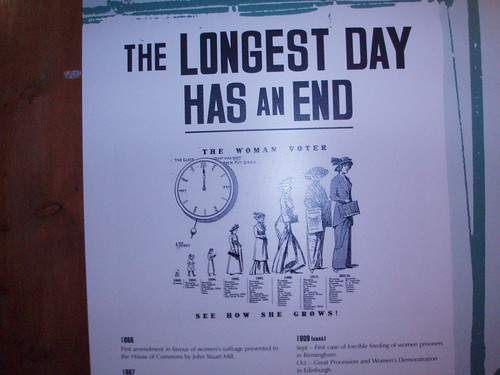
At the Museum of Edinburgh is an exhibition commemorating the women's suffrage campaigns in the UK.

There was this interesting poster there:

The Longest Day has an End

Here's a photo of the detail

The poster has the slogan "The longest day has an end" prominently at the top. Below that on the left is a clock set to midnight. Below that, and rising to the right of the clock, is a timeline running from 1869 to 1913, detailing the countries and sub-national regions that allowed at least some women to vote, graphically illustrated by sketches of a woman growing older and taller from a tiny baby (waving a flag) in 1869 to a full-height woman in 1913.

Reformatted for the web, here's the timeline:

YearCountries/Regions with at least some women allowed to vote
1869Wyoming
1893Wyoming, New Zealand, Colorado
1896Wyoming, New Zealand, Colorado, S. Australia, Utah, Idaho
1902Wyoming, New Zealand, Colorado, S. Australia, Utah, Idaho, W. Australia, New South Wales
1907Wyoming, New Zealand, Colorado, S. Australia, Utah, Idaho, W. Australia, New South Wales, Tasmania, Queensland, Finland
1908Wyoming, New Zealand, Colorado, S. Australia, Utah, Idaho, W. Australia, New South Wales, Tasmania, Queensland, Finland, Victoria, Norway
1911Wyoming, New Zealand, Colorado, S. Australia, Utah, Idaho, W. Australia, New South Wales, Tasmania, Queensland, Finland, Victoria, Norway, Washington, California
1912-1913Wyoming, New Zealand, Colorado, S. Australia, Utah, Idaho, W. Australia, New South Wales, Tasmania, Queensland, Finland, Victoria, Norway, Washington, California, Oregon, Kansas, Arizona, Alaska

Below the timeline is the second slogan "See how she grows!"

The whole exhibition - if you happen to be able to get there before it closes, and find it in the museum (accessibility is not universal) - is worth seeing.

One of the points being made by the timeline is that no area that granted women the right to vote had since revoked it, and I think this point provides a useful division of social justice issues.

For some issues, like suffrage, or the right of LGB people to serve in the military, there is a clear point. It may take decades or centuries of difficult struggle to argue up to that point, but once there the gains are relatively safe - once the critical threshold has been passed in a particular democratic jurisdiction, the idea fairly rapidly passes into general acceptance, to the extent that even those who opposed it before move to support it, at least in public.

The gains are reversible - any violent or otherwise sudden overthrow of the system of government, from within or without, might reverse them - and that they're otherwise unlikely to be reversed of course doesn't imply that there doesn't remain a significant minority of people who believe that they're nevertheless wrong. There are still people in the UK who believe that women shouldn't have the right to vote.

For other issues, there's no such critical threshold. The level of rights available can go backwards and forwards across a wide range over the decades, as different opinions gain and lose dominance in governments and in the wider population. Access to abortion has changed back and forth quite a bit in many countries. It's still, just about, a fringe view in the UK Parliament that it should be outlawed entirely - but of course that's a fringe that will grow as erosions are made to the existing rights. Attitudes - and legislation - towards immigration has also varied back and forth a lot. Any gain made with this sort of issue needs to be heavily defended just to make it into a new baseline against the counter-attempts of privilege.

What's not at all clear to me is why an issue falls into one or other type. It's not just about it being a binary divide or not - in the UK women's suffrage proceeded in stages, while the binary issue of defendant anonymity in rape cases has changed back and forth and remains contentious today.

It's also not, as far as I can tell, about differentials between public opinion and government opinion. Sometimes the government lags far behind public opinion on the matter - as the UK government is doing on same-sex marriage - and sometimes it introduces legislation that leads the way and public opinion follows (as happened with the abolition of the death penalty).

It seems like it would be useful to know why some successes stick and others don't, and perhaps how a success could be made to stick when it otherwise wouldn't, but I don't know of much that's been said on that.

Wednesday, 6 October 2010

Semi-Equality Act: EU directives, and views from the Minister

So, the message from the Equalities Office referred to four European Directives, claiming that they meant that the harassment protections were necessary to implement EU law - with the nasty implication, of course, that if it weren't for those directives, it would be legal to harass people in a racist, sexist or disablist fashion, provided that it didn't constitute direct or indirect discrimination.

  • 2000/43/EC: article 2, paragraph 3 defines harassment as a type of discrimination, and article 3 sets out various areas in which it applies.
  • 2000/78/EC: article 2, paragraph 3 again defines harassment, with articles 1 and 3 setting out that this applies to age, sexuality, disability and religion or belief, in contexts relating to employment only.
  • 2002/73/EC: this is similar to 2000/78/EC but for gender discrimination and harassment in employment. It states that sexual harassment is to be considered harassment and that marital and family status cannot be used as 'covers' for discrimination.
  • 2006/54/EC (PDF): extends 2002/73/EC slightly.

The Equalities Office's claim is that because of these EU regulations, the prohibitions on harassment are not redundant as they implement EU regulations.

However, the Equalities Act rightly goes beyond the requirements of the EU regulations - it forbids harassment on the grounds of gender, age and disability in many contexts other than employment.

There seems little point in raising this with the Equalities Office itself, however. It's fairly clear that their job is to defend the existing law as if it were perfect, until such time as it is changed by Parliament into another perfect form. To an extent that's even a reasonable requirement to place upon the civil service, but it does mean that getting answers to "why" questions out of them is near-impossible.

Meanwhile, the Equalities Minister, Lynne Featherstone MP (Lib Dem, Hornsey & Wood Green) was celebrating the Equality Act becoming active on 1 October. There were several comments criticising the reversals in equality for trans people that the Act caused, which she promised to look into, while expressing doubt (like her office: in opposition to what the Act's own text and Explanatory Notes says) that the Act actually would have that effect. Hopefully there she'll get some good legal advice and be in a position to repeal1 some of those exemptions, which are designed to allow the provision of a service for transphobic individuals at the expense of trans people.

On the harassment exemptions her comment was:

Yes – Evan [Harris, then-MP for Oxford West & Abingdon] and I fought very hard over the differential discrimination in terms of LGB at school – and Labour took no notice. EU is looking at this too at the moment. Will say more when I know more.

So it looks like the EU route may be the best way to get these provisions repealed1, though not a particularly quick one.

1 Her Conservative coalition partners are planning a "Great Repeal Bill", though repealing clauses of legislation for the purpose of strengthening it - especially equality legislation - is probably not what they have in mind. Still, once that bill gets to first reading I'll suggest it.

Wednesday, 15 September 2010

The Equality Act: it's supposed to be flawed.

I got a reply to the letter to the Equalities Office that I sent back in June, asking for the rationale and more details behind some of the unpleasant exceptions in the Equality Act 2010.

Here's the reply

Thank you for your email of 8 July 2010 regarding the Equality Act 2010. I am sorry you have had to wait so long for a reply.

I will respond to the questions in the order you raised them.

Sexual orientation: section 12

We have been provided with no evidence that there is a need for people who identify as asexual to be specifically protected by discrimination law. The Equality Act will, however, provide protection to asexual people who are directly discriminated against because they are perceived to be heterosexual, gay or bisexual.

Dual discrimination: section 14

We have carefully considered which protected characteristics should be included in a claim for dual discrimination. We consider that we have adopted an approach to implementation which is practical, provides sufficient protection and does not impose a disproportionate burden. We are not aware of evidence that claims of discrimination which involve marriage and civil partnership or pregnancy and maternity are failing for lack of a remedy for dual discrimination.

As you may be aware, Ministers are currently considering how certain provisions of the Act, including the dual discrimination provisions, can be implemented in the best way for business and for others with rights and responsibilities under the Act.

Harassment: section 26

Discrimination because of marriage and civil partnership is prohibited in order to address very narrow circumstances in which some employers still adopt policies which may discriminate against married people or civil partners. We have no evidence of people being harassed at work because they are married or in a civil partnership. With regard to pregnancy and maternity, any harassment that a woman is subjected to will be covered by the protection against harassment related to sex. Specific protection against harassment related to these protected characteristics is therefore unnecessary and would add no value.

Harassment: sections 29(8); 33(6), 34(4), 35(4), 85(10); and 103(2)

The above-mentioned sections of the Act disapply the definition of harassment at section 26. This disapplication however does not mean that a person is left unprotected, but they are protected differently. Where harassment is not prohibited explicitly - as is the case for sexual orientation and religion or belief outside work - protection will be provided through the provisions prohibiting direct discrimination by subjecting a person to a detriment. Detriment can include unwanted conduct that violates a person's dignity or creates an intimidating, hostile, degrading, humiliating or offensive environment for that person.

Harassment: section 85(10)

Section 85 of the Act deals with the treatment of schoolchildren and there would be no practical benefit to extending harassment protection for children in schools. We believe that the real problem in schools is bullying between pupils, so what we need to focus on is putting a stop to bullying by children of other children. Extending protection against harassment related to gender reassignment, religion or belief, or sexual orientation to children in schools will not do this, since the relationship between one child and another is not caught by discrimination law.

In any situation that we can envisage, it would be unlawful for anyone working in a school to bully a pupil because of their sexual orientation, gender reassignment or religion or belief. And if a teacher were to ignore or condone such bullying of pupils, it would be unlawful discrimination.

General Qualifications Bodies: section 95

As mentioned above, protection against marriage and civil partnership discrimination applies to employment only.

Conclusion

I feel it is important to make it clear that we consulted fully and widely on our proposals for what is now the Equality Act 2010. As a result we believe we have identified where harmful discrimination is occurring. The Act aims to tackle such discrimination where there is evidence that it occurs and where legislation is considered to be a proportionate response to that problem.

I hope this is helpful.

As I said earlier, I could understand that if the act was structured in such a way that provides no protection except that which is explicitly stated to apply, that it might be easy through privilege to accidentally miss out some situations, and I now add to that that it might be considered understandable in the interests of brevity and clarity not to cover forms of discrimination where there is little evidence that they occur.

However, this Act in many cases sets out blanket protections and then puts forwards exceptions to them. To create an exception adds to the length of the Act and reduces from its clarity. Conversely, leaving the exception out is harmless. If no-one ever does discriminate in that way on those grounds, then no cases will be brought. Because of the way the Act is written, the argument against cluttering up the statute books with unnecessary laws doesn't really apply.

This is an argument against including eye colour in the list of protected characteristics (a characteristic I am personally very glad does not need protection in practice), not an argument for explicitly excluding protected characteristics from certain forms of protection.

I find their reasoning that harassment is always direct discrimination to be highly implausible - if it was automatically direct discrimination, there would be no need for the harassment clause at all. Furthermore, an explicit exemption could be taken (and elsewhere in the Act obviously is!) to override the general case. For example, the Act allows people casting for a play to discriminate based on gender or race where the script requires it (the Explanatory Notes give the example of Shakespeare's Othello). A white woman would be treated less favourably than a black man by most directors casting Othello, and this is a rare form of reasonable discrimination, and there is therefore wording in the Act to allow this despite it meeting the basic definition for direct discrimination.

Similarly, I'm fairly sure that the exclusion of asexual people owes more to the wording being constructed by people who hadn't considered their existence than any deliberate assessment that asexual people are not subjected to sufficient discrimination that they need legal protection.

So, here's my follow-up letter:

Thank you for your reply, which mostly answers my questions. I have a further questions regarding the harassment exemptions, where I remain unconvinced that the exemptions are as harmless as you claim.

It seems to me that the harassment protections must provide some additional protection in some case over and above that provided by the various other parts of the Act, or there would be both no need to include them in the Act and no need to deliberately place particular exemptions into the Act.

The explanatory notes for section 85, for instance, distinguish between direct discrimination and harassment. The example given for harassment could equally apply to homophobic comments made by teachers (even if not directed at any particular pupil) but the exception suggests that they did not.

For a real example: a GCSE biology teacher when discussing genetics refers to a particular genetic pattern which research suggests has been connected to homosexuality, describing its effects as "makes you a [homophobic slur]" while making an associated hand gesture. The teacher does not otherwise treat gay students less favourably (not least because no-one in the class is "out" and so he has no way to know)

A pupil might reasonably feel that this has the effect described in 26.1.b.ii but would I think find it very difficult to claim direct or indirect discrimination if this was the only form of discriminatory behaviour the teacher carried out. Nevertheless this behaviour could be extremely harmful - especially as a pattern of behaviour at the school - and I can see no reason not to forbid it just as equivalent behaviour based on gender, race or disability is forbidden.

It seems rather implausible to me - given that every other exception in the Act is clearly intended to set out situations in which the general protections of the Act do not apply - that the protections of the harassment clause remain even when that clause is specifically excepted.

It seems clear that the intent of the Act, both in the wording of the Act and as expressed in the Explanatory Notes, is that harassment, provided that it is not accompanied by less favourable treatment of other forms, is legal in these specific cases.

My further questions based on this are:

If it is the case that any behaviour constituting harassment would be unlawful because of another part of the act, in the cases where there are exemptions, then why are the exemptions so inconsistent. Specifically:

1) Why is there a harassment exception for sexuality and religion for every matter except employment, where there is not? If it makes no difference to the level of protection, only the route taken to guarantee it, why is employment different?

2) Similarly, why is there only a harassment exception for gender identity / transphobia in certain cases relating to school pupils but not in other cases?

3) Similarly, why is there (rightly) no harassment exception for gender, race or disability, if it really has no functional effect on the legality or otherwise of discriminatory actions?

Additionally:

4) Does the Equalities Office have legal advice that suggests that the harassment clauses are essentially entirely redundant, and if so, could you provide me with a copy of this advice?

It'll be interesting to see what they reply, especially for the fourth part. My assessment of the Act as a whole as far less useful than it should be remains unchanged.

Tuesday, 3 August 2010

What happened next.

A few notes on what's happening now:

[trigger warnings]

  • I got a reply to the letter I sent about the National Child Measurement Programme letters. No surprises: the government will keep doing what it has been doing, whether it makes sense or not. I've followed up to ask for more details of the research they're using to justify their decisions.
  • A YouGov poll asks about opinions on rape defendant anonymity. A majority are in favour (considerably fewer women than men are in favour) but without a second question about how they feel for anonymity for non-rape defendants it's hard to tell why this is. The question wording really doesn't make clear the limited extent of anonymity (that it's only limited reporting restrictions, not that it wouldn't actually make any difference), which also makes things hard to tell.
  • From PinkNews, the BBC trust thinks that a non-apology is sufficient for its posting of the question "Should homosexuals face execution?".
  • When looking at the mass of exceptions to the Equality Act, I somehow forgot to look through the Schedules (many of which are titled "Exceptions", which should have been a big hint). There are a whole mass of further unhelpful exceptions here, and Zoe Brain and Helen G have highlighted several relating to gender reassignment.

Meanwhile, Jake Berry MP (Conservative, Rossendale & Darwen) asks if Parliament can get a cat. It will be investigated, apparently.

Thursday, 8 July 2010

Writing to the government

Some letters I've sent recently regarding recent issues. Specifically:

Letters below.

[trigger warning]

As usual, please feel free to use these for inspiration for your own letters, though remember that letters in your own words are more powerful than copies of other letters, if you have the time and energy to do so.

Regarding RASASC

I sent this by email to mike.fisher@croydon.gov.uk.

Dear Mr Fisher,

You have recently announced that the funding for RASASC, the Croydon Rape Crisis Centre, will be cut by 27,000 pounds a year. This is a significant amount for a rape crisis centre, and it is likely to lead to the centre being unable to support hundreds of rape victims a year.

As the only rape crisis centre for the London area, the service it provides to victims is invaluable, and the effects of reducing its funding will spread well outside your own Council's boundaries. By running a helpline, supporting survivors of rape through counselling and through legal assistance at trials, it not only provides a vital public service, but provides a highly cost-effective way for your Council to support victims of crime.

The government have promised to improve the funding provided centrally for rape crisis centres, but it is not clear when - or even if - this promise will be fulfilled. Until then, it is necessary that others such as your Council play their part in keeping these services open. With thousands of rapes occurring in London each year, RASASC's ability to help additional victims is crucial.

Please restore RASASC's funding.

Yours sincerely,

[me]

Letters regarding children's weight

I sent this using the contact form on the Department of Health's website.

Dear Andrew Lansley MP, Health Secretary

I understand that you are looking for programmes run by the NHS and other health providers within your remit that could be reduced or eliminated without impacting the quality of front-line service.

I would like to suggest the sending of letters regarding the weight category of children, which is carried out as part of the National Child Measurement Programme. While the general aims of that programme are not in question, and the statistical data it gathers is perhaps worth much more to your department than the cost of gathering it, this particular application is not a good use of limited resources.

There have been a few reported cases - for example one last February reported at http://news.bbc.co.uk/1/hi/england/dorset/8523707.stm and one recently reported at http://news.bbc.co.uk/1/hi/england/leeds/10505584.stm - where letters telling parents that their child is overweight and warning of dire consequences, have been sent out to the parents of children who were physically active, eat healthily, and nevertheless happen to be marginally above the guidelines set out by the previous government for a person's required weight.

It is extremely likely that these cases are only the tip of the iceberg and there are many more letters being sent out in similar circumstances. The mechanism used to determine who gets the letters guarantees this.

Firstly, the letters are sent out based on Body Mass Index. This measure was developed as a way of providing a statistical estimate across a wide population of adults. It has never been appropriate to use as an individual measure, has not necessarily coped well with the increase in average height over the century since its introduction, fails to account for normal racial and sexual variations between individuals, and other forms of normal genetic variation, fails to distinguish between fat and muscle mass, and certainly was never intended to apply to children, whose shapes vary considerably and rapidly as they grow, especially in early puberty when the second set of measurements for the NCMP takes place.

Secondly, the children in regard of whom these letters are being sent are at a young and impresssionable age. It may have been the aim of the previous government in introducing these letters to encourage healthy eating and exercise habits to start early. In practice, of course, the effect can be quite the opposite - the child in the second article above refused to eat their meal when they discovered that - as is of course natural and desirable for growing children - their weight had increased since the NCMP measurement. This is something that could very easily turn into a serious eating disorder.

Thirdly, the science regarding weight is inexact. Multiple research studies - Orpana et al 2009 in Canada (doi:10.1038/oby.2009.191), Lenz et al 2009 in Germany (doi:10.3238/arztebl.2009.0641), or the NHANES studies in the USA (Flegal et al 2005) have shown that - at least in Western industrial societies - the mortality risk of people with a BMI in the 25-35 range is not statistically different to that of those in the current government-recommended 18-25 range (indeed, there may be a marginally lower risk for those in the so-called "overweight" 25-30 range). This is the research for adults, suggesting that the BMI guidelines set out by governments for them may not be correct. There is no similar research I know of for children - because, regardless of their weight, children very rarely die of weight-associated conditions other than eating disorders - but it seems very unlikely that the BMI guidelines set for them are correct either.

Fourthly, even if increased weight is correlated with an increase in risk for various health conditions, and even if that correlation is causative, which has generally not been shown, there remains no reliable long-term method for reducing weight in the long term. The few 5-year follow-up studies that have been done show that dieting is ineffective. Exercise certainly improves general health, but does not appear to cause weight loss. Early indications are that the surgeries currently being trialled have a greater chance of causing early death than any of the health conditions associated with above-average weight.

As you have gathered, I would like to see a general move away from the overemphasis of the crude BMI measure, and from the excessive conflation of weight and health carried out by previous governments, in general.

For now, however, I would appreciate it if the money used to produce and send these letters was reallocated into other more useful areas of your department's activities.

Yours sincerely,

[me]

Equality Act exceptions

And finally this one to the Equalities Office general enquiries address, to see what they know. I'll post up the response if I get one.

Dear Government Equalities Office,

I have a number of questions regarding the Equality Act 2010, that are not answered by the explanatory notes provided. Could you please provide me with the Goverment Equalities Office's current opinions on these matters.

The wording of Section 12 is not completely clear to me. While the application of legislation would ultimately be a matter for the courts, does the Government Equalities Office believe that this section would protect those people who identify as asexual (i.e. they are not sexually interested in people of any gender) as well as the bisexual, heterosexual and homosexual people that it more obviously protects?

In the areas of dual discrimination (Section 14), the protected characteristics of "marriage" and of "pregnancy" are excluded. Does this mean that an organisation that did not in general discriminate against people who were married, and did not in general discriminate against women, would still be allowed to discriminate against married women? If so, could you outline a situation where it would be desirable for this to be legal for an organisation to do?

The same characteristics are excluded from Section 26 (harassment). Could you outline a situation where the harassment (as defined in 26b) of a person or persons due to their marital status or pregnancy would be desirable, please?

In Sections 29.8, 33.6, 34.4, 35.4, 85.10, and 103.2, sexual orientation and relgious belief are excluded from the Section 26 harassment prohibition. For each of these situations, could you explain why it might be both necessary and desirable for a relevant organisation to carry out harassing behaviour against LGB people or people of a particular religion?

Section 85.10 also allows harassment on the grounds of gender identity. Again, please could you outline a situation where this is desirable?

Section 85.10 applies to the admission and treatment of primary and secondary pupils. Section 91, which covers the treatment of students in Further and Higher Education, does not contain a similar exception. Could you explain why it is not necessary for tertiary education providers to be allowed to harass LGBT applicants, given that this is apparently necessary for primary and secondary education providers?

Section 95 states that the chapter on General Qualifications Bodies does not apply to marriage or civil partnership. In what case would a qualifications body wish to do make use of this (for example by withdrawing qualifications from people when they were married) and why is it required?

With regard to the above questions, if the Government Equalities Office cannot provide an example of a situation in which a particular exception would be desirable, could you tell me if there are any current plans by the government to remove that exception.

Thank you

Yours faithfully

[me]

Monday, 5 July 2010

Why is this still legal? The Equality-on-a-good-day Act

Why is this even legal? According to the BBC:

Residents of Firhall, built in the early Noughties on the outskirts of Nairn in the Highlands, must abide by certain rules. The deeds for their properties prohibit the keeping of ducks, rabbits, pigeons and bees. Households are allowed to have one dog - but controversially no resident children. To own a house in Firhall you must be over 45 years old. Grandchildren and the children of friends can visit and stay, but there are even limits on how often this happens.

It's not the only thing that's surprisingly legal, either. So much for the grand claims that the Equality Act would protect those most vulnerable to discrimination.

Looking at the Equality Act 2010, this appears to be entirely legal:

4 [...] The following characteristics are protected characteristics [...] age [...]

Part 4: Premises [...] 32.1 [...] This Part does not apply to the following protected characteristics [...] age

Looking at section 17, the terms would be unenforcable for the first 26 weeks of a child's life if their mother was already there, but that's all. (Of course, it would be relatively rare for a mother over the age of 45 to be living there, but not impossible). Otherwise, they seem to be within the exceptions the law provides.

Another unpleasant exception in this section, that I found in my "how is this possibly legal" search - you are allowed to harass people occupying or applying to occupy (as tenants) on the grounds of their sexual orientation or religion.

There's a similar but slightly broader exception in the Education section (which only applies to schools, not to FE colleges and Universities1), the same exception in the Provision of Services section, and in the membership of associations section.

So Labour and the Lib Dems get an LGB-friendly reputation for supporting this legislation (the Lib Dems, to be fair to them, did attempt to amend some of these bits out), which mostly seems to consist of "You must supply these services to LGB2 people, but you can '[create] an intimidating, hostile, degrading, humiliating or offensive environment for [them]' as much as you like in the process."

Additionally, neither "marriage and civil partnership" nor "pregnancy and maternity" are characteristics to which the harassment section applies at all.

There were some good bits in the Equality Act that hadn't been there before, such as the pay audits and the recognition of the existence of intersectional discrimination, and it's not as if by having these exceptions it was removing protections that previously existed, but it still hardly deserves the name. It's not as if this was a drafting error and an unnoticed loophole was left in until it was too late to take it out (though that, in its casual disregard, would be bad enough) - because of the way the Act is worded, someone had to specifically insert these exceptions.

Additionally, you can use these terms to push a lot of other things through. The Act doesn't say how wide an age group has to be, so you can legally say "Sorry, I don't rent to people who were born on 3rd April 1972 between 2am and 2:30am", and provided you then apply that rule consistently to later default tenants, you have a perfectly legal reason3 not to rent to any non-default person you like.

Other things that are entirely legal under the Act and really shouldn't be (or at least, if there is a real need for an exception, it should be the exception that is legal, not the rule):

  • Pregnancy and maternity, and marriage/civil partnership, are excluded from the intersectional discrimination laws. So discrimination against all married people is disallowed, and discrimination against all women is disallowed, but discrimination only against married women is apparently fine (barring explicit exceptions elsewhere in legislation, of course)
  • Refusing to provide a service to married and civilly-partnered people. (You can't, at least, just pick one and sneak in some homophobia) Similarly for single people.
  • Same things for premises
  • Same things for education (yes, your university can refuse to provide an education for single and/or unofficially partnered people, and I have no idea why, and likewise a qualifications board can legally withdraw qualifications from people when they get married/civilly-partnered, though what possible reason4 they'd have to want to I don't know)
  • Additionally, the exception for harassment in schools applies to gender identity as well as the sadly usual pair of sexual orientation and religion
  • The exceptions for what can't be required as a "reasonable adjustment" for disabled people are extensive.

The only area that doesn't seem to have masses of exceptions is employment. I may have missed some other exceptions, since there are a lot and the phrasing used for them varies.

1 Yes, seriously. Apparently homophobia in admissions is essential, and banning it would have terrible consequences for the rights of bigots at the primary and secondary stage, but at the tertiary level the rights of bigots are unimportant. This makes even less sense than usual.

2 It's not at all clear to me whether any of the Act applies at all to asexual people. It can be read either way. The explanatory note suggests that it doesn't apply to them, but I think a good lawyer could probably convince a judge that it did.

3 Disclaimer: not legal advice. If you try this argument you deserve everything you get.

4 "We've been homophobic for centuries and we're not going to stop now" is not a good reason, nor one that governments should be supporting people in, but you can at least understand which group of bigots lobbied to have that exception included. Some of these it's not at all clear why anyone would ask for them.

Wednesday, 26 May 2010

Initial thoughts on the programme for government

So, the Program for Government. It's even possible to comment on the individual aspects of it online, which is impressive (well, now that they've got that bit working) but probably not useful.

The classifications are somewhat arbitrary, and it could do with more linking between sections, which makes it a little hard to read (and also allows things to be a little hidden on anything other than a comprehensive search). Some things appear to be missing entirely from the logical section, but have adequate coverage elsewhere. Other things are more notable for their complete absence from the programme.

It's - as is to be expected for a programme covering a planned 5-year term - very long. It's also short on details almost everywhere, which will only be revealed if and when the relevant legislation or guidelines or budgets are released.

In general, the principles seem fine, but what details there are for proposals don't always back up the principles. There are some long overdue ideas, and also plenty that it would have been better if they had never been put forward. On the whole, I'm cautiously optimistic - it's not a good programme for government, but it's not in most areas a disaster either, and the nature of a coalition government means that campaigning might be able to lead to more satisfactory outcomes.

Details and comments on some of the proposals below. There's a lot I've not commented on, on the basis that I just don't know enough about the area to know what the likely effects are.

Banking

At a first glance, this all looks okay. It'll depend on what the details of the new regulations are.

Business

This is a large section, and a lot of it is relatively uncontroversial. Help for small businesses, requirements for businesses to report on social and environmental duties, etc. However, there's some quite worrying clauses too.

We will cut red tape by introducing a ‘one-in, one-out’ rule whereby no new regulation is brought in without other regulation being cut by a greater amount.

So, on banking, it's all "too much deregulation, everything went wrong, let's regulate them again", but for other businesses it's "too much regulation, let's deregulate". There probably are some regulations that could be removed harmlessly, but imposing a requirement that the total amount of regulation always decreases is absurd - especially when a lot of the rest of the section is talking about things that would require added regulations. It seems like it's just a grab for an easy soundbite.

We will review employment and workplace laws, for employers and employees, to ensure they maximise flexibility for both parties while protecting fairness and providing the competitive environment required for enterprise to thrive.

Given the parties of the current government, I'm fairly certain that this will see more restrictions on the rights to take industrial action, and a net reduction in employee protections in other areas.

Civil liberties

All good stuff, now that the government seems to have accepted that it essentially can't usefully repeal the Human Rights Act (and would never have the Commons votes for it anyway).

Given that this was one of the previous government's worst areas, "stop doing that" is all you really need for a policy success, of course.

In practice, of course, it may just be a different set of civil liberties that get restricted.

Communities and local government

Again, some good things in here, such as improvements to energy efficiency standards, greater protection against aggressive debt collectors, and so on, though how much use they'll be in practice is hard to tell. Also some worrying bits:

We will freeze Council Tax in England for at least one year, and seek to freeze it for a further year, in partnership with local authorities.

Combine that with a likely drop in central government funding for local authorities, and a lot of important local services are going to have to be reduced or dropped entirely, with the usual greater effects on people who are working-class and/or disabled and/or old.

Consumer protection

It's hard for any government to put "actually, we think consumers are too protected", at least, not in this section of the document. There doesn't seem to be anything actually bad here, though how much good any of it does will as always depend on the detail.

Crime and policing

We will reduce time-wasting bureaucracy that hampers police operations, and introduce better technology to make policing more effective while saving taxpayers’ money.

We will amend the health and safety laws that stand in the way of common sense policing.

Making police record - for instance - every stop and search they do, is often perceived, both by the police and large parts of the press, as "time-wasting bureaucracy". Given that it's the only thing that makes it possible to definitively tell how much racial profiling the police are doing, and perhaps gives them second thoughts about doing so on occasion, slowing them down slightly seems a good thing.

As far as "health and safety laws" go, I have no idea what this refers to, but "health and safety" and "common sense" in the same sentence sets off alarms.

We will promote better recording of hate crimes against disabled, homosexual and transgender people, which are frequently not centrally recorded.

Definitely good. Should, of course, have been a requirement from the start.

Culture, Olympics, media and sport

They're in favour of them.

We will cut red tape to encourage the performance of more live music.

If this is about Form 696, then this is definitely a good thing.

Defence

We will maintain Britain’s nuclear deterrent, and have agreed that the renewal of Trident should be scrutinised to ensure value for money. Liberal Democrats will continue to make the case for alternatives. We will immediately play a strong role in the Nuclear Non-Proliferation Treaty Review Conference, and press for continued progress on multilateral disarmament.

"Value for money" is a strange concept to apply to nuclear weapons. In the event that you use them, there will be a near-complete collapse of civilisation and economic systems very soon afterwards. At that point, how much you previously paid for them is irrelevant (and before that point, the less you spend on them, the more you have left over for other things). If you don't use them (which is the plan), the most cost-effective one is the cheapest that your hypothetical enemy believes would work if you did use it.

Also, of course, maintaining the nuclear deterrent while wanting multilateral disarmament seems impossibly inconsistent.

Deficit reduction

We will significantly accelerate the reduction of the structural deficit over the course of a Parliament, with the main burden of deficit reduction borne by reduced spending rather than increased taxes.

In other words, reduced services for those who need them rather than more taxes on those who could do without the reduced services anyway. There might be sufficient unnecessary spending to reduce the deficit without harming services, but I doubt it.

Energy and climate change

Nothing particularly bad, but it's probably not ambitious enough either.

Environment, food and rural affairs

They're in favour of that, too. Lots of "investigate" and "work towards" and not so much actual commitments. Oh, and fox hunting.

Equalities

We will stop the deportation of asylum seekers who have had to leave particular countries because their sexual orientation or gender identification puts them at proven risk of imprisonment, torture or execution.

Better late than never (though "proven" allows a lot of room for error).

There doesn't seem to be anything on disabilities and despite the preamble nothing much on class either.

Europe

We will ensure that there is no further transfer of sovereignty or powers over the course of the next Parliament. We will examine the balance of the EU’s existing competences and will, in particular, work to limit the application of the Working Time Directive in the United Kingdom.

See previous comments on employer versus employee rights.

Otherwise nothing particularly surprising. Not getting any closer to Europe, but not getting further away either.

Families and children

We will review the criminal records and vetting and barring regime and scale it back to common sense levels.

...This will give us plenty of room to scale it back up again in response to the next five years of "how could this person ever have been allowed near children" headlines in the press.

We will encourage shared parenting from the earliest stages of pregnancy – including the promotion of a system of flexible parental leave.

Better leave arrangements in this area could be a big improvement, but the big difference between here and the Scandinavian countries that have more flexible leave is that those countries also pay that leave better.

Foreign affairs

Lots of bits in favour of world peace and co-operation, except for unpopular countries.

We will never condone the use of torture.

It's worrying how far the boundaries of what is acceptable have deteriorated that this even needs to be said.

Government transparency

They're in favour of that too.

We will ensure that all data published by public bodies is published in an open and standardised format, so that it can be used easily and with minimal cost by third parties.

This bit would be very good if it actually happens.

Immigration

Given how bad a mostly-Conservative policy on immigration could have been, it could be a lot worse. There's even some good bits

We will end the detention of children for immigration purposes.

Though it's not just the detention of children that makes the detention centres a problem, of course - and stopping the abuse of adult detainees doesn't get a mention.

The proposals for a cap on non-EU immigration really depend on where the cap is set. If it's too low, and the pressure from the media and the right will always be to lower it, then people who should be allowed in will be turned away (which happens enough as it is). If it's high enough not to actually restrict immigration significantly, then it will cause problems anyway with the reinforcement of the dominant "immigration is bad" framing.

International development

We will support actions to achieve the Millennium Development Goals. In particular, we will prioritise aid spending on programmes to ensure that everyone has access to clean water, sanitation, healthcare and education; to reduce maternal and infant mortality; and to restrict the spread of major diseases like HIV/AIDS, TB and malaria. We will recognise the vital role of women in development, promote gender equality and focus on the rights of women, children and disabled people to access services.

And lots of other things that sound good on paper.

Jobs and welfare

We will re-assess all current claimants of Incapacity Benefit for their readiness to work. Those assessed as fully capable for work will be moved onto Jobseeker’s Allowance.

This sounds like continuing with the previous government's programme, which has not been good. The comments on that page are full of complaints about it, and there was a highly critical report by Citizens Advice not long ago.

Nothing on job creation, either.

Justice

Lots of focus on rehabilitation and reducing reoffending, which is good.

We will change the law so that historical convictions for consensual gay sex with over-16s will be treated as spent and will not show up on criminal records checks.

Good.

We will extend anonymity in rape cases to defendants.

A lot has been said on this already. It's still a bad idea.

National security

Nothing surprising. I'm not sure exactly what constitutes a "verifiable guarantee" in:

We believe that Britain should be able to deport foreign nationals who threaten our security to countries where there are verifiable guarantees that they will not be tortured. We will seek to extend these guarantees to more countries.

Depending on how much verifying gets done, this could allow a lot of torture that apparently we don't condone.

NHS

They're promising to increase real-terms funding despite general cuts in government spending, which means that they can promise a lot more with this.

Lots of cuts on the easy target of "admin", though. I seriously doubt that a third of administration costs are unnecessary - done well, all your admin costs should either be saving money overall or improving service quality anyway.

We will seek to stop foreign healthcare professionals working in the NHS unless they have passed robust language and competence tests.

I keep reading this as "(robust language) and (competence) tests" rather than as "robust (language and competence) tests". Ties in with some of their anti-immigration policies.

As pointed out in the comments there already, the big thing that is missing is anything on mental health treatment. (People with mental health problems get a mention in Justice instead, next to "drugs offenders")

Pensions and older people

We will commit to establishing an independent commission to review the long-term affordability of public sector pensions, while protecting accrued rights.

This could be very controversial, depending on what it says. Public sector salaries are generally lower than private sector salaries for a comparable job, which means other benefits such as good pensions help to make up the difference.

Political reform

Five years seems a bit long for a fixed Parliamentary term, though it does at least ensure that they drift with respect to the local elections rather than being held with the same set each time.

Of course, whether the coalition actually lasts five years is hard to tell at the moment.

We will bring forward a Referendum Bill on electoral reform, which includes provision for the introduction of the Alternative Vote in the event of a positive result in the referendum, as well as for the creation of fewer and more equal sized constituencies. We will whip both Parliamentary parties in both Houses to support a simple majority referendum on the Alternative Vote, without prejudice to the positions parties will take during such a referendum.

Alternative Vote isn't great, and wouldn't make much difference in most seats (except that the uniform transfer calculations don't take into account unpopular incumbents who could still maintain a plurality of the votes), but it's still an improvement on the current system, and a potential step towards a proportional voting system.

We will establish a committee to bring forward proposals for a wholly or mainly elected upper chamber on the basis of proportional representation. [...]

A proportionally-elected upper chamber and a constituency-based lower chamber might actually work out quite well as a compromise system. They're going to adjust the composition of the Lords to make it proportional to vote share in the meantime, so that will provide some testing.

We will ensure that any petition that secures 100,000 signatures will be eligible for formal debate in Parliament. The petition with the most signatures will enable members of the public to table a bill eligible to be voted on in Parliament.

Here are the previous petitions in order of size. There were eight that got above 100,000 and there's one currently open that will probably reach that threshold too if the new government continues with the system.

The responses to the eight were "No", "No", "no answer" (it ended not long before the start of the election campaign), "No-one was planning to do that in the first place", "Still no", "No-one was planning to do that either", "We'll think about it" and "No", which perhaps gives an idea of why the new government is uncertain about what to do with the system, but doesn't explain why they think this is a good idea.

We will introduce extra support for people with disabilities who want to become MPs, councillors or other elected officials.

Good, but again, it'll be the details that matter.

Public health

The Government believes that we need action to promote public health, and encourage behaviour change to help people live healthier lives.

No explicit mention of the role of government in providing safe and affordable facilities for exercise, for instance, but there's also no explicit mention of the "obesity epidemic" in this section, which might allow for some improvements in policy there.

Schools

This section as a whole does not seem particularly good. A lot will depend, as usual, on the details, but many of the principles are worrying in themselves. No mention of home education (it doesn't belong in this section, but it wasn't in "Families and children" either) which hopefully means they're going to leave it alone.

We will give parents, teachers, charities and local communities the chance to set up new schools, as part of our plans to allow new providers to enter the state school system in response to parental demand.

How this will work in practice is difficult to tell. I don't know how many groups would want to take up this offer, or how easy they'd find it to set up a new school anyway. It seems like it would spread the state funding more thinly, and it's somewhat stretched as it is.

We will help schools tackle bullying in schools, especially homophobic bullying.

Again, the details will be important (and since they've mentioned recording transphobic and disablist hate crimes elsewhere, it seems unusual that they aren't also mentioned here), but this is urgently needed.

Social action

The principles are good, but the ideas seem a bit lacking.

I'm fully in favour of volunteering, collective action, and so on, as a way of making improvements to society. Obviously so. However, it's time-consuming, difficult, can have worse accessibility issues than more formalised work, and sometimes expensive. There's a lot of talk in this section about encouraging volunteering, but nothing about giving people the spare time to be able to do it.

We will give public sector workers a new right to form employee-owned co-operatives and bid to take over the services they deliver. This will empower millions of public sector workers to become their own boss and help them to deliver better services.

I'm not completely clear how outsourcing your job to yourself is supposed to improve services (if it really does give them better control, then it might increase morale, which might help). If they then don't deliver better services, can they be replaced? (Either answer makes it a bad idea for someone to actually let this happen for their public services)

Social care and disability

As with many sections, the principles are sufficiently uncontroversial that they're meaningless (who in mainstream politics would admit to being opposed to dignity and respect in a document like this?) but it all depends on the details.

Taxation

The compromises of coalition seem to have meant that most of the tax cuts - at least to start with - will be for people with low incomes and wealth. I expect the Conservatives will want to get back to the Inheritance tax cuts sooner rather than later, though, which they've left quite open.

We will seek ways of taxing non-business capital gains at rates similar or close to those applied to income, with generous exemptions for entrepreneurial business activities.

Good. Capital Gains Tax being lower than Income Tax makes sense for the riskier sort of gains associated with setting up a new business, but not for many of the other sources of money covered by this tax. It's very vague language, though, so whether it actually happens or not will be hard to tell.

We will make every effort to tackle tax avoidance, including detailed development of Liberal Democrat proposals.

I'll believe it when I see it. No government is ever explicitly in favour of tax avoidance, but they all leave enough loopholes.

Transport

Mainly focused on improvements to rail.

We will grant longer rail franchises in order to give operators the incentive to invest in the improvements passengers want – like better services, better stations, longer trains and better rolling stock.

I wonder if this might work better if they were given shorter franchises, renewal of which was made conditional on making improvements (and possibly on continuing the improvements of the previous holder), since the other possibility here is that they'll take the longer franchises as an excuse to do as little as possible.

Universities and further education

As usual, unpopular policy is being held off until a report scheduled for after the election. Funding for universities is quite a problem, and it wouldn't surprise me to see a few universities go bankrupt in the next five years.

Student fees is the big election issue here, but won't make a large difference to university funding as a whole. It really depends how they are implemented - if done well, with good-quality means testing (which, among other things, doesn't assume that students will necessarily be supported by their families) it could actually be beneficial for less wealthy students.

Notes

The deficit reduction programme takes precedence over any of the other measures in this agreement, and the speed of implementation of any measures that have a cost to the public finances will depend on decisions to be made in the Comprehensive Spending Review.

In other words "don't expect any of the bits which cost money to be done". Unfortunately, that includes a lot of the good bits and doesn't include a lot of the worse bits.