Showing posts with label bad arguments. Show all posts

Thursday, 1 September 2011

Abortion rights - convince your MP: this could be a very close vote

More anti-choice work from the usual suspects, in the continuing attempt to gradually introduce US-style "you can only have an abortion if the moon is full on a Tuesday with the agreement of three doctors, two vicars, and a greengrocer, with a 32-hour waiting period" restrictions to the UK.

More information at Abortion Rights and The F-Word.

If you are a UK citizen or resident please write to your MP and ask them to vote against these amendments if they are discussed at Report Stage.

Initial assessments in the press suggest that the amendment might pass but by a very narrow margin. It is therefore crucial that pro-choice MPs are reminded that they need to turn up and vote against it, that wavering MPs are convinced to vote against it, and that anti-choice MPs are given sufficient doubts that they abstain.

You can get a rough idea of how MPs are likely to vote at Public Whip - anyone who voted 'No' on that vote will likely vote 'No' on the amendment too. However, it's quite possible that many of those who voted 'Yes' can also be convinced to vote 'No' this time. If your MP isn't newly-elected, then you may be able to use this information to tailor your letter to their views.

Also potentially in our favour is that the Health and Social Care Bill itself is highly controversial - it has already been returned to Committee for a massive rewrite once, after major public objections and serious Lib Dem uneasiness with its content. Adding an entirely separate controversial issue to it has the potential to wreck the whole Bill, and this may explain the news that the government is now unlikely to support the amendment.

Nevertheless, we can't take any votes for granted.

Here's my letter.

I am writing concerning the amendments proposed by Nadine Dorries MP and Frank Field MP to the Health and Social Care Bill.

The amendments would prevent any non-NHS body that provides termination of pregnancy (including those providing those services on behalf of the NHS) from also offering counselling to women considering abortion.

This principle - that advice should be given by someone entirely unrelated to the provider - is not demanded, and nor should it be, for any other medical procedure.

Furthermore, women seeking abortions who feel that they would like counselling already have the choice to go to any provider that they wish to, and can already choose a separate provider if they feel this would be beneficial.

These amendments act to reduce their available choices, but also - by requiring women who would not otherwise do so to seek out a separate provider for advice and counselling - will increase the time between a woman deciding to obtain an abortion and actually being provided with one. Since the earlier an abortion can be carried out, the easier and safer it is for the woman concerned, this is extremely unhelpful.

Field disingenuously portrays this as being similar to advice on pensions, where there is a conflict of interest if the company selling the pensions is also advising customers on their choice of pensions. However, this reveals more about the mindset of the amendment's sponsors than about the real situation:

  • medical care is not a commercial product, and it is considered beneficial for all other medical procedures for advice to be given by the provider of the procedure. Termination of pregnancy is no different.
  • counselling is explicitly not about giving advice, but about allowing a client to come to their own decisions.
  • neither the NHS nor non-governmental abortion providers have an interest in maximising the number of abortions carried out (unlike a pension company which does have an interest in increasing the number of pensions it sells)

The amendment is based on a transparently false caricature of the motivations of medical professionals, and a massive underestimation of the ability of women to make decisions about their own bodies.

I ask you to please vote against these amendments if they are discussed at Report Stage on the 6th and 7th September, and to encourage your colleagues in all parties to do likewise. It is also rumoured that the Department of Health intends to implement some or all of the measures set out in these amendments without the need for legislation, and I therefore also ask you to put pressure on the Department not to do so against the will of Parliament.

Thank you

Tuesday, 12 July 2011

Assange's extradition, and what English law actually says about rape

[trigger warning]

So, Assange's appeal against his extradition started today. As with last time, his lawyers are going for a "it wasn't illegal"/"it's only illegal in Sweden because they're weird" approach.

These are expensive lawyers... have they actually read English sexual offences laws?

The Guardian's coverage of the case contains a few very odd statements from the lawyers.

11.27am: In one case Assange is accused of having sex with a woman without a condom – but Emmerson [Assange's lawyer] says deceiving someone on this issue is not illegal under English law.

Yes, it is. Quite seriously illegal. Section 76 of the English1 Sexual Offences Act 2003 states that it is to be "conclusively presumed" that the "complainant did not consent" if:

(a)the defendant intentionally deceived the complainant as to the nature or purpose of the relevant act;

A "conclusive presumption" is really strong - it basically says that the condition by definition implies the outcome. So if deception were proved in an English court, it would mean that "but she consented" was legally virtually impossible as a defence.

Slightly later:

11.35am: The so-called "minor rape" allegation – when Assange was alleged to have had sex with one of the alleged victims, known as SW, when she was asleep or half asleep – was an "entirely consensual sexual encounter", Emmerson says.

Again, not under English law. Section 75 of the Act states that there is an "evidential presumption" about a lack of consent if:

(d)the complainant was asleep or otherwise unconscious at the time of the relevant act;

and the defendant was aware of this.

An "evidential presumption" isn't as strong as the section 76 "conclusive presumption", but it's still fairly strong - it says that it will be assumed that there was no consent unless evidence can be provided to suggest that there specifically was - a "defence must prove you didn't" rather than the default "prosecution must prove you did" question.

The 11.35 quote also doesn't fit well with some of the other things Emmerson says - for instance

10.50am: The Assange team is promising not to attack his accusers and not to doubt their discomfort about his sexual conduct.

So... it was "entirely consensual sexual conduct" that was "[felt to be] disrespectful, discourteous, disturbing or even pushing at the boundaries of what [the victims] felt comfortable with." (Liss has more on this at Shakesville)

Or later on

12.22pm [...] this is not intended to challenge "the genuineness of their feelings of regret about having had consensual sex with Mr Assange or trivialise their experiences". [...]

[...] But the sexual activities that occurred had taken place with consent, he argued, and, unlike in Sweden, could not be criminalised in the English jurisdiction. [...]

Except that they're saying it wasn't consensual, or there wouldn't be a case to answer here.

And the judge in the original extradition hearing ruled - quite correctly - that under English law the accusations amounted to 3 accusations of rape and 1 of sexual assault.

A brief comparison of Swedish and English sexual offences laws

  • English law defines a broader range of assaults as rape. The Swedes are trying to extradite Assange on 1 count of rape and 3 of "sexual molestation". In English law, 3 would be rape, and only one the lesser offence of sexual assault.
  • English law also defines, though this is not relevant directly to this case, several types of assaults as "sexual assault" that are not criminalised at all under Swedish law, as far as I can tell.
  • English law has far stronger penalties for rape. The average custodial sentence on conviction is 8 years - the maximum a life sentence. The maximum sentence that Assange could serve in Sweden if convicted is only 4 years.
  • English law has explicit definitions of consent to say that someone who is asleep did not consent, and someone who was deceived as to the nature of sexual activity did not consent - strong enough that the question of consent should not need to be proved in court if there is no argument about the circumstances. Swedish law, as far as I can tell, does not.

But it's the Swedes who apparently have this ridiculously tough law that criminalises normal sexual behaviour. The fact that English law is in fact tougher - and rightly so - in just about every area doesn't stop people believing this - or Assange's lawyer claiming it in court:

11.31am Emmerson argued that Assange was a victim of a "philosophical and judicial mismatch" between English and Swedish law over what constituted sex crimes.

Such mismatch as there is actually works in his client's favour, at the moment, since the extradition would move him to a jurisdiction with less strict laws and less strong punishments.

Footnote

1 Wales uses the same Sexual Offences Act. The laws in Scotland and Northern Ireland are different, but I'm not completely sure how. Unless Assange flees to Glasgow, and Scotland then declares independence, it won't become particularly relevant to this case.

Wednesday, 11 May 2011

More bad education policy, more misguided criticism of same

Education funding policy is back in the news again after journalists noticed that David Willetts MP (Conservative, Havant, Minister for Universities and Science) had suggested that in addition to the publicly-funded places, universities should be able to offer unfunded places to UK students, with the fees payable up front.

Cue massive misplaced outrage about the rich being able to buy university places.

The proposals had a lot wrong with them, and they appear to be being either quietly dropped or quietly hidden for a few weeks. That they let the rich buy university places was not one of the problems.

A quick recap

Undergraduate places available to UK applicants are subject to a strict quota, with universities facing harsh penalties to either under- or over-recruiting to that quota1. Since the universities have to make offers to most potential undergraduates without knowing if those undergraduates would make the grade, this causes a lot of tension among admissions departments, since making the wrong number of offers is a very costly mistake.

On the other hand, if there wasn't a penalty, then the government could be required to pay for far more places than it had budgeted for (yes, they're going to end up doing this anyway)

Places for international undergraduates are not subject to any direct2 quota - universities can recruit as many suitably qualified applicants as they can attract. However, there is no UK public funding for these students (though some may obtain grants from their home country's government, of course) and so they must pay the full costs of their degree - which can be whatever the university declares them to be.

The proposal would allow (or rather have allowed) universities to also supply "off-quota" places to UK students, on the same terms. This would quite clearly not have worked.

Why it was (yet another) doomed idea

Students needing these places are the ones who have failed to successfully compete with the other UK undergraduates for the publicly-funded places. That doesn't make them underqualified - universities reject plenty of straight-A students - but it does mean that they're unlikely to do any better competing against the international undergraduates for the off-quota places.

While there's no externally-imposed limit on how many off-quota undergraduates a university can take, there are plenty of internal limits. Lecture theatre capacities, availability of academics to teach, and for some universities the availability of accommodation for students are all limiting factors. Being willing to pay the off-quota fees doesn't avoid competition - it just gives a second chance.

Since the students who go to study abroad tend to be the best a country has to show, getting a place on this second chance is probably going to be even harder than getting one of the publicly-funded places.

The idea was that the fees would be paid from corporate or charity sponsorship, rather than directly by the student - but what company3 is going to sponsor someone to go to university who couldn't get an offer the normal way? Far more cost effective for them to provide some living-cost grants to several students who did get in.

The number of UK students who actually took an off-quota place - and bear in mind anyone rich enough to do this could study abroad instead - would be tiny.

Like many of this government's policy ideas, it seems to be a way to generate controversy, reinforce their reputation (both constituent parties) as a party for the default, and not actually help any of the people they were nominally supporting.

Not buying places for the rich

What this outrage basically ignores is that the ultra-rich can and do already buy university places for their children.

The admissions processes of universities try to be fair and judge each candidate on their merits. This just isn't possible from a few expected grades, a short personal statement, and maybe a 10 minute interview - especially not with the number of applications that need processing - but universities generally do their best.

The problem is that - as with everything else - a context-free equality of treatment just gives the advantage to those who already have privilege. Rich families can give their children many of:

  1. A home environment focused on academic learning4
  2. Private schooling
  3. Interview practice (especially for Oxbridge)
  4. Private tutors
  5. Access to expensive extra-curricular activities, including gap years, that look good on a personal statement

Middle-class families can give their children enough of those privileges to give them a good chance at a place as well, which is why there's not much wider complaint about this arrangement.

Being outraged that the rich would be able to buy their children university places at market rates rather than subsidised rates is rather strange, in that context - I'm sure that if a "left-wing" group had proposed means-testing fees support so that the ultra-rich weren't entitled to any and had to pay up front, there would have been very little complaint5.

Footnotes (and extended asides)

1 The total quota for all UK universities is smaller than the number of people who would like a UK undergraduate place. This is a major reason why the whole "market in higher education" won't work - as can be seen by the vast majority of universities declaring at £9,000 - demand outstrips supply. The threats of "A uni that as an Oxbridge graduate I consider a Third Rate Ex-Poly can't charge £9,000 - students will go elsewhere" that ministers were making were completely empty: applicants have nowhere else to go except "not to university at all".

Then recall that students are effectively not paying the fees with their own money due to the extremely generous loan repayment terms (which resemble a tax more than a loan), for many students the repayments when/if they graduate on a £7,000 a year degree and on a £9,000 a year degree will be exactly identical; for the rest there will be relatively little difference, and earning a salary in excess of £40,000 a year1a will probably make them uninclined to care.

So demand is higher than supply, and the difference between the low and high prices is negligible. No-one has an incentive to charge a low price, and no-one has any economic reason not to pay. (Fear of debt, because of all the huge numbers being thrown around, is a reasonable but not economically sound reason)

I've actually been quite surprised by how many universities haven't declared £9k fees across the board - I expect by 2014 or thereabouts the fees will have crept up to this.

1a I'm not saying all graduates will go on to a 40k or above salary - I'm saying that only those who do will notice a difference in repayments between those two costs of degrees.

2 The whole "we will cap immigration to a round number whether it's a good idea or not" policy that the government is imposing does provide a national limit. This has already led to conflicts on international student numbers between the government departments responsible for racism ("keep those foreigners out!") and money ("they're willing to pay tens of thousands to UK organisations, let them in!")

3 Of course, a family rich enough to afford the up-front fees can probably also afford a front company to pay the grant, but they can probably also afford to just buy the place the old-fashioned way.

4 And because this is something that the rich provide, academic learning becomes morally more valuable than other ways in which a home environment can be good.

5 I would have objected to this, because the problem with this means-testing (and it's a problem with the existing set-up too) is that it assumes that the only barrier to all young applicants to university getting financial support from their families is their wealth. Applicants whose families don't want to fund them through university but theoretically could get the short end of this stick.

The NUS LGBT campaign has been pointing out from years that the students they represent are particularly vulnerable to their family refusing financial support; they're not the only un-privileged group of students this applies to.

Sunday, 27 February 2011

Incompetent campaigning

Two weeks ago, I noted that, apparently lacking good arguments in favour of FPTP, the No2AV campaign were instead campaigning on cost - and had significantly exaggerated the cost through a mix of accounting fraud and the political technique commonly known as "making stuff up".

Fortunately for No2AV, the Yes campaign seems determined not to capitalise on this mistake.

It should be a major mistake - if you start complaining about the cost of democracy, what other "cost saving" measures are you willing to entertain? Less frequent elections? Increased restrictions on suffrage? Dictatorship? We don't have democracy because it's cheap but because it's worth it.

Rather than pointing this out - and indeed, pointing out that even the massively inflated £250 million price tag is insignificant - the Yes To Fairer Votes campaign have instead chosen to ... complain to the Advertising Standards Authority

The ASA replied to point out that they don't regulate political campaigning, to which the Yes campaign's response was to start a petition asking them to start doing so.

Yes. Really.

Reasons this is a major mistake include:

  1. The ASA doesn't regulate political campaigning, and it would probably need legislation to give it that power. Chances of this happening before 5 May: nil
  2. The ASA takes months to make decisions over commercial advertising. Chances, even if it decided to unilaterally take power over political campaigning tomorrow, of it returning a verdict before 5 May: nil
  3. The ASA's typical verdict, in the cases where an advert is found to be misleading, is an instruction not to run an advert making that claim again. This is virtually useless, of course, since everyone has already seen it. Indeed, there are a few companies who specialise in exploiting this commercially. Chances of an ASA ruling, even it had the powers and speed to make it before 5 May, making any difference: nil

They should be taking this major opportunity to portray the No campaign as self-admittedly anti-democratic. They should be pointing out that we can afford a better democracy. Instead, they're chasing after a giant red herring.

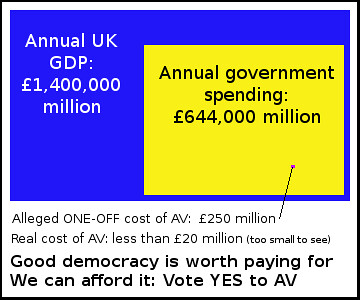
Just in case it makes it clearer, here's a quick picture.

Edit: As MarkWadsworth points out, GDP is around £1,400 billion, not £2,250 billion. I've updated the graphic, and corrected the figures in the rest of the post.

Graphical representation of AV cost

Description: Most of the image is filled with a large blue rectangle, labelled "Annual UK GDP: £1,400,000 million.
Inside that is a smaller yellow rectangle to scale with the rectangle labelled "Annual government spending: £644,000 million"
Inside the yellow rectangle, barely visible, is a tiny purple rectangle (again, to scale). An arrow points to it indicating that this is the £250 million alleged cost of AV.
Below the diagram, the text: "Real cost of AV: £20 million (too small to show)", and then in larger type "Good democracy is worth paying for. We can afford it: Vote YES to AV."

£20 million is probably an overestimate too, but should comfortably cover the slightly larger ballot papers needed, any voter education campaign, user research into the best format of ballot paper, and other one-off transitional costs.

If we can't spend - once, not every year - around a fifth of a percent of a percent of our national GDP on improving the voting system (or even a fiftieth of a percent, if you accept the massively inflated figure), then we are basically concluding that democracy is too expensive in general1.

This sort of campaign - and the Yes campaign can afford better graphics than I can put together in a few minutes - could completely nullify the No campaign and leave them without much of an argument.

It should be an extremely easy argument to win, but the Yes campaign seems determined to lose it anyway - I agree with Matt Wootton's assessment that the Yes campaign simply does not understand how to run a political campaign. (Their letter-writing to the BBC over the use or otherwise of 'reform' is much the same)

So, that delicious red herring?

There is, absolutely, a strong argument that political campaigning should be regulated to make sure that candidates/supporters can't intentionally deceive the electorate.

In practice, though, there's no reasonable way to do this for a referendum. There is no candidate, and there is no extent to which a supporter could falsely campaign that would make it proportionate to disqualify a referendum option. Fines or disqualification from further campaigning on the issue are not major deterrents in the context of a one-off referendum campaign. (Whereas in elections, which are regulated somewhat, losing the seat that you won can be a deterrent)

Additionally, there's the timescale. The determination of the election court over former MP Phil Woolas's campaigning took months to conclude that he had intentionally misled the electorate about his opponent's character. Likewise, any robust system for determining whether the electorate were deceived (or whether the disputed point was just fair differences in opinion), and whether this was intentional, would take months with respect to a referendum. The capacity to respond within a couple of days would be virtually impossible (indeed, submitting vexatious requests would be a good way to slow the system and your opponents even if it could respond this quickly)

The ASA certainly isn't the right body to be doing this, but there aren't any other suitable ones either.

Footnote

1If you genuinely prefer FPTP to AV, of course, then any money spent on switching to what, for you, is an inferior voting system is obviously mis-spent. But it would also be a bad idea for you to switch to AV even if it turned out to save a little money. Either way, the financial argument isn't compelling.

Tuesday, 15 February 2011

The cost of democracy

The No to AV campaign, apparently lacking good arguments in favour of First Past The Post, has claimed that AV would cost too much.

Plenty of other commentators have already pointed out that their claims are absurd - including the cost of the referendum itself as a cost of AV is the sort of accountancy that would get you investigated for fraud if you tried it on your corporate expenses; paying a huge amount for unnecessary vote counting machines1 that we wouldn't actually buy; and so on.

The idea that a relatively trivial sum should be used as an excuse not to run a democratic process in one of the richest countries in the world has also been widely criticised, and rightly so. Next Left, for instance, points out that extrapolating the votes in a seat from a statistical sample would be even cheaper - Isaac Asimov's Franchise being the end of that road. (I didn't put cost saving as an explicit advantage of Vote From Hat, but perhaps I should have).

What's been missed, at least in the commentary I've read so far, is that while the principle that democracy is too expensive is repulsive to most Britons, we do it all the time - not in the choice of vote counting system, but in the operation of our vote collection.

At the last general election, there were several cases of disenfranchisement through underfunding - shortages of ballot papers that would have cost more to print; people being turned away from polling stations because local authorities didn't want to pay enough polling staff to meet the Electoral Commission recommended minimum staffing levels; intentionally using inaccessible polling stations; failing to spend time and money reviewing the accessibility of polling stations and fixing the problems, and so on. For some people with disabilities, the idea that it's not worth paying money to allow them to vote is well established.

I certainly believe that if you're going to have a democracy, you can't then put a maximum price on establishing a universal franchise - you pay the costs happily.

If First Past The Post is to be considered superior to Alternative Vote - a stance I disagree with, of course - it should be on the grounds of its ability to democratically reflect the will of the electorate, not on the grounds of cost. But let's apply that to other areas of electoral administration too, not just the vote counting system.

Footnote

  1. The Meek variant of Single Transferable Vote, because it recursively adjusts the transfer values to get the optimal result (rather than the near-optimal estimates used by other STV variants), can only be counted by computer. Every other vote counting system I'm aware of, including most STV variants, can be done entirely by hand.

    A computer-assisted count - using generic laptops or desktops the local authority already has to run a spreadsheet or OpenSTV, not expensive specialised hardware - would make things considerably easier for most Single Transferable Vote variants, Borda, and Range Voting, but even that isn't necessary for Alternative Vote.

Tuesday, 14 December 2010

Bad but common arguments for free speech absolutism

"Freedom of speech" is, of course, an extremely important right. It's not, however, necessarily the most important right, and like all rights, it is not absolute.

The documented harm that certain forms of speech can cause - especially dehumanisation and other forms of hate speech - is serious enough for me to believe that it is proportionate to restrict it in these cases. Whether that restriction best takes the form of a state ban or private actions in the form of boycotts, protests or other criticism, will obviously depend on the details. (You might not consider the latter form a restriction on free speech, because it isn't, but see the "exaggeration of scope" section below)

Arguments against restricting freedom of speech in this way tend to mostly be based on a few extremely flawed themes. 1

The slippery slope

"If we criminalise a particular form of speech that we don't like, then we're giving power to the state to criminalise any form of speech it wants, and it won't always agree with us."

The first problem with this argument is that it can trivially be generalised to this argument.

"If we criminalise a particular form of behaviour, then we're giving power to the state to criminalise any form of behaviour it wants."

This is true, and there are various anarchist critiques of state power that are based around this (and I'm not addressing those here, because that's an entirely different argument - and a much more consistent one), but for non-anarchists, people who are quite happy for the state to criminalise murder or theft and apply a range of punishments for these crimes, but trust it not to extend this to criminalising "walking faster than 2 metres per second" or "owning a lettuce" or - more seriously - "being a member of the Opposition political party", there seems no real reason to treat speech with more cautiousness than physical actions.

The second problem is that the state already criminalises (or allows civil cases to be brought) for certain forms of speech and the vast majority of people are happy with this principle. Some examples:

  • Conspiracy to commit a crime.
  • Libel or slander (the UK laws do need a serious rewrite, but very few are arguing that it's a breach of free speech to have libel laws at all)
  • Knowingly or recklessly giving false advice on certain legal or financial matters.
  • Speaking via a megaphone between certain hours in residential areas.
  • Misuse of emergency services numbers.

The principle that the government can and should restrict or forbid certain forms of speech is well-established even in so-called "liberal democracies". There doesn't seem to be a particular risk of slipping into a totalitarian dictatorship as a result. Therefore we should be able to discuss exactly which forms of speech should be restricted or forbidden by the state without "all of them" or "none of them" being the only possibilities.

I do think we need to be very cautious about enforcing restrictions on speech, but that doesn't make them automatically wrong.

The marquee inconsistency

One of the major usability complaints about scrolling text banners on the web - bear with me for a moment! - is that they're inconsistent about importance. As the poster there puts it:

What information do you have that is not important enough to have a place on the screen at all times, but is important enough that a person will wait until it appears again if they missed it?

Arguments against restriction of free speech seem to fall into a related inconsistency. Restriction of free speech, it's accurately said, is one of the ways in which governments suppress criticism. Exercise of (certain forms of) free speech is powerful because it keeps the state accountable to its citizens and residents.

Having established that "the pen is mightier than the sword" and other such cliches, that speech is powerful and can have massive real-world effects, the argument that particular forms of speech should not be forbidden, restricted, or even particularly considered carefully by their users, because they can't be causing real-world harm, doesn't make a lot of sense.

(The argument that the real-world harm being caused to people who aren't the debater is a price worth paying to have free speech for other purposes, I think is just a variation on the slippery slope theme above)

Naturally this only seems to apply to speech that hurts the non-privileged. The harm caused by speech that hurts the default is well recognised and such speech is discouraged by various methods.

Exaggerating the scope

There are various forms of restriction on speech. One can, with varying degrees of difficulty - and I make no claims that this list is comprehensive:

  1. Forbid it magically and omnisciently.
  2. Forbid it to the full extent of the state's actual enforcement powers.
  3. Allow it under restricted circumstances but not more generally.
  4. Allow it under general circumstances but not in particular restricted ones.
  5. Allow it but with penalties for its use. (Non-state penalties, such as being boycotted, rather than actions via the civil or criminal law)
  6. Allow it but with situational penalties for its use.
  7. Allow it but disapprove of it.

It seems very popular to pretend that people suggesting options 5 to 7 are actually suggesting 2 (or somehow 1) and then argue against them on that basis, or to merge this with the slippery slope arguments and say "Well, you might only be recommending we disapprove of this, but that's the first step to throwing people in jail for it".

It's not an argument as such, but it seems a common overreaction to mild suggestions.

Footnote

1 I'm not saying here there aren't good arguments against restrictions: I'm saying these aren't those arguments, and that they're commonly used enough to be worth noting.

Tuesday, 7 December 2010

Mathematical Morality

It seems that some people think that morality works on a numeric points basis - plus fifty points for donating to charity, minus ten points for queue-jumping, etc. - and then assess people or actions based on the perceived total score.

So, mathematical morality. There's three related applications of it that I've seen just in the last week, and they're all enraging and favourable to society's default people.

Heroes

There seems to be this need to elevate heroes, and to stand by them right or wrong, and to use mathematical morality to justify this.

And they either think "Oh, X has got a score of plus one million, there's no way they'd ever do anything significantly negative" or they think "Oh, X has got a score of plus one million, and they may have done this bad thing, but that's only minus a few thousand, so they're still plenty in credit."

And of course, having convinced themselves that their hero is incapable of wrongdoing, they'll dismiss out of hand, with the most convoluted contortions, the possibility that they might have, or that it matters if they did.

So the people who don't get to be official heroes - and of course being a default person makes it much easier to become one in the eyes of the default-centric world - end up discarded to defend the hero.

I'm/they're not an X-ist

This sort of mathematical morality is also, of course, the source for a lot of the common "not an X-ist" arguments that get passed around. It's slightly more sophisticated than heroic maths - only heroes get to have their total scores aggregated - in that it gives points in various sections.

So, for a white person, "has black friends and is polite to them" gets plus 100 points on the "racist/not a racist" scale (it should just be part of the "meets minimum standards of decent behaviour" score, anyway, but...). Using a racist slur, well, that's only minus 20 points on that scale. They're still at plus 80, so they're not a racist. Incidentally, these scales also have low standards - for white people, anti-racist activist starts at plus one, racist starts at minus ten thousand, everything in between is "not a racist".

Of course, it doesn't work like that. Even the most committed activist is going to slip up sometimes, if they're working in an area where they have at least some privilege. Their high positive score might mean that the initial reaction to them is different - a friendly notice, a starting belief that it was accidental, etc. - than it would be to someone with a history of dragging their privilege around everywhere.

What it doesn't mean is that they can cancel things out. Their previous good work doesn't mean that they don't need to make amends for this one time they slipped up. (They may also need to tell other privileged people who are trying to be helpful by claiming this on their behalf to shut up, while they're at it)

Nor can they cancel out the perception of their mistake by doing other good work later but leaving the mistake unamended for.

Ends justify the means

This mathematical morality also infects actions, by letting the end justify the means. So the goal - winning a victory for their political team and keeping the other side out - is worth plus ten thousand points to them. That means, to some people, that they can do nine thousand or so points worth of negative stuff, that they'd disapprove of if it were someone else (like their opponents) doing it, as means of achieving that end.

Their opponents, of course, aren't allowed to use any. Them winning is minus ten thousand on its own. Any negative things they do on their campaign just put them even more into moral debt.

So we see just about every form of discrimination being used as a tool, from people who are allegedly against it, and who'll try to justify or minimise the collateral harm they're causing, while criticising the other side for doing exactly the same thing for the same reasons.

Wednesday, 6 October 2010

Semi-Equality Act: EU directives, and views from the Minister

So, the message from the Equalities Office referred to four European Directives, claiming that they meant that the harassment protections were necessary to implement EU law - with the nasty implication, of course, that if it weren't for those directives, it would be legal to harass people in a racist, sexist or disablist fashion, provided that it didn't constitute direct or indirect discrimination.

  • 2000/43/EC: article 2, paragraph 3 defines harassment as a type of discrimination, and article 3 sets out various areas in which it applies.
  • 2000/78/EC: article 2, paragraph 3 again defines harassment, with articles 1 and 3 setting out that this applies to age, sexuality, disability and religion or belief, in contexts relating to employment only.
  • 2002/73/EC: this is similar to 2000/78/EC but for gender discrimination and harassment in employment. It states that sexual harassment is to be considered harassment and that marital and family status cannot be used as 'covers' for discrimination.
  • 2006/54/EC (PDF): extends 2002/73/EC slightly.

The Equalities Office's claim is that because of these EU regulations, the prohibitions on harassment are not redundant as they implement EU regulations.

However, the Equalities Act rightly goes beyond the requirements of the EU regulations - it forbids harassment on the grounds of gender, age and disability in many contexts other than employment.

There seems little point in raising this with the Equalities Office itself, however. It's fairly clear that their job is to defend the existing law as if it were perfect, until such time as it is changed by Parliament into another perfect form. To an extent that's even a reasonable requirement to place upon the civil service, but it does mean that getting answers to "why" questions out of them is near-impossible.

Meanwhile, the Equalities Minister, Lynne Featherstone MP (Lib Dem, Hornsey & Wood Green) was celebrating the Equality Act becoming active on 1 October. There were several comments criticising the reversals in equality for trans people that the Act caused, which she promised to look into, while expressing doubt (like her office: in opposition to what the Act's own text and Explanatory Notes says) that the Act actually would have that effect. Hopefully there she'll get some good legal advice and be in a position to repeal1 some of those exemptions, which are designed to allow the provision of a service for transphobic individuals at the expense of trans people.

On the harassment exemptions her comment was:

Yes – Evan [Harris, then-MP for Oxford West & Abingdon] and I fought very hard over the differential discrimination in terms of LGB at school – and Labour took no notice. EU is looking at this too at the moment. Will say more when I know more.

So it looks like the EU route may be the best way to get these provisions repealed1, though not a particularly quick one.

1 Her Conservative coalition partners are planning a "Great Repeal Bill", though repealing clauses of legislation for the purpose of strengthening it - especially equality legislation - is probably not what they have in mind. Still, once that bill gets to first reading I'll suggest it.

Thursday, 30 September 2010

Incompatible views on equality legislation

Those following my correspondence asking of the Equalities Office why the exceptions in the Equalities Act were there might like to see how it ends. This is the reply to the last message I sent, and further follow-ups to them don't seem productive as I think we're talking at cross-purposes. (I do have another plan)

I've cut the reply up, because it's a long message.

In reply to your further e-mail, I should say at the outset that the Equality Act 2010 is not drafted in terms of exceptions to harassment protection, so my reply does not use that terminology. Rather what certain provisions in the Act do is to disapply the protection from harassment as provided for in section 26 of the Act.

I am not at all sure what the legal difference between an "exception" and a "disapplication" is, but okay.

It may be helpful if in answering your questions, I first provide some background to why there is any specific protection from harassment in our discrimination law at all.

The Equality Act 2010, as with the discrimination law currently still in force, contains a patchwork of protection against conduct which would be considered to be harassment. This has happened as a freestanding right not to be harassed has been introduced gradually into domestic law to comply with our European legal obligations in relation to specific fields and specific protected characteristics.

Prior to the introduction of the freestanding right, behaviour which amounts to harassment was outlawed by the prohibition on subjecting an individual to a detriment, which is one method of committing direct discrimination. Therefore the detriment provision covered most acts of harassment related to all relevant protected characteristics - certainly in the sense that the word is commonly understood. The detriment provision remains part of the law, which means that where a victim of harassment cannot bring him/herself within the definition of the freestanding right, that individual can nevertheless argue the offending behaviour amounts to a detriment.

It is for this reason that there is not blanket protection from harassment in the Equality Act. This explanation of the current position in domestic discrimination law addresses your questions 1 to 3.

This particular reasoning strikes me as rather backwards, but I'll look at it in more detail later.

Returning to the first part of your e-mail, this deals with the practical application of the law. With regard to how the law has been working in practice, since 1986, there have been successful tribunal cases where victims of sex-related, sexual and race harassment at work were found to have been subjected to a detriment. However, we are not aware of any cases of this nature outside employment (which includes schools) reaching the courts since the introduction of the Sex Discrimination and Race Relations Acts in the 1970s, nor since specific protection was first introduced into domestic discrimination law in 2003. So the evidence suggests that pupils are not looking to discrimination law to deal with these issues.

It never even occurred to me, when I was being bullied at school, that there might be a provision in the law that prevented it. Certainly, applying the letter of the law to school bullies is something that gives confusing results. I can't imagine that there would have been any support should I have decided to pursue either a civil case for damages or a criminal case against the bullies at my school, nor could I have afforded a sufficiently good lawyer on my pocket money anyway.

In the case of LGB and/or trans pupils, who might not be out to their families, legal action (or any form of official action) takes on even more difficulties.

At any rate, this seems more to be an argument for not applying any harassment protections to pupils (or indeed any legal rights at all, if you take the argument much further), not for specifically excluding homophobic, transphobic and religionist harassment.

I shall turn now to why we believe the provisions in the Equality Act are adequate. We recognise that the detriment protection would not cover cases where the employer treats everyone equally badly, for example where he or she subjects both men and women to sex-related verbal abuse but only a woman finds this particularly offensive. However, there is no evidence that this is the sort of situation which lesbian, gay, bisexual and transgender (LGB and T) people are concerned about outside employment. What people are worried about are homophobic bullying and harassment which would be covered by the detriment protection because it is only LGB and T and not heterosexual people who would be subjected to such abuse. Similar arguments apply in relation to instances which might be considered to be harassment-like conduct related to religion or belief.

Nope, no evidence at all that trans people are concerned about this outside employment. Definitely none. They got a lot of letters about this at the time, and amendments were tabled in Parliament (though they sadly didn't get scheduled for debate).

The idea that people who are straight and are known to be straight are not subjected to homophobic slurs is also in obvious denial of the facts. This happens all the time. It's indisputably nowhere near as serious in effect as the same slurs being used against LGB people, but it's still not right. Anyway, the Act provides the same (lack of) protection to heterosexual people.

We do not therefore think there is a gap between the LGBT harassment protection offered by the detriment approach and the protection offered by the freestanding right. We are clear however that in every case we can envisage, such acts would constitute less favourable treatment or detriment and therefore be covered by the direct discrimination provisions in the Equality Act.

As for the intent of the Act, what both the Act and the Explanatory Notes say is effectively that where a person is subjected to harassment-like conduct, they can bring a claim of harassment, where there is express harassment protection or a claim of direct discrimination where express harassment protection does not apply, but a claim cannot be made for both harassment and direct discrimination on the same facts.

Turning to your question number 4, the harassment provisions in the Act give effect to specific obligations in certain European Directives, namely Directives 2000/43/EC, 2000/78/EC, 2002/73/EC and 2006/54/EC. The harassment provisions in the Act are therefore not redundant.

This still doesn't make sense. If the provisions in the Act aren't redundant because they're needed to implement European Directives, then this means that they provide some protection over and above the direct discrimination protections, even if the Equalities Office has a self-admitted lack of imagination in this area. In which case, why not protect against all forms of harassment in this way?

Furthermore, "we're only protecting people against harassment because the EU says we have to" doesn't strike me as the best attitude for an Equalities Office to have. I would expect - of all offices of the government - them to be taking the most proactive approach. (More worryingly, they probably still are).

There seems to be a major difference in approach here - I think discrimination on unfair grounds should be illegal in all its forms. The government seems to think that only certain forms should be illegal, those that have received the most complaints in the past (trans people are going to lose that numbers game every time, of course), regardless of what this says about the actual amounts of discrimination occurring, or whether even a small amount should still be illegal.

At any rate, this seems to be the answer to the question - to get harassment protections extended to LGBT people and religious groups will require an EU Directive to give the government no choice.

I have three MEPs, one from each major party, so that seems like a good place to start. More on this once I've drafted the letters...

Thursday, 23 September 2010

You wouldn't discriminate against someone else like that

It's very common for people faced with one form of discrimination to say something like "you wouldn't say/do that about/to [other group]". In practice, the other form of discrimination used in the comparison is almost always racism. Here's a recent example from Stonewall UK (The F-Word have a screenshot and some more context).

It's a terrible argument.

The basic assumption behind the argument is that racism is taken more seriously than homophobia (since the recent example is those two, I'll use them in this post, but this all generalises to any form of discrimination). The evidence presented for this is generally that the use of racial slurs is condemned, but the use of homophobic slurs is not condemned (or at least not as strongly)

Oppression Olympics

The first thing wrong with this is the standard "Oppression Olympics" problem. The nature of oppression means that it's not meaningful to ask which is worse. This does not mean that in a particular society all oppressions are equally bad, just that they're all linked together in such a complex way that even determining where one sort begins is tricky. Weighing up the effects across society of two sorts to determine which is "worse" becomes impossible. Even if it were possible, there wouldn't be a lot of point to doing so - once you know "severe, sometimes fatal", it's usually a waste of time to go around putting more precise numbers on it.

When you go from effects on society to effects on the individuals that make up society, the "which is worse" question gets even more absurd.

The line of argument of course generally ends up erasing people who are both BAME and LGB - if the response to "you wouldn't do that to a black person" can be "but I just did" the argument clearly doesn't work, but often the people using the argument assume that people can only be one or the other.

An argument that generalises to "You wouldn't discriminate on one ground in exactly the same way that you discriminate on other grounds" might be true but it's not particularly useful, since of course there are differences between oppressions beyond exactly which part of humanity is on the sharp end.

Only true if it isn't

A second problem is that the argument relies for its effectiveness on the basic assumption being true, but relies for not being obviously absurd on the basic assumption being false. Let's swap out racism for something that really is generally considered unacceptable in this country. "You wouldn't steal from a charity, so why do you use homophobic slurs?" or "You wouldn't insult people for their eye colour, so why do it for their sexuality?"

Or keep it as racism, but use an archaic slur - "You wouldn't say [obscure 15th century racial slur], so why do you use [homophobic slur]". It still doesn't work as an argument, because the whole force of the argument is in the instant shock value and familiarity of the racist slur.

But if the racist slur actually has shock value, then that's because racism is a problem. And if racism's a problem (which it is), the first half of the argument that "you wouldn't use a racist slur" isn't actually generally true. And, of course, using a racist slur purely for its shock value is exactly the sort of behaviour the argument is saying is unacceptable.

It's right about the "unacceptable" bit, though it'll be a while before that's generally agreed on.

A low standard

A third problem is that since racism is still a serious problem within society regardless of the exact severities of its various manifestations. A campaigner against homophobia really does not want to have "Why don't you discriminate against us more like you discriminate against BAME people" as their argument.

This brings out the assumption behind the argument - that because you "can't say X any more", racism is over or at least substantially weakened. It's not a good claim.

Friday, 3 September 2010

Alternative vote and the flaws with proportionality arguments

One of the arguments that's used against adopting Alternative Vote (AV) is that it isn't a proportional system, and in some cases is "less proportional" than First Past the Post (FPTP).

This argument annoys me not because it's false - it's entirely true - but because it's not relevant.

You can apply second-preference polling to the First Past the Post result fairly easily - the BBC has a chart of the 1983-2005 general elections and my alternative vote swingometer uses roughly the same calculations for its 2010 base case.

You can tell from this fairly easily - play around with the AV swingometer if you're unconvinced - that AV ends up more proportional if the winning party of Conservatives and Labour has less Lib Dem support than the second-placed party (as happened in 2010) and less proportional in the opposite situation (as happened in 1997).

This doesn't actually make a lot of sense, though.

Firstly, it's not sensible to assume that first preferences under AV are the same as votes cast under FPTP. You're essentially assuming no tactical voting if you do this, and while the extent and impact of tactical voting is heavily debated, no-one denies that it does occur. At the moment, polling suggests that 5-10% of voters do not cast a FPTP vote for their AV first preference, but the nature of tactical voting means that these may be more concentrated in the marginal constituencies.

It's difficult to model accurately. I'm not too bothered about it in the AV swingometer yet, because there's very little useful polling, and the boundary changes will mean that it's not particularly useful for predicting an election result, as opposed to looking at the general impact of particular preference distributions, at the moment. However, for talking about "what ifs" for previous elections, it matters.

People will vote differently under different voting systems, as the polling shows. Parties will campaign differently under different voting systems, because the proportion of the electorate that they really need to appeal to for a majority changes, and even which parties can exist with a reasonable chance to get elected changes.

Secondly, in a preferential system, the concept of proportionality starts to break down. Proportional to first preferences is usually what is meant, but that's not necessarily meaningful either because the preference ordering doesn't tell you about the gap between the preferences.

At the last election, had it been AV, I would have taken a long time to decide which order to put the first two preferences in, and it would have been - as it was under FPTP - a very marginal decision. The third to sixth preferences would have been very easy as there would have been a wide margin. So for proportionality my vote should probably have counted in the ratio 50:45:3:2:0:0, but someone else casting a vote with the same preference order might mean it as 70:20:5:2:2:1

Thirdly, neither is designed as a proportional system - it's not possible to have a proportional system while keeping a strict one MP per constituency and not having top-up MPs (this isn't quite true, actually1). Comparing AV and FPTP on proportionality, as well as depending on a number of false assumptions about voting habits and hidden definitions of proportionality itself, to me doesn't even make sense. It's like comparing two cars based on which one needs the shortest runway to land on.

A comparision between AV and FPTP should be based on the effect they will have at the constituency level, on campaigning methods and incentives, on the effect on political decisions, and so on. There may well still be consequences in that to make a supporter of proportional representation prefer FPTP over AV given that a PR system is not on offer (though that isn't my view).

1 Single-seat proportionality

There is actually one voting system which will usually (it's not actually guaranteed, but with the hundreds of constituencies the UK has, it's fairly likely) give a significantly more proportional result than FPTP using the existing constituency set up.

I call it "Vote From Hat". You take all the votes cast within a constituency, discard those for which voter intent cannot be determined or are otherwise invalid, and put the remainder into a giant hat. Stir well. The Returning Officer then selects at random a ballot paper from the hat, and declares the candidate chosen by that ballot paper to be the winner.

For a large enough number of seats this is almost as proportional as a whole-country list system would be, provided that there aren't huge turnout differentials or size differences between seats.

A quick review of the advantages of this system.

  • Generally proportional on both a regional and national level. Regional parties (the Northern Ireland parties, the SNP, Plaid Cymru, Mebyon Kernow, etc.) are represented roughly proportionally within their regions without significantly affecting the national proportionality of the nation-wide parties.
  • Maintains a strong constituency link as there is one MP per seat.
  • Strong incentive to vote - your vote could literally be the one that makes the difference, in any constituency.
  • Easy to get rid of unpopular MPs. Actually, quite easy to get rid of popular ones, too. There is no such thing as a safe seat.
  • Very quick to count, and no need for recounts.
  • No incentive for tactical voting - you should always vote for the candidate you genuinely want to win.
  • Election night is much more exciting - even if the government comes out, as it did in 2001, with much the same number of seats that it started with, that doesn't mean that they'll be the same seats or that prominent ministers won't have lost their seat.
  • Shows that proportionality is not the sole criterion by which a voting system should be judged.

Sadly it's not on offer.

Friday, 9 July 2010

The big anonymity debate in Parliament

[trigger warning]

The big debate on rape defendant anonymity was yesterday. The transcript is now out. There's still time to sign the petition or write to your MP, among other actions.

I've updated both the timeline and the common bad arguments post.

On the debate itself...

There's been a lot written about this debate elsewhere, including

Simon Hughes MP (Lib Dem, Bermondsey & Old Southwark) made various interventions such as this one, suggesting that it was the means and method rather than the name that would be useful in catching serial rapists.

Does the hon. Lady agree that, as the police say, it is often not the name or physical identity or picture of the suspect that brings people forward but the knowledge of the method of operation? I speak as the MP of John Worboys, who operated as a cab driver. The knowledge that the offender was a cab driver was enough to encourage others to come forward. It could be knowledge that the person committing the offence usually climbs through a window at 1 o'clock in the morning. The point is that is often the operation, not identity, that is important.

For "stranger" rapists this is probably true. For the more common acquaintance rapists, Lisak and Miller found that the methods used were so similar that it wouldn't really help. If police released a report that someone was behaving in a manner of the typical serial predators they described, then either thousands of victims would come forward, naming a wide range of rapists who vaguely matched that description, or more likely none would.

I don't doubt that it's a valuable method for catching certain serial rapists, but as the only available method it might not be so useful.

Aidan Burley MP (Conservative, Cannock Chase) makes a speech that is basically a long repetition of this bad argument. This was his first speech in the Commons. For his constituents' sake it will hopefully also be his last.

Caroline Flint MP (Labour, Don Valley) makes an excellent speech later in the debate that contains this rebuttal to that argument.

Equality before the law does not and cannot mean identical treatment for defendant and complainant. There is a vast array of ways in which the criminal justice system already, and rightly, treats defendants and complainants differently. Both should be treated fairly, but that does not mean identically; if that were the case, presumably we would no longer afford the defendant the advantage of the burden of proof, and complainants would have to be held on bail or in custody before their case came to court. The suggestion betrays a fundamental misunderstanding of why victims of rape are given anonymity in the first place, and that has been expressed very eloquently by colleagues in today's debate.

Finally, Robert Buckland MP (Conservative, South Swindon). He makes some good points - that the debate should be about "reporting restrictions", which is what they are, rather than "anonymity", which gives a highly misleading impression. He also says some things that are not so useful.

I will give the House a simple example. Where the act took place can often be a powerful indicator of whether consent or the lack of it can be proved. For example, if the act took place on a floor or an area that would not be consistent with consent, scientific evidence can often help to prove a case, particularly if the defendant and the complainant disagree about where the particular act of intercourse or sexual misconduct took place.

He goes on to make a good point about how police should be doing a better job of treating the places where rapes took place with the care they would treat other crime scenes, but is he really trying to say that the floor is definitionally inconsistent with consent?

Slightly later, saying that the decision on anonymity should be left to the judge, he says:

It would also allow a properly informed judge, faced with an unmeritorious application from a defendant who perhaps did not deserve the protection of reporting restrictions as much as someone of good character, to make a decision based on all the information before them.

Given that "of good character" is usually a euphemism for "white, male and middle-class", I'm not sure this would be a good addition to the process. There are already enough problems with judges treating domestic violence cases as not particularly serious (the tea poisoner, for instance)

Later on he intervenes to ask

The hon. Gentleman is not suggesting that there is a trade-off between the effect on an innocent person and rape being undetected and victims not being served by the system, is he?

Geraint Davies MP (Labour, Swansea West) gives the obvious reply that of course there is a trade-off. The harder you make it to convict defendants, the more innocent defendants will be acquitted (or not charged, or not arrested), but clearly too the more guilty defendants will escape justice and often go on to commit crimes against more victims.

This is why I don't believe "it is better to acquit 100 guilty suspects than to convict a single innocent one". If you convict an innocent one, you've created one victim, plus however many additional victims the real offender then causes. If you acquit 100 guilty ones, that creates many more victims. I'm not sure where the balance should lie, but one could probably work out the victim-minimising ratio for any particular crime based on the amount of serial offenders.

General lessons

One very useful thing about this debate, apart from exposing some discontent from at least some coalition backbenchers (mainly the women: have I mentioned that a gender-balanced parliament would almost by definition make better decisions?), is that it sets out exactly what the government intended that line in the coalition agreement to mean.

  • Reporting restrictions
  • For the crime of rape only
  • Up until charge

Up until charge means that the number of people falsely accused who will actually be protected by this is tiny - reporting in the press pre-charge is extremely rare indeed. I stand by my estimate of one every 3-4 years, based on Kelly, Lovett and Regan - and the Ministers have accepted that the false reporting rate is not higher than 10%, which makes the KLR data for the actual number of named suspects usable - and on the Daily Mail sample that Hannah Mudge put together.

For the crime of rape only gets an extension to this particular bad argument, because as several MPs pointed out from all sides during the debate, this makes no sense. If the consequences of an accusation of rape are so serious, why are they so much more serious than a range of other violent sexual offences, some of which are clearly viewed as more serious by the public, and others of which get colloquially but not legally called rape as well.

Next debates to watch out for

Justice is back for questions on 20 July, and Equalities on 22 July, so probably there will be more questions asked there.

Friday, 25 June 2010

This makes even less sense than I initially thought.

[trigger warning]

But first, some other updates on the rape defendant anonymity proposal:

So, there's the argument - advanced by Kenneth Clarke MP among other members of parliament, and by numerous supporters of rape defendant anonymity on the internet - that the defendant should get anonymity because the victim does. Or, alternatively, though not yet on the record from anyone in government, the defendant shouldn't have anonymity but neither should the victim.

I've already pointed out that there's no general reason why the defendant and victim should have the same treatment in a court case, but let's assume - as many people have argued by assertion - that in the particular case of anonymity this is true, and the suspect or defendant and the victim should have an identical level of anonymity.

Where then are all the people calling for the (over 18) victims of (non-sexual) crimes where the defendant is under 18 to be made anonymous. After all, the defendant has anonymity, so surely so should the victim. It'd only be fair.

The reason no-one is calling for this, of course, is that it makes no sense whatsoever. There is no need for the victims in those crimes to remain anonymous, whereas the defendants are anonymous for a range of near-universally accepted reasons. Nevertheless, if you believe that "defendant anonymity" should always be equal to "victim anonymity", that's what you're arguing for.

Wednesday, 16 June 2010

Yes, this is exactly a "Rapist's Charter"

Yesterday's Justice debate in the Commons, as predicted, had a lot of questions for the government on their proposal to give rape suspects anonymity.

There were many speeches, all now linked to in the updated parliamentary timeline and several written questions.

For now, though, I just want to concentrate on an answer given by Kenneth Clarke QC MP (Conservative, Rushcliffe) near the end of the debate.

[trigger warning]

Barbara Keeley MP (Labour, Worsley & Eccles South) asks:

In a recent case, a Salford man had committed a rape and was bailed, but then committed a further rape, and the police believe that there are further victims of this man. Can the Secretary of State explain why the Government have committed in their coalition agreement to extending anonymity to such defendants before all the evidence is heard? Can he also say who will now be consulted for that evidence?

It's a reasonable question, but after all the other reasonable questions he's already been asked during the debate, it finally provokes him into saying what he's actually thinking. I'll break this into a few separate bits.

With great respect, I find it very surprising that so many questions are being raised about a proposition that has been before the House, on and off, for the past 20 years and is not easily resolved.

I'm entirely sure that the Conservative and Lib Dem MPs supporting this proposal were somewhat taken by surprise by the breadth and depth of opposition it rapidly attracted. This is because they're a bunch of mostly-white, mostly-male, mostly-otherwise-default people with very little sense of their own privilege and very little empathy for people who aren't like them.

Mr Clarke previously in the debate was offering some unconvincing denials that the proposal only made it into the programme for government because of the all-male negotiating teams.

We will, of course, look at all arguments, including the experience of the case to which the hon. Lady has referred, but that is only one of the considerations to be taken into account. There will undoubtedly sometimes be cases where the publication of the name of the accused person gives rise to other people coming forward with well-founded complaints against that person. We will have to see whether there is any evidence that such cases are a significant proportion of the total cases of rape.

This is something I don't know whether there have been any studies done (though I'd be surprised if not) - and if the government is going to fund some more, great.

However, this is not the only reason for which suspected rapists' anonymity is undesirable.

We shall also have to consider the arguments on the other side, where a woman can make an anonymous complaint, the man can eventually be convicted, after going through a long and probably rather destructive ordeal, and the woman retains her anonymity as she walks away, with her ex-boyfriend or ex-husband left to live with the consequences.

My initial reaction mirrored that of several of the MPs present, recorded in Hansard:

What?

I'll say it again. What?

Mr Clarke, let us remember, is the Justice Secretary. Responsible for Justice, and crime and punishment and law and order and other such things.

He has just described someone who has been convicted, in the courts of this land, of one of the most severe crimes we recognise, and he is complaining that this convicted criminal has to live with the consequences? That is the entire point of having a justice system, and criminal law, and punishing people who break it, that criminals have consequences for their actions that they have to live with.

I know there are good arguments for reform of the justice system and the prison system, that justice is often racist and classist, that prison conditions can be needlessly unpleasant, and that people are often given prison sentences for minor crimes that would be better dealt with in some other way. Saying "Oh, poor rapists. How terrible that they're imprisoned." is not, however, the sort of reform that the system needs, and not the sort of reform I expected a "tough on crime" Conservative to suggest.

Back when this proposal was first released in the programme for government, it was called "a rapist's charter". People calling it that were told that they were over-reacting - it was "for suspects", "innocent until proven guilty", that was "all". But now and again, the mask slips, and its real purpose becomes clearer.

Congratulations to all the Labour MPs involved in keeping up the scrutiny of the government here. It sounds like some more will be needed.

Meanwhile, in other "sexual predators getting light sentences" news, a police officer who coerced women into sexual activity in exchange for overlooking minor traffic offences has been jailed for the derisory term of three and a half years on charges of "misconduct in public office".

Thursday, 10 June 2010

Rape defendant anonymity: update

This post discusses rape, suicide and has links to some extremely graphic news articles. [Trigger warning]

At Prime Minister's Questions on Wednesday, Caroline Flint MP (Labour, Don Valley) followed up on her earlier adjournment debate with more questions for Cameron.

gorilerof3b points out that he may have read the Stern Review, but he didn't comprehend it, and that the sources for some of his statements were unclear.

Yet again, the government are exposed as having thought of the idea first (in the way that eight white cis men in a negotiating room might do), without having any actual evidence to justify it beyond the belief in rape myths of those eight men. So, here's David Cameron PM:

We know that a lot of people are falsely accused, whose careers and lives can be blighted- [Interruption.] Opposition Members shake their heads, but in some cases people have committed suicide.

Yes, it is true, some people have committed suicide after a (presumed by Cameron to be false1) accusation of rape. Let's assume, again for the sake of argument, that this - as opposed to the vast number of rape victims who attempt or commit suicide because society won't help them - is something the government should try to deal with at all costs.

A big problem for Cameron remains even if we unconditionally accept this twisted premise: his proposals would make no difference.

As previously covered here and in the Parliamentary briefing paper, "anonymity" in law, as currently given to victims and now proposed for defendants, only prevents the media from reporting your name or identifying information.

I'm going to make an assumption here: where the press reports on a rape case and names a suspect, and this reporting takes place before a suicide attempt, the press will also report the suicide attempt. In other words, no-one is going to be named by the press as a suspect, commit suicide, and then not have their death reported. This isn't a completely safe assumption, but it seems unlikely that a media organisation, having decided that a rape case was "interesting" enough to report on in the first place, would then decide that the death of the suspect/defendant would lead to the story becoming less interesting (in some cases, the suicide attempt seems to have been necessary for the story to have been interesting enough for the press to report on the case at all).

So, I searched for news articles containing "rape" and "suicide" from the last ten years. I then ruled out those:

  • that came from locations outside the UK,
  • there were a lot of these - where the combination of words resulted from the victim having attempted or committed suicide
  • where the suspect is only reported as having "contemplated suicide" but for which there's no evidence that they made an attempt
  • where the suicide attempt predated any police involvement in the case (i.e. they raped someone, tried to kill themselves, then got arrested)
  • where the suspect wasn't named
  • where the suicide attempt came after they were convicted
  • where I already had an article mentioning this suspect in my list

I don't think I found all of them, but I do think I got a decent sample of relevant articles.

Having excluded those, 18 cases remained, spread across the ten years and from a variety of local and national sources. For each of those, I searched Lexis Nexis UK to see if I could find any mention of the defendant or suspect in the press before the report of their attempted or completed suicide. Trigger warning for all links.

ArticleYearConvicted?In press prior to attempt
12003Dead before trialNo
22004AcquittedNo
32004Dead before trialNo
42005Acquitted, attempt beforeNo
52006Dead before trialNo
62006Dead before trialNo
72006YesNo
82007Dead before trialNo
92007Dead before trial (confessed to police)No
102007YesNo
112007YesYes, after he broke bail
122008Not chargedNo
132008Not charged, committed suicide a year laterNo
142008YesNo
152009Acquitted, suicide afterNo
162009Trial ongoingYes, when bailed
172010Dead before trialNo
182010YesYes, after charge

In only three of the eighteen cases was the case reported on in the press before the defendants attempted suicide. In two of those cases, the defendant was later convicted. In the third, the trial is still ongoing.

So, the total number of falsely-accused defendants' lives that would be saved by giving anonymity in the media to defendants, over a ten year period, appears to be approximately zero.

Well done, Mr Cameron.

Meanwhile, this multiple murder suspect, named repeatedly in the press when charged, has recently attempted suicide. I didn't do a detailed study, but even before this report came in today, I didn't have trouble finding cases where murder suspects have attempted or committed suicide. Yet no-one seems concerned about the effect on murder suspects of having their names publicised.

Coming up later in Parliament: at 2:30pm on Tuesday 15 June, is Oral Questions to the Justice department, who "own" this proposal. At 10:30am on Thursday 17 June, the same for Women and Equality. Given the current strong efforts of Labour MPs to keep this issue on the agenda, both seem worth keeping an eye on.

1 which, of course, is also not necessarily true. 5 of the above sample were convicted, and in a majority of the "Dead before trial" cases reported there was an extremely strong case and no suggestion anywhere in the press that there was a false allegation.

Tuesday, 8 June 2010

Update on rape defendant anonymity

Last night there was an "adjournment debate" in the House of Commons on the proposals to grant suspected rapists anonymity.

[trigger warning]

Before we get to that:

  • There are now just under 1,600 signatures on the petition. Please sign it if you haven't yet done so.
  • There have been another nine signatures on Early Day Motion 105, including the first and so far only coalition member - Mike Hancock MP (Lib Dem, Portsmouth South) - and Green MP Caroline Lucas (Brighton Pavilion).

Earlier in the day, Lorely Burt MP (Lib Dem, Solihull) asked Nick Clegg MP (Deputy PM) about the proposals. His answer was fairly predictable, of course, and again hinted that they might drop or significantly cut back the proposal.

The adjournment debate itself was begun by Caroline Flint MP (Labour, Don Valley), who had earlier that day written this article for the Independent. Several other Labour MPs made statements in the debate.

Crispin Blunt MP (Conservative, Reigate) did the replying for the Government (and was the only person speaking in favour of the proposals during the debate). gorilerof3b and Sian at UKFeminista both have excellent analysis on why his arguments are incoherent.

The coalition as a whole seems to be having difficulty putting forward a consistent line on it, with the initial statement in Parliament by George Young MP, David Cameron MP's response at Prime Minister's Questions, and the two responses today not having much in common. I hope this suggests that even at a senior level in the government there's not that much enthusiasm for the idea and so more chance that we can get it dropped.

One of the areas in which Crispin Blunt MP suggests that there is not sufficient evidence (which it appears means "he has not tried hard enough to find evidence" rather than "there is no evidence") is in the prevalence of serial rapists. Here's the particular bit of his speech.

Lisak and Miller's paper on the subject provides fairly clear evidence on the subject - the majority of undetected rapists were serial rapists who had committed a mean of 5.8 rapes each. (And, of course, some of the non-serial rapists might well just not yet be serial rapists). He references other studies showing that the pattern for convicted rapists is similar.

Another piece of evidence for most rapists being serial rapists is the sheer numbers involved. Earlier, I roughly estimated the annual number of rapes as being around 210,000 based on British Crime Survey data. We know from the same sources that around 98% of rapists are men.

The British Crime Survey covers (it will be extended to younger people soon) ages 16-59. Let's assume that as the estimate above includes no victims outside that age range, it also includes no perpetrators. So, around 210,000 rapes a year are committed (and this figure is relatively stable over time). Over the lifetime between 16-59 of a person, therefore, around 9.2 million rapes will be committed. Let's round this down to 9 million to give a conservative estimate of how many of those were committed by men.

On 2009 figures (Flash, so accessibility may not be great, but the raw data is also available), there were just over 18 million men in that age range, a figure that is also not expected to have massive changes over time.

So, either Lisak and Miller are right, and the majority of rapes are committed by serial rapists, or Lisak and Miller are wrong (or right about the USA where this research takes place, but the UK is for some reason very different), the majority of rapes are committed by one-time rapists, and around half of the male population of the country either needs to spend a while in jail or will do soon. (Yes, using Lisak's figures and those of other studies we find that around 1 in 10 men are rapists, which is only marginally better than "1 in 2", and similarly impractical in its implications for the prison system).

I've sent the following message to the Ministry of Justice via the general enquiries email - general.queries@justice.gsi.gov.uk. I'm also sending a message with similar information to my own MP.

Dear Crispin Blunt MP, Parliamentary Under-Secretary of State for Justice,

In the recent adjournment debate regarding Government proposals to give anonymity to rape defendants you said (HC Deb, 7 June 2010, c155) that:

[...] when I asked for evidence of how many rapists were serial offenders, and what proportion of convicted or charged rapists might fall into that category, there appeared to be insufficient data to form a reliable evidential picture

You may be interested to read the paper "Repeat Rape and Multiple Offending Among Undetected Rapists" by Lisak and Miller published in 2002 in Violence and Victims (Vol 17. No. 1). If you do not have access to that journal, the paper is available online at http://www.publicintegrity.org/investigations/campus_assault/assets/pdf/Document5_Lisak_study.pdf

This paper answers this question - in summary, the average rapist has committed around 4 rapes, with the vast majority of rapes being committed by serial rapists. The findings have been replicated elsewhere, for example in the 2009 paper "Reports of Rape Reperpetration by Newly Enlisted Male Navy Personnel" by McWhorter, et al., published in Violence and Victims, Vol. 24, No. 2. You will also find several references in Lisak and Miller's paper to earlier papers which researched the prevalence of serial rape (again, very high) among convicted rapists.

There is some possibility that Lisak and Miller's findings in the USA would not be replicated in the UK, although the two countries have similar statistics on many other aspects of rape perpetration and detection, and approximate calculations based on British Crime Survey data and other studies on reported and unreported rape suggest that the figures for the UK are likely to be similar to those found by Lisak and Miller.

It would, however, be straightforward and inexpensive to carry out similar studies in the UK if you believed that there was likely to be a significant difference.

I remain concerned that these proposals have been brought forward at all, and been given a place in the Programme for Government that effectively forms the coalition's manifesto, if it is your opinion that there is not yet sufficient evidence regarding some of the crucial questions surrounding the proposal such as the prevalence of serial perpetrators. Would you be able to give a guarantee that no proposals to introduce anonymity for defendants will be brought forward until independent research has been carried out on these questions?

Yours sincerely,

[me]

...and to my MP

Dear Roberta Blackman-Woods MP,

Thank you for your recent letter on this subject, and for the work that you and your colleagues have been doing to oppose this idea, which appears from the contradictory statements made by various members of the government to be having an effect.

I read with interest the recent adjournment debate begun by your colleague Caroline Flint MP, and the responses by the government delivered by Crispin Blunt MP.

One of the statements that Mr Blunt made was that there is insufficient evidence on the prevalence of serial rapists, both in general and relating solely to convicted rapists. Since it is unlikely to be the first time this claim is made, if you have not already seen it, I would like to draw to your attention a paper by Lisak and Miller published in 2002 in the journal "Violence and Victims".

This paper, "Repeat Rape and Multiple Offending Among Undetected Rapists", shows that the vast majority of rapes are perpetrated by serial offenders, with the average offender committing around 4 rapes. It also contains numerous references to other papers on the subject, including two specifically looking at the behaviour of convicted rapists.

If you do not have access to the journal, this paper is available online at http://www.publicintegrity.org/investigations/campus_assault/assets/pdf/Document5_Lisak_study.pdf

While this paper describes research carried out in the USA, the UK has very similar levels of prevalence of rape in general, and so the burden of proof should be on the government, if it does not believe that Lisak and Miller's study and other similar studies are applicable to the UK, to fund similar independent research in this country before proceeding with any variation of its proposals.

Again, thank you for all the work that you and your colleagues have done so far on this issue.

Yours sincerely,

[me]