Showing posts with label women. Show all posts

Monday, 6 June 2011

Crime statistics? Now why would journalists understand those?

[trigger warning]

So the BBC has an article on the number of women who have been convicted for domestic violence. It's as bad as you'd expect a BBC article to be.

It notes a rise in convictions of women for domestic violence between 2005 and 2010 from 1,500 to 4,000.

The article then goes on for several paragraphs speculating about why this might be, cultures of violence in women, etc.

In the final paragraph, after most readers will have got bored and wandered off, they note that in the same time period convictions of men committing domestic violence rose from 28,000 to 55,000 - not quite as large a proportionate rise, but still big.

Further penalty points, too, for their heteronormative assumption that all domestic violence is committed against someone of the 'opposite' gender to the attacker.

Domestic violence reduction is actually a relative success for our justice system and government - with the rates of assault significantly falling, and the rate of convictions significantly increasing. It remains a serious problem - around 300,000 incidents a year - but this is a third of what it was 15 years ago, and a vastly-increased proportion (now around 1 in 6) of those perpetrators are convicted (even if not all of them get appropriate sentences).

It's still really bad and there's much still to do - but there has been significant progress made. Not that you'd know that from this article.

Lots of quotes from un-named "some experts", too - presumably because no real expert would actually put their name to such uninformed speculation.

Here's the complaint that I sent them.

Regarding your article "Women's convictions for domestic violence 'double'", I found it to be poorly researched and sensationalist, leaving a key piece of context for the final paragraph, and ignoring obvious research that could easily answer some of the "experts say this" / "other experts say that" pseudo-debate in the article. By doing so, it gives a completely misleading impression, both about the extent of domestic violence generally, and the number of women committing it.

Firstly, convictions are not at a measure of the prevalence of crime. A doubling of convictions could mean twice as many crimes were being committed, or it could mean that the number of crimes was constant but the reporting rate had doubled, or it could mean that the reporting rate was constant but improvements in police and CPS procedure meant that the chances of a conviction had doubled. Or - more likely - some combination of the three.

Fortunately, the British Crime Survey is a long-standing statistical measure of crime, including domestic violence, and - together with other CPS and Police/Home Office statistics - can be used to answer this. A quick summary of the figures can easily be found by searching for "BCS Domestic Violence" - http://www.dewar4research.org/DOCS/DVGovtStatsAug09.pdf for instance

It shows that - far from increasing, the rates of domestic violence against both men and women have been generally decreasing. The proportion of victims who were male is also roughly the same as it has been over the last decade.

Secondly, the key piece of context - that there had also been a massive increase in convictions for domestic violence in general and by men specifically - is left for the last paragraph. This is a key piece of context, which strongly suggests that much of the increase is due to improvements in prosecution and investigation - contrary to the suggestions in the early paragraphs - and yet it is buried at the bottom of the page where relatively few readers will see it.

This news of a massive increase in convictions for men is not accompanied by "some experts" wondering if it is part of a "growing culture of violence" among men - despite the 2005 number for men being seven times the 2010 number for women.

Thirdly, the article assumes throughout that all male victims of domestic violence were attacked by women, and vice versa. This is obviously not the case, but the article implies it anyway.

Please let me know what steps will be taken to ensure that such basic mistakes in reporting on crime statistics do not recur in future.

Thursday, 19 May 2011

On Clarke's policy and comments

[trigger warning: rape, prison]

So, the big news recently is that Kenneth Clarke MP (Conservative, Rushcliffe, Minister for Justice) has made some comments about rape. As with a previous occasion, what he said was appalling, but it still wasn't particularly good even just considering what he meant.

The BBC has helpfully provided a transcript of the interview.

A bit of background: Clarke is considerably more liberal on punishment than the average Conservative, concentrating more on alternatives to prison. This has brought him into conflict with both his own party and with Labour, who generally support the "lock 'em up and try not to think too hard about what to do next" approach to sentencing.

At the moment, a suspect who pleads guilty can expect to have their sentence reduced by up to a third. Clarke proposed that this be increased to a possible reduction of a half, for all crimes.

Labour opposed this, and Clarke's junior minister, Crispin Blunt MP (Conservative, Reigate) gave rape victims as an example of people who would benefit from early guilty pleas. Sadiq Khan MP (Labour, Tooting) asked a follow-up question, which Clarke then answered.

The press reporting then concentrated on the effects on sentencing for rape, and Clarke gave the interview above.

He has since clarified that he thinks "all rape is a serious crime" and that he had made the "wrong choice of words" earlier.

So, two things:

On Clarke himself

He is not the best person for picking the right words, which is a political liability, though not a moral one. However, I think his problems regarding the treatment of rape cases go beyond that.

I'm willing to give the benefit of the doubt that, intellectually, he gets that all rape is serious, that rape without additional violence is still serious, that rape within a relationship is serious, and so on. The problem is that he doesn't appear to instinctively understand this.

So, when he's under pressure - in an interview or in the Commons - and doesn't have the luxury of thinking it through, he says things that he wouldn't otherwise say.

I don't think he should be sacked as Minister for Justice over this - bad as his instinctive attitudes on this issue are, they're fairly typical for a privileged man who's spent their whole life soaking up rape culture, and so I have no confidence that anyone the coalition picks as a replacement would be any better. (Yes, there are people on the coalition benches who would be far better on this issue, but they're not likely to get the job if Clarke steps down)

I would, however, recommend that he does a lot more reading of the research on rape and rapists, until it starts to sink in at an instinctive level. It would - as well as the general benefits to society of having a Justice Minister who got this - make it less likely his verbal slip-ups would be in the pro-rape direction.

One of the exchanges in the transcript that hasn't yet been widely picked up on is this one:

Derbyshire (interviewer): Have you met women who've been raped?

Clarke: I've taken part in rape trials. I was a lawyer, sort of, yes I've met women who've been raped.

Derbyshire: And have you put this idea to women who've been raped?

Clarke: No I haven't put this idea to women who've been raped because I haven't met one recently. My experience of rape trials….

Now, the idea of halving sentences for guilty pleas has been around for a while. I can find news reports from late 2010 that talk about it as a policy proposal that had already been introduced by the coalition.

Quite evidently the chances that Clarke has met no women who have been raped since then are zero. He might not have sat down with anyone to ask "as a rape victim, how do you feel about this plan?" (though, one might think that asking the people a policy will supposedly benefit might be a good start) - but that's not quite the same thing. (Derbyshire's first question from the exchange isn't useful for much the same reason)

Intellectually, but not instinctively.1

On the policy

It all comes down to the details, of course, but I think the policy in general is fairly good - and it would be a shame if it was lost because Blunt and Clarke can't keep their feet out of their respective mouths.

Prison - in contradiction to former MP Michael Howard (Conservative, Lords) and current MP Jack Straw (Labour, Blackburn) - does not work all that well. For crimes so severe that life imprisonment is appropriate for the protection of society, it's necessary.

For other crimes, society - those parts of society living outside the prison walls, at least - may be temporarily protected while the offender is in prison, but unless successful work is done on rehabilitation, that often stops when they're released again.

We don't know anything like as much about rehabilitation as we should - because it's been far easier for politicians to go for a populist "lock 'em up" approach. So keeping people on average in prison for less time, and using the significant savings to fund more and better rehabilitation programs, seems an excellent idea in general.

What about for rape?

From what we know about rapists, any rapist who actually gets caught has probably committed several rapes that most people don't know about. (Weinrott and Saylor's research, for instance, estimates an average of 10, though with significant variance). Numerous studies into undetected rapists have shown that they will readily admit to raping people - provided they're asked "did you do action X?" not "did you do action X which is rape?".

The likelihood of a released rapist reoffending is therefore almost certainly really high. Effective intervention and rehabilitation - given that we don't give most rapists a life sentence - would therefore significantly reduce the number of rapes. Letting a rapist out after two years, with effective rehabilitation so that they don't reoffend, is far better than letting them out after four years without that and having them continue their crimes (I'm assuming an average 8-year basic sentence, halved for general parole, halved again for an early guilty plea).

(Starting early on the rehabilitation might also prevent them committing more rapes while in prison, which is an aspect of the crime and punishment debate which gets swept under the carpet rather too often)

Can two years of prison costs, targeted on someone who entered a very early guilty plea and so is perhaps more likely to be reformable, deliver a highly effective rehabilitation programme? I've absolutely no idea. That's for government researchers to figure out, and as I said, it all comes down to the details.

It seems, to me, that if after doing that research it looks feasible, that it's got to be worth trying. We can't end rape by locking up all the rapists - there's just too many of them by several orders of magnitude. That's not to say that temporary imprisonment of the ones we catch won't help, but it can't solve the problem.

Prevention of rapes, by preventing people from becoming rapists, and convincing existing rapists to stop, is the only way that rape will stop being such a major problem. Imprisonment is a fairly ineffective way to convince rapists to stop - we need something better. If Labour and the Conservatives are going to unite behind a "tough on crime" populist stance every time alternatives are suggested, this won't happen soon.

Footnote

1As an aside, this is yet another problem with having MPs and senior civil servants mainly come from the most multiply-privileged section of society (which is unsurprisingly also the section least likely to be raped). A government and civil service that more reflected who actually lives in society would notice these things before the public mistakes.

"Intellectually, but not instinctively" is the reason why well-meaning privileged allies are no substitute for people with lived experience, and that includes in Parliament. The counter-argument that MPs have to represent all their constituents really misses the difference. I've written about this before.

Sunday, 20 March 2011

Coalition: untrained and stressed workers better for the economy

On 6 April 2011, parents of children aged 17 were to be given the right to request flexible working from their employers. Not the right to have flexible working, understand - just the right to request it.

The coalition intends to cancel this regulation before it takes effect.

From that press release.

The Government is committed to extending the right to request flexible working to all employees in due course, as set out in the Coalition Agreement.

The aim behind delaying the extension of flexible working is to allow businesses breathing space in the current economic climate.

Flexible working is currently available for parents with children 16 and under and carers.

Okay. So, let's go through this more slowly.

  1. The right to request flexible working is currently available for parents of children 16 or under, and carers. Employees do not have to grant flexible working - ever - but the employee has the right to ask and have their employer consider it, and the employer must have a good reason to say no.
  2. On the 6 April, the number "16" in that sentence would have changed to "17".
  3. But to reduce red tape by keeping the number and complexity of regulations related to flexible working exactly the same, it now won't.
  4. This will save the economy, because rather than worrying about whether all their employees with children aged exactly 17 (many small businesses have exactly zero employees fitting that description) were suddenly going to descend on them and ask for flexible working, employers will be able to ... um ... er ... Profit!
  5. Later, if the economy is better, they will increase red tape again by simplifying that regulation even further so that it says "all employees" rather than "all employees meeting conditions X, Y, Z"

No surprises for guessing that this sort of change will harm non-default employees - women, disabled people, working class people especially - far more than it harms the default ones (who weren't going to request flexible working much anyway)

And don't think about developing your skills either

Similarly, the right to request time off to train will be removed for employees of businesses with under 250 people.

Most economists would say that increasing the skill levels of your workforce improved productivity and so led to increased economic growth - but not Vince Cable and the Department of Business, Innovation and Skills (DBIS): they know the truth. Their next step will presumably be to rename themselves to the Department of Business, Stagnation, and Lack of Skills, to better reflect what the country needs right now.

Has DBIS said anything economically sound recently?

Hmm... it was also Cable's department that was responsible for the economically bizarre plans for tuition fees:

  1. Make students take out at least a "very large" loan to go to university at all
  2. Set the repayment terms such that for most of them (except the ones who get rich enough not to care) the total repayments will be exactly the same for a "very large" loan and a "really very large" loan.
  3. Let the universities choose whether their students will need a "very large" or "really very large" loan (but give the universities more money per student in the "really very large" case)
  4. Act incredibly shocked when every single university says "really very large".

Perhaps they've already fired all their well-trained economists, and aren't letting their replacements read any textbooks in case they learn something. This would explain rather a lot about their recent policy announcements.

Monday, 14 March 2011

Bad for families, bad for small businesses? How very conservative.

The Telegraph reports that "Ministers plan to exempt small firms from maternity leave rules" as part of the Budget.

If the leak is accurate, businesses with 10 or fewer employees would be exempt from the statutory maternity and paternity leave requirements. Instead, employees would have to negotiate it individually.

Bad for families

The bad for families bit is pretty obvious. A lot of people are employed by small businesses, and if they have to personally negotiate their new parent's leave, they're unlikely to get as good a deal as the statutory leave available to people working for larger businesses.

The statutory requirements are currently:

  • Maternity leave, available to the person actually giving birth, is 6 weeks at 90% of salary, then another 33 weeks at the statutory rate (either 90% of salary or £124.88, whichever is lower), then another 13 weeks unpaid.
  • Paternity leave, available to one partner of the person giving birth - despite the name, this person need not be male or the father - 2 weeks at the same statutory rate.

There must also be the same or an equivalent job to return to at the end of the leave period.

The maternity leave is relatively generous - though much less than provided by some other European countries - and it might be difficult to negotiate something that good on one's own. In a small business, support from a union is difficult to come by, too.

So, that's a lot of new parents who - at an expensive time in their life - will be getting less financial support because they happened to work for a smaller employer than their neighbours. And, of course, the majority of people who are really much worse off as a result will be women. Typical.

Bad for small businesses

Firstly, negotiating leave like this is extra effort for the employer, too - especially if the employee actually puts up an argument. Make too low an offer, and you might not get your employee back after the leave is over, now that they know the value that you place on their work.

Secondly, at the moment, the government covers the expenses associated with statutory maternity and paternity pay. Businesses making less than £45,000 in class 1 National Insurance contributions annually (roughly: businesses with less than £400,000 in staff salary costs, which will be just about every business with ten or fewer employees) can reclaim from the government 104.5% of the costs of paying statutory pay to the employees.

Yes, that's more than 100% reclaimable. Small businesses actually make a small amount of money - in addition to not having to pay their salary (though that might go on hiring a temp) - by having employees on maternity or paternity leave. This is not a well-known fact.

Furthermore, the reclaiming is done by taking the money out of the income tax the business sends to the government for its employees, so the money is available immediately with no delays.

That's at the moment. The government, however, only refunds statutory pay. If a company - as my employer does - chooses to give a more generous maternity or paternity leave package, then the government only allows the statutory portion to be reclaimed.

Now consider the effect of removing any statutory requirement for small businesses - it goes from being marginally profitable (in reality, this is to cover increased payroll administration costs, rather than actual profit) to costing the business several thousand pounds to keep the same terms.

So small businesses that value their employees and want to keep giving the same terms as before - as generous terms, as with other signs that an employer actually values its employees, make it more likely that employees will return at the end of their leave - might end up several thousand pounds out of pocket as a result.

So who is it good for?

The government balance sheets. If they can stop paying maternity leave to employees of small businesses, that's a fairly large direct cost saving overall. (The indirect costs will probably vastly exceed the saving, of course)

It's a leaked proposal, so the details aren't available, and they might instead retain reimbursement at the statutory rates. But if they do that, the proposal basically does nothing other than aggravate employers and employees. In that situation:

  • There's no point in paying less than the statutory rates, if they remain reimbursed for small businesses, because it doesn't cost any more.
  • For paternity leave, the length of leave is nothing that employees couldn't reasonably take as holiday anyway. There's not much point in trying to argue it below two weeks.
  • For maternity leave, the employee is going to have a child and going to need some time off work as a result. If you try to skip that, you'll just end up with them taking sick leave instead, for which the repayment terms aren't as generous. They'll be away long enough that if your business can't manage without them, you'll need to hire a temp - at which point, unless qualified temps are either much rarer or much more expensive than qualified permanent staff (both unlikely, especially with these unemployment levels), the big hassle of temporarily losing an employee is over and done with.
  • But rather than this all being agreed in statute, you have to argue over it with every single employee.

In this alternative case the benefit to the government is that it gets to "cut red tape" (by increasing it) and get a policy boost with the "mothers belong at home" crowd, at no direct financial cost.

Sunday, 28 November 2010

Collecting and interpreting rape statistics

[trigger warning]

Since some of this isn't completely obvious, and so I want to write this down for my own use later if nothing else, here's a post on the difficulties of collecting statistics on the prevalence of rape. A lot of this applies, in other forms, to collecting statistics on just about anything that happens to humans, but because it's working against privileged structures, statistics about rape get criticised more for the same inevitable problems.

A lot of the problems aren't as important as they're made out to be, though, from the point of view of having useful statistics. (Furthermore, despite the problems, the statistics are all relatively consistent to within an order of magnitude)

I'm discussing the problems here from the perspective of statistics on victims; statistics on perpetrators have basically the same sort of problems.

Definitions

The first difficulty is that the colloquial and legal definitions of rape vary considerably. Colloquially rape is sex without consent. Legally, this could be any of "rape", "assault by penetration", "sexual assault" or "legal". Furthermore, the same sexual activity could be rape if A does not consent, but "only" sexual assault if A consents and B does not, because of the asymmetry in the law discussing penetration.

This is to an extent an inevitable problem with the law. The Sexual Offences Act 2003 defines "rape" and "assault by penetration" very precisely. Everything else, whether it would generally be considered rape or not, is "sexual assault". This matters, because the maximum sentence for sexual assault is ten years, whereas rape and assault by penetration have life sentences. Providing a loophole-free legal definition of rape is the same problem as providing a loophole-free definition of sex and adding "without consent" to the end of it.

Add to this the "reasonable belief" exemption in law that means many things that the victim will call rape the law will call "legal" or "no crime".

The problem comes, then, when you try to do any sort of measures of prevalence. People will correctly say that they were raped when it wasn't rape in legal terms. There seems to be some attempt to deal with this in the British Crime Survey's figures on sexual assault, which split "serious sexual assaults" (which include rape and assault by penetration) away from "less serious" (indecent exposure, sexual touching, sexual threats, etc: note that "sexual touching" is in law the same crime as raping someone by forcing them to penetrate you)

If you classify according to the strict legal definition, then you inevitably lose quite a few rapes in there buried in the sexual assault and no crime categories. If you classify according to the colloquial definition, then it becomes much harder to do comparisions with the statistics produced by the criminal justice system (and apologists will claim that your statistics are worthless because they don't only include government-approved rapes)

There's also a question of whether to include the "attempted" types of crimes within the statistics. I think that one should, because the difference between the two is largely down to random circumstances, and either way there's a rapist to apprehend: that they didn't get quite as far as raping this victim (but far enough to make it clear that they were going to try) shouldn't be considered.

Reporting

The second problem is that being a victim of rape has an extremely strong stigma associated with it, and even if it didn't, as a traumatic act it's something that some victims block out of their minds. (Associated with this, misconceptions about consent aren't just confined to rapists, so it's common for people not to define what was done to them as rape until much later, even though they're dealing with the psychological consequences immediately)

So it becomes very difficult to find out if people have been raped by surveying them. The British Crime Survey tries to do this by asking questions about actions rather than about legal definitions, and this does help - around twice as many people will say that someone did [action(s) constituting rape] to them than will say that someone raped them. However, you then inevitably have the situation that the survey is only as good as the questions are exhaustive (and even then despite good methodology people may decline to answer).

We can use the surveys to establish some upper and lower bounds, at least. The 2009/10 BCS data gives 0.4% of women and 0.1% of men, in the preceding year, have been subject to rape, assault by penetration, "serious sexual assault" and/or an attempt at either. We can't necessarily scale up from this to a lifetime prevalence (if we for simplicity assume the likelihood of being raped doesn't change with age1 it gives a likelihood of 17.6% of women and 4.4% of men, not all of whom will be raped in the legal sense).

The NSPCC survey (page 66 onwards) gives figures for sexual violence of around 27% for girls, 16% reporting that they were pressured into intercourse (6% with physical force). There's no particular attempt to match these up to legal categories, but it's obvious here that the risk to 13-16 year old girls (not varying much by age within that) is considerably higher than the average risk for the 16-59 year old adults covered by the BCS. The NSPCC survey notes that figures between 4% and 78% have been found by other surveys of children, with - as with adults - there being a significant gender split in perpetrators and victims.

Meanwhile the Havens survey says that 41% of 18-25 year old Londoners have felt pressured into unwanted sex. 9% of women in the sample had said no and been ignored, and 25% of women (almost certainly a strongly overlapping set) had said nothing and been ignored2.

Measuring the legal system

It's relatively easy, within the provisos of the definition problems, to get statistics on the legal process - convictions, prosecutions, arrests, reports. Relying solely on those statistics is a mistake: the attrition rate from report to conviction has worsened considerably since the 1970s, while the number of convictions has increased. What's happening is that rapes that wouldn't previously have been reported - and marital rapes that were legal until 1991, for that matter - are now being reported ... and the justice system hasn't caught up.

There isn't any comparable prevalence survey going back that far - the BCS only started asking about sexual violence in 2004 - but despite everything, and despite appearances, the justice system is probably better now (with its 90%+ attrition rate, and widely reported failings) than it was in the 1970s with a much lower attrition rate - because most of the attrition was occuring before reporting.

Measures from the justice system aren't useful for measuring incidence of rape, but they are useful for measuring the (in)effectiveness of the justice system (and hopefully improving it). It's important, however, to note that the definitions problem makes it very difficult to compare prevalence statistics with justice system statistics (which makes getting meaningful figures about reporting rates - beyond "very low" - very difficult indeed).

Another problem is that the categorisations used for reporting and police activity - the report to charge stage - use one set of categories (managed by the Home Office), but the categories at the charge to conviction stages use a different set (managed by the Ministry of Justice). This makes sense, because the police often won't know exactly what crime has occurred until after they've investigated, whereas the CPS and courts do know the details of the charges, but it makes comparisions tricky. Kelly, Lovett and Regan's attrition study dealt with this by following cases right through the report to conviction process (or as far through the process as they got, anyway).

The need for statistics

On the one hand, it doesn't really matter at this stage. It's very clear from the statistics that the (lifetime) chances of being raped (in the colloquial sense) are somewhere between 1 in 20 and 1 in 2 for women (and most probably around the 1 in 4 figure generally quoted), and lower (but still probably higher than most people would guess) for men. Wherever it falls within that range, it's still a massive problem (we view murder as a serious problem at the far lower 1 in 10003 lifetime prevalence, and rape is sentenced similarly)

On the other hand, if it's not to remain a problem, there's a need for accurate statistics to monitor things over time, so that it's possible to tell if actions to deal with the problem (by bringing rapists to justice and more importantly because we don't have space for all of them by educating people so they don't become rapists).

Fortunately, for the purposes of accuracy, it doesn't matter than much exactly what definitions you use, as long as you're consistent over time. You'll always only be asking about - and being told about - a particular subset of sexual violence, but you should be able to measure trends in it. The way that rape culture works, it's vanishingly unlikely that one particular form of sexual violence that you're surveying will disappear or expand while the rest remain unchanged.

As long as you remember that changes in methodology are likely to give changes in result significantly larger than any change in the underlying facts, then changes can be seen (and yes, this means sticking with methodology you know is flawed, at least until you've run it in parallel with the improvements for a few survey cycles to see what difference it makes).

A final thing to note - and bear with me here - is that accuracy can be overrated. For year-to-year comparisions about the scale of the problem, a repeatable survey that's not too vulnerable to random noise is needed. For surveys to establish the existence of a problem within a particular context, it's not. There was a recent NUS Women's Campaign survey looking at female university students' experience of sexual violence, which gave the predictable results. It wasn't at all statistically sound: self-selected sample, no attempt to normalise it demographically, massive difference in response rates between universities, etc. but that doesn't actually matter for establishing the existence of the problem.

Now, if universities were to take the NUS survey seriously and start doing (actually useful4) things to reduce sexual violence on campus, then a survey less sensitive to random noise would be needed. But if they were going to take it seriously they'd fund their own surveys for that purpose, and if they're not going to take it seriously a "yes, this is still a problem, what did you expect?" survey is all that's needed.

Footnotes

1 I believe it decreases with age, but I don't have the figures for that.

2 This brings us back to definitions. Silence is not consent, but the law usually takes it as such. But you'd never find out about this set of colloquial rapes/sexual assaults if you didn't ask that specific question.

3 Massive variation with gender, cis/trans status, age, race, class, sexuality, disability, location, etc. As a society we don't view the elevated number of murders of certain non-default individuals as a problem, even if the murder rate as a whole is considered a problem.

4 Putting up "have you considered not getting raped?" posters, for instance, is fairly common and massively counter-productive.

Thursday, 28 October 2010

Suffrage and successes that stick

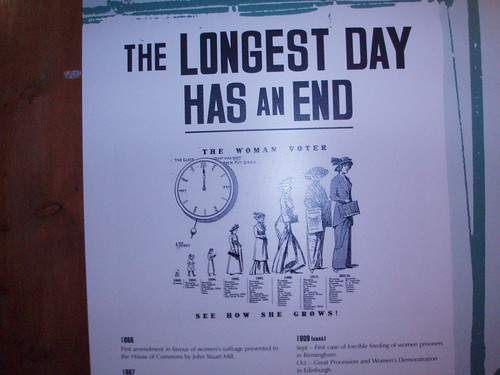
At the Museum of Edinburgh is an exhibition commemorating the women's suffrage campaigns in the UK.

There was this interesting poster there:

The Longest Day has an End

Here's a photo of the detail

The poster has the slogan "The longest day has an end" prominently at the top. Below that on the left is a clock set to midnight. Below that, and rising to the right of the clock, is a timeline running from 1869 to 1913, detailing the countries and sub-national regions that allowed at least some women to vote, graphically illustrated by sketches of a woman growing older and taller from a tiny baby (waving a flag) in 1869 to a full-height woman in 1913.

Reformatted for the web, here's the timeline:

YearCountries/Regions with at least some women allowed to vote
1869Wyoming
1893Wyoming, New Zealand, Colorado
1896Wyoming, New Zealand, Colorado, S. Australia, Utah, Idaho
1902Wyoming, New Zealand, Colorado, S. Australia, Utah, Idaho, W. Australia, New South Wales
1907Wyoming, New Zealand, Colorado, S. Australia, Utah, Idaho, W. Australia, New South Wales, Tasmania, Queensland, Finland
1908Wyoming, New Zealand, Colorado, S. Australia, Utah, Idaho, W. Australia, New South Wales, Tasmania, Queensland, Finland, Victoria, Norway
1911Wyoming, New Zealand, Colorado, S. Australia, Utah, Idaho, W. Australia, New South Wales, Tasmania, Queensland, Finland, Victoria, Norway, Washington, California
1912-1913Wyoming, New Zealand, Colorado, S. Australia, Utah, Idaho, W. Australia, New South Wales, Tasmania, Queensland, Finland, Victoria, Norway, Washington, California, Oregon, Kansas, Arizona, Alaska

Below the timeline is the second slogan "See how she grows!"

The whole exhibition - if you happen to be able to get there before it closes, and find it in the museum (accessibility is not universal) - is worth seeing.

One of the points being made by the timeline is that no area that granted women the right to vote had since revoked it, and I think this point provides a useful division of social justice issues.

For some issues, like suffrage, or the right of LGB people to serve in the military, there is a clear point. It may take decades or centuries of difficult struggle to argue up to that point, but once there the gains are relatively safe - once the critical threshold has been passed in a particular democratic jurisdiction, the idea fairly rapidly passes into general acceptance, to the extent that even those who opposed it before move to support it, at least in public.

The gains are reversible - any violent or otherwise sudden overthrow of the system of government, from within or without, might reverse them - and that they're otherwise unlikely to be reversed of course doesn't imply that there doesn't remain a significant minority of people who believe that they're nevertheless wrong. There are still people in the UK who believe that women shouldn't have the right to vote.

For other issues, there's no such critical threshold. The level of rights available can go backwards and forwards across a wide range over the decades, as different opinions gain and lose dominance in governments and in the wider population. Access to abortion has changed back and forth quite a bit in many countries. It's still, just about, a fringe view in the UK Parliament that it should be outlawed entirely - but of course that's a fringe that will grow as erosions are made to the existing rights. Attitudes - and legislation - towards immigration has also varied back and forth a lot. Any gain made with this sort of issue needs to be heavily defended just to make it into a new baseline against the counter-attempts of privilege.

What's not at all clear to me is why an issue falls into one or other type. It's not just about it being a binary divide or not - in the UK women's suffrage proceeded in stages, while the binary issue of defendant anonymity in rape cases has changed back and forth and remains contentious today.

It's also not, as far as I can tell, about differentials between public opinion and government opinion. Sometimes the government lags far behind public opinion on the matter - as the UK government is doing on same-sex marriage - and sometimes it introduces legislation that leads the way and public opinion follows (as happened with the abolition of the death penalty).

It seems like it would be useful to know why some successes stick and others don't, and perhaps how a success could be made to stick when it otherwise wouldn't, but I don't know of much that's been said on that.

Sunday, 25 July 2010

I'll believe it when I see it

[trigger warning]

The Telegraph is reporting that "Coalition plans to give anonymity to men accused of rape are to be abandoned".

Well, maybe. The report is based on this speech by Crispin Blunt MP in which he says:

[...] it was agreed on both sides of the House when the Sexual Offences Act 2003 went through Parliament that all people charged with offences ought to have their identity protected until the point of charge. That is the guidance that the Press Complaints Commission put into effect in 2004. There is an issue around the strength of that guidance and, as I said in the debate 12 days ago, we are not satisfied that it is strong enough. We want in the first instance to try to find a non-statutory solution [...]

I don't think this is an abandoning of the plans as such. It doesn't surprise me that they want a non-statutory solution, since it was made clear that they probably didn't have the votes for it. The coalition has a majority. The male coalition MPs (not all of whom support this either) do not on their own form a majority. They might still want to do it, but they're not going to risk "government defeated in Parliament" headlines over it while the opposition to it is so strong.

It probably doesn't have universal support even in the Cabinet, which may be where the talk of "fairly free" votes is coming from.

I can't find the Press Complaints Commission guidance referred to - this one is close but not the right one. At any rate, they could ask the media to self-regulate, it could refuse (though contempt of court laws make most of the pre-trial reporting that might cause problems somewhat risky for journalists)

Given that there are so few cases reported, naming a suspect, pre-charge (or indeed pre-trial) this would however provide the coalition with an easy way out. They can talk to the PCC, the PCC can bring out some guidance, the papers can ignore the guidance (because the PCC has no useful enforcement power), hardly anyone will actually be named in reports pre-charge anyway (because they aren't being at the moment) and the government can claim victory for doing nothing.

The Telegraph also notes:

The MoJ had planned to bring out a report this week giving statistics on false allegations of rape – the main reason put forward by campaigners for letting men charged with serious sexual offences remain anonymous

This appears to be the promise of the report, which was supposed to contain "an independent assessment of the current research and statistics on defendant anonymity in rape cases". That's not what the Telegraph reports it as being, though. Either way, it's not surprising that it's been delayed while they look for actual evidence.

Parliament returns from recess in September, so it should definitely be available after that. The contents of the report will probably be a far better indication than the Telegraph article of what the coalition really intends.

Given that the government so far has not managed to get its Ministers to give consistent answers - it will be for all sexual offences - it will be for rape only - it will be until conviction - it will only be until charge - it will be legislated on soon - it will be a "fairly free" vote but not soon - it will not be a matter for legislation - then I'm not going to take the anonymous sources and inferences from speeches as a definite sign that it will be abandoned either.

It might be a "U-turn", or it might just be more of the coalition's total lack of coherence on the issue. Either is good news, of course.

Tuesday, 20 July 2010

Only in a very narrow sense is this not a gender issue

[trigger warning]

"This isn't a gender issue" was a sentiment expressed a few times during the defendant anonymity debate.

As with many simple assertions, whether or not it's accurate is something that depends on what definitions you are using.

Firstly, looking at the numbers, estimated from the British Crime Survey and from Kelly, Lovett and Regan, the chance of being a victim of rape is considerably higher than the chance of being a victim of a false accusation for both government-recognised genders.

For adult women, the annual chance1 of being raped is approximately one in 375, and the annual chance of being falsely accused is basically zero. 2.

For adult men, the annual chance of being raped is approximately one in four thousand, and the annual chance of being falsely accused is at most one in 120 thousand (the chance of being charged as a result is at most one in 2.4 million, which is realistically the first time one's name might appear with the case in the press).

So for both government-recognised genders the plan is intended to protect a very small number of people (no women, and probably no falsely-accused men either) at the expense of a much larger group. In that very limited sense, it's not a gender issue, it's just a truly terrible idea.

On the other hand, the proposed law will also protect rapists, who are (to within rounding errors) all male. The studies cited in Lisak's summary suggest that around 6% of men3 will commit rape at least once (with serial rapists being more usual).

In that sense, it's very definitely a gender issue. The rapists the proposed law would protect are all men. Around 90% of the rape victims the proposed law would harm are women. A law doesn't have to say that its effects only apply to one gender for it to have a disproportional effect on people of that gender.

The most convincing proof that this is a gender issue, however, is to look at who is talking about it. For something that wasn't a gender issue, you'd expect that the proportion of people taking a particular side would not be dependent on gender.

Here's - up until the start of this week - the gender balance of those speaking for and against the issue in the House of Commons (the balance in the Lords is similar, but the numbers involved on either side are much smaller)

I'm including written questions and answers in this where they are relevant, and am counting all seven of the MPs in the coalition negotiations as "Against" (or one of them would have picked it up). Some of the judgements, especially around the "Neutral" category, are a little subjective, so don't be surprised if you get slightly different results on recounting.

Numbers, and percentage of MPs of that gender
FemaleMale
For0 (0%)15 (3%)
Neutral3 (2%)5 (1%)
Against24 (17%)6 (1%)

In EDM signatures, 38% of the women in the Commons have so far signed EDM105, but only 9% of the men. Of the Labour MPs, 65% of the women have signed, but only 26% of the men.

In the media, and in debates on the internet, the picture is much the same. When women write about the issue, they are nearly all opposed to the proposals. When men write about the issue, opinions are more split, but a significant majority are in favour.

If it wasn't an issue that had significantly different effects on different genders, that would be very unlikely to happen, especially to the highly visible extent that it has. The support numbers of course mean that in a gender-balanced Parliament this proposal would get nowhere, which is yet another clue that it is definitely a gender issue.

1 Setting out an average risk for the millions of adult women in the UK is not necessarily particularly meaningful, of course. There are several groups particularly at risk from rapists for whom the chance of being attacked by one will be much higher.

2 It's probably safe to say that while it's not impossible, the number of women accused specifically of rape (as opposed to other serious sexual offences) in most years will be zero. The number of false accusations will be even smaller.

3 This means that, assuming undetected rapists are no more or less likely to enter politics than anyone else, there are approximately 30 undetected rapists sitting as MPs in the Commons, and another 30 undetected serious sexual offenders. In other words, an MP is statistically more likely to be an undetected serious sexual offender than they are to be a Liberal Democrat. No wonder it's difficult to get anti-rapist legislation through Parliament.

Friday, 9 July 2010

The big anonymity debate in Parliament

[trigger warning]

The big debate on rape defendant anonymity was yesterday. The transcript is now out. There's still time to sign the petition or write to your MP, among other actions.

I've updated both the timeline and the common bad arguments post.

On the debate itself...

There's been a lot written about this debate elsewhere, including

Simon Hughes MP (Lib Dem, Bermondsey & Old Southwark) made various interventions such as this one, suggesting that it was the means and method rather than the name that would be useful in catching serial rapists.

Does the hon. Lady agree that, as the police say, it is often not the name or physical identity or picture of the suspect that brings people forward but the knowledge of the method of operation? I speak as the MP of John Worboys, who operated as a cab driver. The knowledge that the offender was a cab driver was enough to encourage others to come forward. It could be knowledge that the person committing the offence usually climbs through a window at 1 o'clock in the morning. The point is that is often the operation, not identity, that is important.

For "stranger" rapists this is probably true. For the more common acquaintance rapists, Lisak and Miller found that the methods used were so similar that it wouldn't really help. If police released a report that someone was behaving in a manner of the typical serial predators they described, then either thousands of victims would come forward, naming a wide range of rapists who vaguely matched that description, or more likely none would.

I don't doubt that it's a valuable method for catching certain serial rapists, but as the only available method it might not be so useful.

Aidan Burley MP (Conservative, Cannock Chase) makes a speech that is basically a long repetition of this bad argument. This was his first speech in the Commons. For his constituents' sake it will hopefully also be his last.

Caroline Flint MP (Labour, Don Valley) makes an excellent speech later in the debate that contains this rebuttal to that argument.

Equality before the law does not and cannot mean identical treatment for defendant and complainant. There is a vast array of ways in which the criminal justice system already, and rightly, treats defendants and complainants differently. Both should be treated fairly, but that does not mean identically; if that were the case, presumably we would no longer afford the defendant the advantage of the burden of proof, and complainants would have to be held on bail or in custody before their case came to court. The suggestion betrays a fundamental misunderstanding of why victims of rape are given anonymity in the first place, and that has been expressed very eloquently by colleagues in today's debate.

Finally, Robert Buckland MP (Conservative, South Swindon). He makes some good points - that the debate should be about "reporting restrictions", which is what they are, rather than "anonymity", which gives a highly misleading impression. He also says some things that are not so useful.

I will give the House a simple example. Where the act took place can often be a powerful indicator of whether consent or the lack of it can be proved. For example, if the act took place on a floor or an area that would not be consistent with consent, scientific evidence can often help to prove a case, particularly if the defendant and the complainant disagree about where the particular act of intercourse or sexual misconduct took place.

He goes on to make a good point about how police should be doing a better job of treating the places where rapes took place with the care they would treat other crime scenes, but is he really trying to say that the floor is definitionally inconsistent with consent?

Slightly later, saying that the decision on anonymity should be left to the judge, he says:

It would also allow a properly informed judge, faced with an unmeritorious application from a defendant who perhaps did not deserve the protection of reporting restrictions as much as someone of good character, to make a decision based on all the information before them.

Given that "of good character" is usually a euphemism for "white, male and middle-class", I'm not sure this would be a good addition to the process. There are already enough problems with judges treating domestic violence cases as not particularly serious (the tea poisoner, for instance)

Later on he intervenes to ask

The hon. Gentleman is not suggesting that there is a trade-off between the effect on an innocent person and rape being undetected and victims not being served by the system, is he?

Geraint Davies MP (Labour, Swansea West) gives the obvious reply that of course there is a trade-off. The harder you make it to convict defendants, the more innocent defendants will be acquitted (or not charged, or not arrested), but clearly too the more guilty defendants will escape justice and often go on to commit crimes against more victims.

This is why I don't believe "it is better to acquit 100 guilty suspects than to convict a single innocent one". If you convict an innocent one, you've created one victim, plus however many additional victims the real offender then causes. If you acquit 100 guilty ones, that creates many more victims. I'm not sure where the balance should lie, but one could probably work out the victim-minimising ratio for any particular crime based on the amount of serial offenders.

General lessons

One very useful thing about this debate, apart from exposing some discontent from at least some coalition backbenchers (mainly the women: have I mentioned that a gender-balanced parliament would almost by definition make better decisions?), is that it sets out exactly what the government intended that line in the coalition agreement to mean.

  • Reporting restrictions
  • For the crime of rape only
  • Up until charge

Up until charge means that the number of people falsely accused who will actually be protected by this is tiny - reporting in the press pre-charge is extremely rare indeed. I stand by my estimate of one every 3-4 years, based on Kelly, Lovett and Regan - and the Ministers have accepted that the false reporting rate is not higher than 10%, which makes the KLR data for the actual number of named suspects usable - and on the Daily Mail sample that Hannah Mudge put together.

For the crime of rape only gets an extension to this particular bad argument, because as several MPs pointed out from all sides during the debate, this makes no sense. If the consequences of an accusation of rape are so serious, why are they so much more serious than a range of other violent sexual offences, some of which are clearly viewed as more serious by the public, and others of which get colloquially but not legally called rape as well.

Next debates to watch out for

Justice is back for questions on 20 July, and Equalities on 22 July, so probably there will be more questions asked there.

Monday, 5 July 2010

Why is this still legal? The Equality-on-a-good-day Act

Why is this even legal? According to the BBC:

Residents of Firhall, built in the early Noughties on the outskirts of Nairn in the Highlands, must abide by certain rules. The deeds for their properties prohibit the keeping of ducks, rabbits, pigeons and bees. Households are allowed to have one dog - but controversially no resident children. To own a house in Firhall you must be over 45 years old. Grandchildren and the children of friends can visit and stay, but there are even limits on how often this happens.

It's not the only thing that's surprisingly legal, either. So much for the grand claims that the Equality Act would protect those most vulnerable to discrimination.

Looking at the Equality Act 2010, this appears to be entirely legal:

4 [...] The following characteristics are protected characteristics [...] age [...]

Part 4: Premises [...] 32.1 [...] This Part does not apply to the following protected characteristics [...] age

Looking at section 17, the terms would be unenforcable for the first 26 weeks of a child's life if their mother was already there, but that's all. (Of course, it would be relatively rare for a mother over the age of 45 to be living there, but not impossible). Otherwise, they seem to be within the exceptions the law provides.

Another unpleasant exception in this section, that I found in my "how is this possibly legal" search - you are allowed to harass people occupying or applying to occupy (as tenants) on the grounds of their sexual orientation or religion.

There's a similar but slightly broader exception in the Education section (which only applies to schools, not to FE colleges and Universities1), the same exception in the Provision of Services section, and in the membership of associations section.

So Labour and the Lib Dems get an LGB-friendly reputation for supporting this legislation (the Lib Dems, to be fair to them, did attempt to amend some of these bits out), which mostly seems to consist of "You must supply these services to LGB2 people, but you can '[create] an intimidating, hostile, degrading, humiliating or offensive environment for [them]' as much as you like in the process."

Additionally, neither "marriage and civil partnership" nor "pregnancy and maternity" are characteristics to which the harassment section applies at all.

There were some good bits in the Equality Act that hadn't been there before, such as the pay audits and the recognition of the existence of intersectional discrimination, and it's not as if by having these exceptions it was removing protections that previously existed, but it still hardly deserves the name. It's not as if this was a drafting error and an unnoticed loophole was left in until it was too late to take it out (though that, in its casual disregard, would be bad enough) - because of the way the Act is worded, someone had to specifically insert these exceptions.

Additionally, you can use these terms to push a lot of other things through. The Act doesn't say how wide an age group has to be, so you can legally say "Sorry, I don't rent to people who were born on 3rd April 1972 between 2am and 2:30am", and provided you then apply that rule consistently to later default tenants, you have a perfectly legal reason3 not to rent to any non-default person you like.

Other things that are entirely legal under the Act and really shouldn't be (or at least, if there is a real need for an exception, it should be the exception that is legal, not the rule):

  • Pregnancy and maternity, and marriage/civil partnership, are excluded from the intersectional discrimination laws. So discrimination against all married people is disallowed, and discrimination against all women is disallowed, but discrimination only against married women is apparently fine (barring explicit exceptions elsewhere in legislation, of course)
  • Refusing to provide a service to married and civilly-partnered people. (You can't, at least, just pick one and sneak in some homophobia) Similarly for single people.
  • Same things for premises
  • Same things for education (yes, your university can refuse to provide an education for single and/or unofficially partnered people, and I have no idea why, and likewise a qualifications board can legally withdraw qualifications from people when they get married/civilly-partnered, though what possible reason4 they'd have to want to I don't know)
  • Additionally, the exception for harassment in schools applies to gender identity as well as the sadly usual pair of sexual orientation and religion
  • The exceptions for what can't be required as a "reasonable adjustment" for disabled people are extensive.

The only area that doesn't seem to have masses of exceptions is employment. I may have missed some other exceptions, since there are a lot and the phrasing used for them varies.

1 Yes, seriously. Apparently homophobia in admissions is essential, and banning it would have terrible consequences for the rights of bigots at the primary and secondary stage, but at the tertiary level the rights of bigots are unimportant. This makes even less sense than usual.

2 It's not at all clear to me whether any of the Act applies at all to asexual people. It can be read either way. The explanatory note suggests that it doesn't apply to them, but I think a good lawyer could probably convince a judge that it did.

3 Disclaimer: not legal advice. If you try this argument you deserve everything you get.

4 "We've been homophobic for centuries and we're not going to stop now" is not a good reason, nor one that governments should be supporting people in, but you can at least understand which group of bigots lobbied to have that exception included. Some of these it's not at all clear why anyone would ask for them.

Thursday, 1 July 2010

Two private member's bills

There is usually very little opportunity in the House of Commons for anyone other than the government to present legislation. A rare opportunity for an ordinary MP to put forward changes in the law is the Private Member's Bill. Only at most 20 MPs a session can put forward a bill this way (chosen randomly), and usually not all of those will get a chance.

Even when a bill is put forward, it is of course extremely unlikely that it will pass - or even get beyond the Second Reading stage for further consideration - without government support. Nevertheless, they are a guaranteed way to get an issue debated at some length in Parliament, and depending on the support, can influence future government policy or even on rare occasions pass into law.

A couple of the ones that have got onto the list this session:

A lot of focus has been on the proposed Face Coverings (Regulation) Bill from Philip Hollobone MP (Conservative, Kettering), which according to to the BBC would make it illegal to wear full-face Islamic veils. Oh, and balaclavas. Mustn't look too racist. Operation Black Vote has more analysis of why this is a terrible idea.

I don't have anything substantive to add to that, except to say that living in the colder North of England, as opposed to Mr Hollobone's more southerly constituency, I often go out during the winter wearing a hat and a scarf pulled over my mouth and nose, exposing much the same area of skin as a full-face veil does. I have not once been criticised for this, told I should keep my face uncovered in public, or had MPs challenge my right to dress in that way. I expect that if I did wear a full-face veil, however, I would get all three. So, the MP's attempt to hide his racism (and indeed sexism) by also criticising my dress really doesn't work.

Fortunately, his Bill is 17th on the priority list, so it's unlikely to get the time it needs scheduled.

At 6th on the list, however, where it might actually get debated, is Anna Soubry MP's (Conservative, Broxtowe) bill: Anonymity (Arrested Persons). The Second Reading has been scheduled for the 4 February 2011, and it's unlikely that the full text of the bill will be available until shortly before then. For now, there's the summary:

A Bill to prohibit the publication of certain information regarding persons who have been arrested until they have been charged with an offence; to set out the circumstances where such information can be published without committing an offence; and for connected purposes.

It's already not police practice to reveal the names of pre-charge suspects who they have arrested, so the times this occurs generally break down into the following categories:

  1. The arrest took place in public and the suspect's allies are encouraging the reporting to draw attention to what they view as a wrongful arrest. Arrests of people who were protesting, for instance.
  2. The suspect's name or identity has already been revealed, because the police needed to do so to locate them. People who've been arrested after a stand-off, for example, or after an appeal to locate someone alleged to be a dangerous criminal.
  3. The crime is incredibly high profile, and half the neighbourhood already knows who has been arrested for it. The press don't even have to ask the police, except to get confirmation that a "37-year old man" was arrested.
  4. The suspect is very famous for other things, and someone in the police leaks the information to the press (directly, or more likely indirectly via a friend).

In the first case, no-one actually wants anonymity, except perhaps the police and the government, of course. In the second case, their identity is already public and there's no point in avoiding revealing that they've been arrested. In the third case, the rumours will spread fast enough anyway, and it's probably best to stop any incorrect rumours that someone else was arrested by allowing the press to report on the matter.

The fourth case is less clear - this shouldn't really happen, and celebrities shouldn't have less of a right to privacy than other people, true. It could also make it easier to find a jury who haven't been influenced by press reporting. I can't, however, think of a way to rule out this case that doesn't take out the third case as well, which could be a problem. Perhaps the Bill, when the full details appear for Second Reading, will have found a clever way to draft the details.

I wonder why this Bill was introduced. I can't work out whether it's been introduced to give more support - and possibly bring forwards - the proposals to give anonymity to rape defendants, or if it's been introduced as a way to distract from them by introducing something that looks good and would keep certain people happy without actually interfering with police operations.

If it's the former, of course, it'll bring the plans forward quite a bit, which means there's less chance of the coalition government collapsing or deciding they have better things to do, and that would be very bad indeed.

If it's the latter, I think it's in theory quite clever - between arrest and charge is a maximum of 24 hours (if they're arrested and released, it's fair enough not to report their name, I think), so that's not really time for the police to do anything useful with publicising their name, so they won't. Pre-arrest it won't cover, so it won't interfere with police investigations and evidence gathering. Post-charge it won't cover, so it won't interfere with the CPS preparing a case. So it can be debated and passed, the coalition can feel that it's achieved enough of the anonymity proposal to count it as done and avoid a bigger fight, and in practice very little will actually change.

There is of course the catch that having been introduced the government or the Lords could easily amend it into something more unpleasant, so if this is the idea I don't think it's a particularly safe way of doing things.

The full text of the Bill, which might give some clue as to what the intent is, probably won't be available until shortly before the Second Reading. The Bill's sponsor is a new MP, so doesn't really have any voting or speaking record to analyse yet. I'll keep monitoring it to see what happens.

Tuesday, 22 June 2010

A commitment on rape the government should keep

[trigger warning]

The discussions in Parliament on rape defendant anonymity continue (timeline updated), but meanwhile there is a second government policy proposal that also deserves some attention, and would do a lot of good if it happened.

Phillipa Willitts at The F-Word draws attention to a campaign by Rape Crisis (England and Wales) to make sure that the coalition government keeps its promise (in the Justice section of the Programme for Government) to:

[...] consider how to use proceeds from the Victim Surcharge to deliver up to 15 new rape crisis centres, and give existing rape crisis centres stable, long-term funding.

Naturally, Rape Crisis would prefer that they did more than "consider how to" do this, and actually implemented it.

They have a sample letter which they suggest is sent to Theresa May MP, the Home Secretary and Minister for Women and Equalities. Given that her department has previously said "nothing to do with us, that's a Justice proposal" on a related matter, it might be worth also sending it to Kenneth Clarke MP, the Minister for Justice.

As always, if you have the time to adapt and rephrase the template letter to reflect your personal thoughts and writing style, it's more likely to be taken into consideration - receiving 50 different letters has far more impact with MPs than receiving 500 identical ones. (Nevertheless, if you don't have the time, energy and/or ability to set thoughts down in writing in a manner you are satisfied with, it's still definitely better to send a template letter than not to do so).

Here's mine (a slightly different version went to Kenneth Clarke):

Dear Theresa May MP, Home Secretary and Minister for Women and Equalities

In the coalition Programme for Government is the commitment to

consider how to use proceeds from the Victim Surcharge to deliver up to 15 new rape crisis centres, and give existing rape crisis centres stable, long-term funding.

Your colleague, Kenneth Clarke QC MP, reiterated this commitment in Parliament on 15 June (HC Deb, 15 June 2010, c725), saying

The Government are committed to providing up to 15 more rape crisis centres.

With 10 centres in England and Wales having closed in the previous five years, this remains an urgent issue. It is not enough for the government to commit to providing funding for these centres; it needs to begin providing that funding urgently.

Rape crisis centres provide an extremely valuable service to women and girls who have survived rape, providing specialist support services that would otherwise be unavailable, but the lack of sustainable funding means that many areas of England and Wales do not have a rape crisis centre, and for those that do the future is uncertain.

In Scotland, however, the provision of guaranteed government funding has significantly improved the stability of rape crisis centres, and allowed four more to open.

The government must back up its commitment with quick action, and allow rape victims/survivors in England and Wales access to the same services as are available in Scotland. Will you, in conjunction with your colleagues in the Ministry of Justice, set a date for this commitment to be implemented, in time to prevent the closure of further centres.

Yours sincerely,

[me]

Contact details for Equalities Office

Contact details for the Ministry of Justice

The F-Word post includes details of other possible campaign actions.

Wednesday, 16 June 2010

Yes, this is exactly a "Rapist's Charter"

Yesterday's Justice debate in the Commons, as predicted, had a lot of questions for the government on their proposal to give rape suspects anonymity.

There were many speeches, all now linked to in the updated parliamentary timeline and several written questions.

For now, though, I just want to concentrate on an answer given by Kenneth Clarke QC MP (Conservative, Rushcliffe) near the end of the debate.

[trigger warning]

Barbara Keeley MP (Labour, Worsley & Eccles South) asks:

In a recent case, a Salford man had committed a rape and was bailed, but then committed a further rape, and the police believe that there are further victims of this man. Can the Secretary of State explain why the Government have committed in their coalition agreement to extending anonymity to such defendants before all the evidence is heard? Can he also say who will now be consulted for that evidence?

It's a reasonable question, but after all the other reasonable questions he's already been asked during the debate, it finally provokes him into saying what he's actually thinking. I'll break this into a few separate bits.

With great respect, I find it very surprising that so many questions are being raised about a proposition that has been before the House, on and off, for the past 20 years and is not easily resolved.

I'm entirely sure that the Conservative and Lib Dem MPs supporting this proposal were somewhat taken by surprise by the breadth and depth of opposition it rapidly attracted. This is because they're a bunch of mostly-white, mostly-male, mostly-otherwise-default people with very little sense of their own privilege and very little empathy for people who aren't like them.

Mr Clarke previously in the debate was offering some unconvincing denials that the proposal only made it into the programme for government because of the all-male negotiating teams.

We will, of course, look at all arguments, including the experience of the case to which the hon. Lady has referred, but that is only one of the considerations to be taken into account. There will undoubtedly sometimes be cases where the publication of the name of the accused person gives rise to other people coming forward with well-founded complaints against that person. We will have to see whether there is any evidence that such cases are a significant proportion of the total cases of rape.

This is something I don't know whether there have been any studies done (though I'd be surprised if not) - and if the government is going to fund some more, great.

However, this is not the only reason for which suspected rapists' anonymity is undesirable.

We shall also have to consider the arguments on the other side, where a woman can make an anonymous complaint, the man can eventually be convicted, after going through a long and probably rather destructive ordeal, and the woman retains her anonymity as she walks away, with her ex-boyfriend or ex-husband left to live with the consequences.

My initial reaction mirrored that of several of the MPs present, recorded in Hansard:

What?

I'll say it again. What?

Mr Clarke, let us remember, is the Justice Secretary. Responsible for Justice, and crime and punishment and law and order and other such things.

He has just described someone who has been convicted, in the courts of this land, of one of the most severe crimes we recognise, and he is complaining that this convicted criminal has to live with the consequences? That is the entire point of having a justice system, and criminal law, and punishing people who break it, that criminals have consequences for their actions that they have to live with.

I know there are good arguments for reform of the justice system and the prison system, that justice is often racist and classist, that prison conditions can be needlessly unpleasant, and that people are often given prison sentences for minor crimes that would be better dealt with in some other way. Saying "Oh, poor rapists. How terrible that they're imprisoned." is not, however, the sort of reform that the system needs, and not the sort of reform I expected a "tough on crime" Conservative to suggest.

Back when this proposal was first released in the programme for government, it was called "a rapist's charter". People calling it that were told that they were over-reacting - it was "for suspects", "innocent until proven guilty", that was "all". But now and again, the mask slips, and its real purpose becomes clearer.

Congratulations to all the Labour MPs involved in keeping up the scrutiny of the government here. It sounds like some more will be needed.

Meanwhile, in other "sexual predators getting light sentences" news, a police officer who coerced women into sexual activity in exchange for overlooking minor traffic offences has been jailed for the derisory term of three and a half years on charges of "misconduct in public office".

Monday, 14 June 2010

How many is this actually helping?

Some more discussion of whether the coalition's proposals on rape defendant anonymity would do anything useful, even if the inevitable negative effects are ignored or disbelieved. (Summary: No)

(and please sign the petition if you haven't got round to it yet)

[trigger warning, especially for some of the links]

Kelly, Lovett and Regan's (PDF) study on attrition includes a section on false allegations. In their sample of 2,643 reported cases, the police had recorded 8% as false allegations. Some of this, however, was found to be due to misclassification - after removing those, and cases where the police had declared the report false due to misconceptions of what a "real" rape victim would do, they estimated that around 67 of the sample were really false allegations. Between these allegations, there were at most1 39 named suspects, 6 of whom were arrested and 2 charged.

The British Crime Survey reports that police recorded 13,133 rapes in the 2008-9 reporting period. Based on the combination of these figures, we'd therefore expect at most (39 / 2,643) * (13,133) false accusations naming a suspect annually, or around 200.

Previously calculated: there are around 210,000 actual rapes each year, or over a thousand times as many. I know it must be unpleasant to be falsely accused of any crime, but this is really not a significant risk. (For comparision, around 200 men might be falsely accused each year, but around 7% of those 210,000 actual rapes have a male victim, or around 15,000 annually. That's quite a difference in both risk and impact even if you only consider men)

Of those 200, how many will be reported on in the press? Looking at Lexis Nexis, I'd estimate2 that around 250-500 rape cases annually will receive some reporting in the press either before the end of the trial or when there is an acquittal. (Many more are reported after conviction, of course) A few of these will be reported on multiple times in multiple press sources if it's a particularly high profile trial, but most will not.

So, that's around 500 of 13,000 receiving some press attention. Of those, virtually all are post-arrest. So, of the 6 people arrested on a false accusation, roughly (200 * 6 / 39) * (500 / 13,000), or 1.18, will be reported on in the press. Actually, the number is likely to be smaller than that, since most of the post-arrest press reports are post-charge, the 500 is the upper estimate, some of these reports involve the rape of children under 16 (which involves different crimes), and so on.

So, the coalition is proposing this anonymity in the press for alleged rapists, to help protect the reputation of one person a year. Now, I'm sure this person is very happy about this, and so would I be if the government introduced legislation for my personal benefit.

(Note that even if we go with the higher 8% figure that the raw police data claims - and Kelly et al. demonstrate fairly convincingly why it's probably not the case - that still only increases the partial protection this change would provide to about 5 people a year) Edit 15 June. Sorry, no it doesn't. There were 39 named suspects, 6 arrested, 2 charged, out of the full sample of 2,643. I was already assuming conservatively that the 3% figure included all of them, so increasing the rate back to 8% doesn't add in any more suspects.

Now, it's not that protecting the reputation of the innocent is a bad thing (just as reducing suicides of suspects - even the guilty ones - is not a bad thing). It's just that this is a stunningly ineffective way of doing it and comes with such massive costs that it's impossible to see it as a net benefit to society unless you value the reputations of a few men above the welfare of tens of thousands of rape victims.

For around two or three people's reputation ([stronger trigger warning] and maybe a fraction of a suicide prevented) each year, the government is willing to harm the cases of thousands of rape victims and provide additional to protection to serial rapists.

False, "false" and the unhelpful law

While I'm on the topic of false allegations, I should bring up a flaw in the current law on rape that means that it's possible for an allegation to be simultaneously true and false depending on exactly what definitions you use.

The Sexual Offences Act 2003 defines a set of offences, including rape, using the following formula (emphasis mine):

(1) A person (A) commits an offence if

(a) he [carries out the act associated with this offence] on another person (B)

(b) B does not consent to the [act], and

(c) A does not reasonably believe that B consents.

(2) Whether a belief is reasonable is to be determined having regard to all the circumstances, including any steps A has taken to ascertain whether B consents.

(3) Sections 75 and 76 apply to an offence under this section.

So, the colloquial definition of rape, and the one that matters from the victim's point of view, is that (1a) and (1b) both happen. From a legal point of view, however, for there actually to have been a crime committed, (1c) must also be true. Sections 75 and 76 set out some limited situations in which a belief in consent is automatically unreasonable, but not enough.

This law is still an improvement on the previous one, which allowed unreasonable beliefs to also be a defence, but it's still not enough. It's not the wording of the law as such that's wrong, but the context of the culture it exists in.

In a culture that's so saturated with rape myths - that consent is the default state for women, that wearing revealing clothing or flirting are indicators of consent, that consent is not revocable, that consent to one activity implies consent to other activities, and so on - "reasonable" is a really low standard. In a culture based on enthusiastic consent, it would be a perfectly fine standard, since point (2) would be interpreted usefully, but we don't have one of those and so the law needs to be better worded (wording improvements, of course, would not harm the law's effectiveness in a future enthusiastic consent culture)

It's based on what an average person would do in the same circumstances, but we know from surveys (2005, but more recent surveys give similar numbers) that the average person is very likely to have a rape culture-influenced definition of consent.

We have a situation here where the victim can make an allegation that they believe to be perfectly true - and which is, in any sense other than one, true - but is as a matter of legal fact false.

So, perhaps it's this set of people that Cameron is trying to protect - those that had ideas of consent that don't meet any dictionary definitions of the word, or fit with definitions commonly in use every day in non-sexual contexts. Those, in fact, that Lisak and Miller and previous studies identified as the 5-15% of men who are perfectly willing to admit to carrying out activities meeting the legal definition of rape or other serious sexual offences as long as you don't call it that on the survey. The "I'm not a rapist, I just force women into sexual activity against their will" crowd.

Now, obviously if you include those that the false allegation rate will go way up (and indeed the number of "real rapes" identified by the BCS will drop too), but I'd put it to the government that these are not people deserving of special rights beyond those granted to the average criminal suspect.

1 39, 6 and 2 are figures from the full sample of false allegations, whereas 67 is found by scaling up a sub-sample where sufficient data had been recorded by the police. It's likely, therefore, that some of the 39/6/2 were in the "not actually false" part of the sample, but the paper doesn't state this.

2 The Lexis-Nexis search engine really isn't good enough for this. I restricted the search to a particular year (2009), to UK publications reporting on UK events, and to articles categorised as "Sexual Assault" and "Sex Offences", and searched for articles containing "rape" AND ("alleged" OR "allegation" OR "acquittal"). I then visually checked a sample of the result to see how many of the reports were about the same case, or not actually about a specific rape, or post-conviction, to get an estimate of 250 a year. I then doubled this to allow a margin for errors in searching to get 500.

Friday, 11 June 2010

Rape defendant anonymity: Parliamentary timeline

Our MPs are not letting the proposals to give defendants in rape trials anonymity get anywhere without resistance, and are exposing the coalition's representatives' lack of knowledge of the issue at numerous opportunities.

This post is - as far as I can manage, and please let me know if I've missed anything - a complete Parliamentary/Government timeline. Like the earlier countering bad arguments post, I'll be updating this as things happen, the evening after the day of the debate if I can keep up with it. (Last update: 12 November 2010)

[trigger warning]

In previous governments

This Briefing Paper produced by Parliamentary researchers to inform MPs summarises the history well. Anonymity for the defendant was introduced in 1976 (at the same time as anonymity for the victim), and then abolished in 1988.

The last time this was voted on in the Commons it was an entirely party-line vote, with Conservatives and Lib Dems voting for, and Labour voting against. A few minor party MPs voted for it as well.

May 20, 2010

The coalition releases its Programme for Government. It doesn't take long for people to notice in the Justice section that it contains "We will extend anonymity in rape cases to defendants.", and criticism from feminist and victim support groups is very quick to appear. There is also criticism from several lawyers, and from the police.

The proposal is from an obscure Liberal Democrat policy dating back to 2006, that was not in that party's manifesto.

One of the coalition negotiators must have suggested it.

  • Danny Alexander MP (Lib Dem, Inverness, Nairn, Badenoch & Strathspey)
  • William Hague MP (Conservative, Richmond)
  • Chris Huhne MP (Lib Dem, Eastleigh)
  • David Laws MP (Lib Dem, Yeovil)
  • Oliver Letwin MP (Conservative, West Dorset)
  • Ed Llewellyn (Conservative party advisor)
  • George Osborne MP (Conservative, Tatton)
  • Andrew Stunnell MP (Lib Dem, Hazel Grove)

May 25, 2010

A petition to Kenneth Clarke QC MP (Conservative, Rushcliffe) Secretary of State for Justice, urging that the proposal be dropped, is started.

The debate on the Queen's Speech begins in the House of Lords. Baroness Royall of Blaisdon (Labour) mentions and condemns the proposals, in a couple of sentences that sum up the problems and lack of perspective of a heavily male-dominated government:

Then there is the constitutional programme claimed by the Deputy Prime Minister to be the greatest piece of democratic reform since the great Reform Act of 1832. Over half of the population of this country who secured the franchise in the period since then-women, they are called-might take a different view, but after a pretty much all-male election and with the coalition Government being run pretty much as a boys' club, women in this country might just prefer to differ, just as they might prefer to differ over the recent announcements in respect of rape and anonymity, which is a truly retrograde step for abused women.

Meanwhile, in the Commons, acting Labour Leader Harriet Harman MP (Camberwell & Peckham) opens the opposition speeches, including this paragraph:

We ask the Government to reconsider their plans to change the rules for prosecuting rape and their proposal for anonymity for rape defendants. It is often only after many rapes that a defendant is finally brought before the court, and it is often only when previous victims see the name and details of the defendant that they find the courage to come forward. Police and prosecutors say that that is essential in helping get a conviction. To make only rape defendants anonymous sends a message to the jury that, uniquely, a rape victim is not to be believed, and it sends a message to the woman who has been raped that, "We don't believe you." We have made progress on bringing rapists to justice; I urge the Government not to turn the clock back.

May 26, 2010

Fiona Mactaggart MP (Labour, Slough) proposes Early Day Motion 105 criticising the proposals and calling for their withdrawal.

Other Labour MPs sign up to it very quickly, especially female MPs, rapidly reaching 50 signatures. The only early non-Labour signature is Jonathan Edwards MP (Plaid Cymru, Carmarthen East & Dinefwr)

May 27, 2010

Rosie Winterton MP (Labour, Doncaster Central) as Shadow Leader of the House, Kerry McCarthy MP (Labour, Bristol East) and Fiona Mactaggart MP all raise the issue in the "Business of the House" debate (in the official context of "this is an important issue; could we have some time to discuss it in Parliament"). The debate transcript.

Here's the relevant bit of the reply from George Young MP (Conservative, North West Hampshire):

The right hon. Lady has raised a serious issue about rape and anonymity. I recognise the concern about this issue, and there should be no doubt in anyone's mind about this Government's determination to tackle rape and sexual offences and to ensure that those who commit such offences are convicted and properly sentenced. No quarter will be given to those convicted of rape. However, the House will also be aware that some people's lives have been wrecked by being falsely and maliciously accused of rape. That is why we have said that we will undertake a careful and sensitive analysis of the options and implications before we bring any proposals to Parliament. Of course, any proposals to change the law will have to go through this House and the other House.

Nothing particularly useful there, and the argument in favour is a vague statement about "some people" being harmed by "false and malicious" accusations.

June 2, 2010

Kerry McCarthy MP asks a couple of written questions to the Home Office, on the proportion of rapes unreported (89% of serious sexual assaults is the estimate) and on what evidence they have collected on the proportion of false accusations (none, but the Stern Review recommends that they should)

Harriet Harman MP, meanwhile, questions the Prime Minister. Parts of his reply were picked up on as possible evidence of backtracking.

We came to the conclusion that there was a case for saying that between arrest and charge there was a case for anonymity.

[...]

We all want the same thing, which is to increase the number of successful rape prosecutions and to send more rapists to jail: that is what this is about.

Of course, between arrest and charge there is already de facto anonymity for the overwhelming majority of defendants, as the police will not release the name unless there's a strong need (a public safety issue such as Derrick Bird, for instance). I wasn't able to find a single example of a non-celebrity rape suspect being named in the press at this stage.

June 7, 2010

The Commons debate is on Constitution and Home Affairs. Labour as the Opposition propose an amendment to the letter Parliament is sending to the Queen (the link explains why this makes sense as something to do) including opposition of the anonymity proposal.

The amendment predictably fails (it wasn't proposed with the purpose of passing), but gives several MPs opportunity to make speeches.

Lorely Burt (Lib Dem, Solihull) starts by asking how Deputy PM Nick Clegg (Lib Dem, Sheffield Hallam) intends to take the debate forwards. He answers:

The Deputy Leader of the House tells me that there is an Adjournment debate about the matter tonight. It is a difficult and sensitive issue, which my hon. Friend is right to raise. It has been raised many times and I read some articles in the press about it again this morning. Everybody is united in wanting the conviction rates for rape to increase. Everybody wants more support to be provided to victims of rape so that they come forward in the first place, while also wanting to minimise the stigma attached to those who might be falsely accused. However, I want to make it clear that, although the Government have proposed the idea, we want to listen to everybody who has a stake or expertise in or insight into the matter. If our idea does not withstand sincere scrutiny, we will of course be prepared to change it.

Again, there's a lot in there to give an impression of backing off, and a lot of words intended - largely unsuccessfully, for me - to reassure that the government is doing this to help victims. For someone whose party came up with the idea, he's being very equivocal about it.

Bridget Philipson MP (Labour, Houghton and Sunderland South) opposes the proposals

I am particularly grateful to be called to make my maiden speech during the debate on home affairs. Prior to my election, I worked managing a women's refuge based in my constituency for families fleeing domestic violence. It is through my work with victims of sexual violence that I have such deep reservations about proposals to introduce anonymity for defendants in rape cases. I ask the Government to look carefully at prioritising measures that will increase the number of rape convictions instead of deterring vulnerable women from coming forward.

Stephen McCabe MP (Labour, Birmingham Selly Oak) and Alan Johnson MP (Labour, Kingston upon Hull West and Hessle) also spoke in opposition in passing.

Later that night was the adjournment debate arranged by Caroline Flint MP (Labour, Don Valley). This is covered in more detail in another post and Crispin Blunt's arguments are dissected by gorilerof3b and Sian at UKFeminista.

Meg Munn MP (Labour, Sheffield Heeley), Cathy Jamieson MP (Labour, Kilmarnock & Loudoun), Fiona Mactaggart MP, and Kerry McCarthy MP all raise points against the proposal. Denis MacShane MP (Labour, Rotherham) contributes some heckling.

The response from the government is left entirely to Crispin Blunt MP (Conservative, Reigate), a minister in the Justice department. His arguments are basically that:

  • Rape defendants are significantly more likely to suffer damage to their reputation even if acquitted or not charged than suspects in other trials.
  • There is not sufficient evidence on the prevalence of serial offending.

He also states:

There is no implied view in our proposals of the prevalence or otherwise of false allegations in rape cases

...which isn't particularly believable in the context of what some of his colleagues have said before or since.

June 8, 2010

Kerry McCarthy MP follows up the debate by asking as a written question what the scope of the policy is. Crispin Blunt MP replies that they recognise that sexual offences other than rape might also be covered.

June 9, 2010

Another written question, from Andrew Stephenson MP (Conservative, Pendle), on what plans the government have. Crispin Blunt MP replies that they will bring some plans forward after considering the options.

Caroline Flint MP continues to keep the pressure on the government, asking David Cameron MP at Prime Minister's Questions. Cameron's reply is unsatisfactory - gorilerof3b points out his highly selective reading of Stern, and I cover the improbability of anonymity proposals actually preventing any defendant suicides. The possibility of an increase in victim suicides, if the justice system starts to fail them even more, isn't mentioned at all.

June 11, 2010

It's the Parliamentary Business debate again, and Rosie Winterton MP again calls for a proper Parliamentary debate on the issue, and criticises Crispin Blunt's responses at the adjournment debate.

I do not think the Leader of the House was in the Chamber to hear the Adjournment debate initiated by my right hon. Friend Caroline Flint, who spoke eloquently and effectively about the Conservative-Liberal Democrat proposals for defendant anonymity in rape cases. The response of the Under-Secretary of State for Justice, Mr Blunt, was frankly disappointing, and showed very little understanding of the message that he was sending to rape victims. He did say, however, that the Government wanted informed contributions, and would consider all the options before formulating the proposals.

Glenda Jackson MP (Labour, Hampstead & Kilburn) and Maria Eagle MP (Labour, Garston & Halewood) also ask for a fuller Parliamentary debate.

George Young MP doesn't promise any debates, but doesn't try to defend the proposal either.

Early Day Motion 105 is now up to 73 signatures, including Caroline Lucas MP (Green, Brighton Pavilion) and a single coalition MP - Mike Hancock (Lib Dem, Portsmouth South). Of the five candidates for the Labour leadership, only Diane Abbott MP (Hackney North & Stoke Newington) has signed it.

June 14, 2010

Kate Green MP (Labour, Stretford & Urmston) asks what proportion of rapes were committed by people known to the victim. Crispin Blunt doesn't know (though he says "not possible" when he means "not practical").

June 15, 2010

A busy day.

Three more written questions and answers, from Lisa Nandy MP (Labour, Wigan), Kate Green MP again (this time getting a useful answer on bail statistics - about 20% of defendants at Magistrates courts, and around 40% at Crown court, are granted bail between charge and verdict, and around 60% are granted bail between arrest and charge), and Sandra Osborne MP (Labour, Ayr, Carrick & Cumnock) asks the Home Department what they plan to do about conviction rates. The answer from James Brokenshire MP (Conservative, Old Bexley & Sidcup) is:

We need to increase the number of successful rape prosecutions and send more rapists to jail. The current conviction rate in cases of rape proceeded against in court stands at 38%.

As we have made clear, the victim in rape cases remains our priority and we welcome many of the improvements introduced by the police and the Crown Prosecution Service in recent years, intended to improve both victim care and the number of cases reaching court. These include specially trained officers and prosecutors, dedicated rape units within police force areas and investment in Sexual Assault Referral Centres for the improved collection of forensic evidence and provision of immediate crisis and medial care to victims.

It is important, however, that victims have access to longer term support and we have therefore committed to providing sustainable support for rape crisis centres.

Over the coming months, we shall work with partners to consider what more needs to be done to ensure that perpetrators of rape are brought to justice.

(The conviction rate above isn't the 58% quoted elsewhere, because the 58% includes those who plead guilty)

There was also the anticipated debate on oral questions to the Justice department. There were numerous questions asked on the anonymity proposal in this debate. The first set went quite well. The initial questions were asked by Caroline Flint MP, Meg Munn MP, and Bridget Philipson MP. Kenneth Clarke QC MP responded - his personal belief is that the defendant should have anonymity because the victim does. He also brings up that sometimes the defendant gets anonymity because identifying them would identify their victim. (Which I don't think anyone who supports victim anonymity is arguing for stopping)

Maria Eagle MP then asks

I listened with great care to what the right hon. and learned Gentleman the Secretary of State said about the mystery of where the policy came from, but can he enlighten the House as to why, over that weekend of negotiations between the Liberal Democrats and the Conservative party about the coalition agreement, the matter suddenly became a major priority when it had not been in either manifesto before? Will he also please tell us how many women were involved in those negotiations?

Kenneth Clarke MP responds:

I was not involved in the negotiations, but the policy actually emerged from them. I remind the hon. Lady that the Liberal Democrat assembly voted in favour of the policy in 2006, but it did so against a background of considerable debate. People from all parts of this House decided to vote for anonymity in 2003, and we recently had a report from Baroness Stern, who I do not think supports anonymity but recommended that the matter be debated more extensively.

The one thing that I can say to the hon. Lady is that the idea that the proposal was a male decision to the exclusion of female sensitivity on the subject is, frankly, slightly wide of the mark. Nobody in the House denies that rape is a serious offence; nobody in the House wants to reduce the protection that is given to women who are threatened with it or experience it.

As Georgia Kirke points out in a TheyWorkForYou annotation, Baroness Stern's report recommended an independent study be done, which is not the same as recommending a chat in the Commons.

"slightly wide of the mark" is a very mild dismissal of the idea that the proposal came about - in Kenneth Clarke's words - as "a male decision to the exclusion of female sensitivity". He doesn't say what it was instead.

There's then another set of questions from Kevin Brennan MP (Labour, Cardiff West), Katy Clark MP (Labour, North Ayrshire & Arran) and Emma Reynolds MP (Labour, Wolverhampton North East). Again, Clarke gives the usual answer about being prepared to consider all arguments and viewing rape as a serious crime, to which Kevin Brennan MP (who, incidentally, is the first male Labour MP to engage with the debate beyond a passing reference or heckling) says:

The point is that the Justice Secretary has come before the House and talked about the proposal as if he were suggesting perhaps a Green Paper or a national debate, but it is in his programme of government, and I notice that his Front-Bench team is a Liberal-free zone. Does he feel, and will he now admit to the House, that basically he has been sold a pup?

This is exactly right. Pretty much any time they've been questioned, the Conservative ministers (and Lib Dem leader and deputy Prime Minister Nick Clegg MP) have been very non-committal, "got to consider all options", "plenty of time for debate", and so on. But the proposal is in as a manifesto-esque commitment in the programme for government.

The Minister dodges the questioning a bit, and a further question by Katy Clark MP gives this sentence in answer.

The conviction rate among those charged with rape is 38%, which is lower than that for some other offences, but rape is different in many ways from more straightforward crimes such as theft. In rape cases, we are essentially relying on the frame of mind of one of the parties; something that is perfectly lawful and affectionate if the woman is consenting is a very serious criminal offence if she is not.

It's an interesting statement that doesn't show what he thinks it does. Theft, of course, is another act which is only illegal in the absence of consent. I can take your possessions perfectly legally if you agree to let me do so. If you disagree, it's theft. The difference between theft and rape is not that one does not involve questions of consent, it's that in considering theft, people's culturally-trained expectations of what consent entails are not utterly broken.

Another question by Emma Reynolds MP, and then the first intervention by a non-Labour MP who isn't a Government Minister. Jonathan Evans MP (Conservative, Cardiff North) asks:

Does my right hon. and learned Friend agree that it is important that the appropriate counselling is available for victims coming forward? That counselling has recently been withdrawn in my constituency and that of Kevin Brennan. It is now provided by volunteers. Will my right hon. and learned Friend look at ensuring that appropriate funding is put in place for that service?

Kenneth Clarke MP responds (emphasis mine)

I certainly will. I have already referred to our commitment to try to provide new rape crisis centres, preferably using the proceeds of crime when they are recovered from criminal offenders. I strongly agree with my hon. Friend that we are long past the stage at which a woman complaining of rape is treated as if she were complaining about a handbag robbery. There is no doubt that all these cases have to be treated with considerable sensitivity because it is very difficult for a woman to bring herself to complain and not enough do so, even in the present climate of opinion.

So, yes, we have a pervasive and strong rape culture and a large number of police forces still failing to treat rape seriously (a handbag robbery at least is unlikely to result in the police saying "Well, maybe you gave it to them. It's just one person's word against another.") but he's surprised that the reporting rate is so low.

At this point the debate moves on, but later on, Luciana Berger MP (Labour, Liverpool Wavertree) asks about the low conviction rate and why rape defendants should be given more protection than defendants for other serious crimes. Kenneth Clarke MP keeps up the line about defendants being entitled to anonymity if the victim has anonymity.

A bit later, Siobhain McDonagh MP (Labour, Mitcham and Morden) notes that there have been references to Stern's recommendation on false allegations, and wonders what the government plans to do about the other twenty-two recommendations. Kenneth Clarke MP replies that the other recommendations are important and should be considered.

So, like a lot of people, he focuses on the trivial amount of false allegations and hardly considers the other more important points that Stern made that are preventing true allegations from being prosecuted effectively.

Finally, Barbara Keeley MP (Labour, Worsley & Eccles South) asks:

In a recent case, a Salford man had committed a rape and was bailed, but then committed a further rape, and the police believe that there are further victims of this man. Can the Secretary of State explain why the Government have committed in their coalition agreement to extending anonymity to such defendants before all the evidence is heard? Can he also say who will now be consulted for that evidence?

The reply is shocking (if not really surprising).

With great respect, I find it very surprising that so many questions are being raised about a proposition that has been before the House, on and off, for the past 20 years and is not easily resolved. We will, of course, look at all arguments, including the experience of the case to which the hon. Lady has referred, but that is only one of the considerations to be taken into account. There will undoubtedly sometimes be cases where the publication of the name of the accused person gives rise to other people coming forward with well-founded complaints against that person. We will have to see whether there is any evidence that such cases are a significant proportion of the total cases of rape. We shall also have to consider the arguments on the other side, where a woman can make an anonymous complaint, the man can eventually be convicted, after going through a long and probably rather destructive ordeal, and the woman retains her anonymity as she walks away, with her ex-boyfriend or ex-husband left to live with the consequences.

More analysis of that statement and the problems with it

The Justice debate got a BBC News article

June 16, 2010

In the Commons, written questions from Kerry McCarthy MP and Glenda Jackson MP asking what consultation took place and what evidence was considered before the announcement of the policy.

Kenneth Clarke MP dodges the question somewhat, saying:

The proposal to grant anonymity to defendants in rape trials was included within the coalition Agreement following negotiations between the two coalition partners. All of the policy commitments made by the coalition Government were derived from the existing policy of one or both of the governing parties. The issue of anonymity for defendants in rape trials was adopted as party policy by the Liberal Democrat Party while in opposition. It was also the subject of an extensive inquiry by the Home Affairs Select Committee, in its fifth report published on 24 June 2003.

Most of the day's activity, however, was in a House of Lords debate on the crime of rape generally, begun by a question from Baroness Scotland of Asthal (Labour) asking:

To ask Her Majesty's Government what proposals they have to change the way in which prosecutions are undertaken in rape cases.

The answers are all from Lord Wallace of Tankerness (Lib Dem). After initial questions by Baroness Scotland and Baroness Kingsmill (Labour), it is established that the government is looking at the Stern review recommendations, and wishes defendant anonymity to be debated. Again, the government attitude is of suggestions that deserve debating yet again, rather than the firm decision of the programme for government.

Baroness Howarth of Breckland (Crossbench) then asks:

My Lords, the Minister spoke of talking to experts. Does he accept that the greatest experts in this field are those who have been victims of rape? Will he ensure that their views are taken carefully into consideration and that he listens to the groups representing them?

Lord Wallace replies

I am certainly prepared to give that assurance. Those people have a very regrettable but very real experience. It is because of the importance that we attach to the way in which we as a society deal with victims that the coalition Government are committed to trying our best to increase the number of rape crisis centres and to put those which exist on a more stable financial footing.

Lord Campbell-Savours (Labour) then asks:

My Lords, evidence has shown that the two-tier offence arrangements that exist in New Zealand lead to far higher levels of successful prosecutions. Would the Government consider changing the law in the United Kingdom to mirror the arrangements in New Zealand?

Lord Wallace has no idea what the law on rape in New Zealand is, and neither did I. As far as I can tell from this paper on changes in NZ law (subscription required and badly OCRed), there are two separate types of offence.

The first is one in which the lack of consent involves force, threatened force, or misleading someone about one's identity or the nature of the sexual acts (it seems to be mirrored fairly closely by the circumstances in the Sexual Offences Act 2003 in which a belief in consent is assumed to be unreasonable)

The second is one in which the lack of consent is caused by "threats of criminal behaviour, blackmail, or abuses of power or authority arising from the occupational or vocational positions or the commercial relationship between the parties clause". In the original bill this had a lower maximum sentence, but both types were given a 14-year maximum sentence when the law was passed.

Certainly an addition of those types of coercion to the list in the Sexual Offences Act 2003 would be beneficial (although, as mentioned earlier, if we had a society with reasonable ideas of consent, it wouldn't be necessary)

I haven't been able to find anything more recent explaining the situation - if anyone more familiar with New Zealand law reads this, could you leave an explanation or a link to one in the comments, please?

The next question relevant to anonymity is from Lord Thomas of Gresford (Lib Dem) who asks:

My Lords, I also congratulate the noble and learned Lord on his appointment. Will he ensure that any changes to the criminal law are evidence-based and that no change in the anonymity rules is brought into effect until there is an opportunity to get statistics from police forces all round the country on whether the anonymity of the defendant would result in fewer women coming forward with their complaints?

As usual, the government response is that they like evidence and welcome it, but no specific commitment not to do anything without it. It is good to see the occasional coalition member express concern, though.

Next, Baroness Whitaker (Labour):

My Lords, will the noble and learned Lord explain exactly why those accused of rape should be entitled to greater protection than those accused of other serious crimes?

Lord Wallace answers:

That question is sometimes raised. As I indicated earlier, the issue has been debated for some considerable time. It is a realisation of the severity of the stigma that is attached to rape. It is a unique crime, inasmuch as the victim has anonymity. In terms of its apparent uniqueness, perhaps I may draw attention to the fact that in the coalition Government's programme for government we are also considering proposals that would give anonymity to teachers who are falsely accused by pupils. Where professional and personal reputation is at stake, we want to look at these issues with a proper degree of sensitivity.

I noted a while back the similarities between the treatment of rape allegations and allegations made against teachers. In both cases the scale of the false allegation problem may be significantly overstated based on studies with unsound methodology, the victims are often subject to a presumption that they are lying, and there are power differentials in place.

Finally, Baroness McIntosh of Hudnall (Labour) asks:

My Lords, given that the Minister told the House that securing more prosecutions in rape cases is a priority as regards this range of offences, in what way do he or the Government believe that securing the anonymity of defendants will assist in that?

It's an obvious question, since in the Commons especially government ministers have been repeating their insistence that this is the case. Lord Wallace may not have been briefed properly, however, so gives the honest answer (emphasis mine).

I am not sure that there is necessarily a direct link. There are many other approaches we want to consider whereby we can raise the conviction rate. It is also important to remember that the 6 per cent figure that is sometimes used represents the percentage of cases that are initially reported to the police. In fact, the figure, in terms of convictions in cases that are taken to court, including those convicted of lesser but nevertheless serious sexual offences, is approaching 59 per cent. There is always room for improvement. The report of the review of the noble Baroness, Lady Stern, made many recommendations for public authorities-the police, prosecution and judiciary-to improve their service. There are ways to raise the percentage of convictions, an objective shared by all parts of this House.

Not at all surprising, but it's good that one of the people defending the anonymity proposal has actually said outright that itself it will not help rape victims.

June 17, 2010

Several written questions today:

Helen Jones MP (Labour, Warrington North) asks a couple of questions. Firstly:

To ask the Secretary of State for Justice what meetings he has had with (a) members of the judiciary and (b) organisations representing victims of crime on proposals to grant anonymity to defendants in rape cases.

Kenneth Clarke MP responds:

I have as yet had no such meetings.

Secondly:

To ask the Secretary of State for Justice if he will place in the Library a copy of each piece of written evidence he considered before deciding to bring forward proposals to extend anonymity to defendants in rape trials.

Crispin Blunt MP responds:

The Director of Analytical Services in the Ministry of Justice has been asked to compile all the available research and statistics relating to this issue into an independent report and publish this before summer recess.

So, no actual evidence yet, then.

Glenda Jackson MP asks:

To ask the Secretary of State for Justice which (a) organisations and (b) individuals have informed his Department that they are in favour of anonymity for rape defendants; and if he will make a statement.

Kenneth Clarke MP:

As of 15 June 2010, our records show that no organisation had informed the Ministry of Justice (MoJ) that it favoured this proposal and no organisation had informed the Ministry that it opposed the proposal. Three correspondents have written to the Department in support of the proposal. It would not be appropriate to release their names.

I note that he volunteered the low figure of organisations opposing the proposal, but made no mention of the number of individuals doing so. Significantly more than three, I expect.

There's also another question from Kate Green MP asking about the ages of victims. The information isn't held much, but Crispin Blunt MP provides what there is. The attrition at this stage is getting less severe, at least.

Finally, two similar questions from Luciana Berger MP and Caroline Flint MP, asking where the Department for Women and Equalities has been in all this.

Lynne Featherstone MP (Lib Dem, Hornsey & Wood Green) avoids the question ("hiding" would be unparliamentary language) and answers:

The Prime Minister and Deputy Prime Minister have, with the whole House, made clear the desire to increase the number of successful rape prosecutions and send more rapists to jail, as well as provide the best possible support to victims of this appalling crime. The Government regard rape as a very serious crime which should be prosecuted in all cases where sufficient evidence exists.

We will bring proposals to Parliament when all the options have been carefully considered. Our consideration of the options will include an equality impact assessment.

That will be an interesting test of the usefulness of equality impact assessments, certainly.

That last question leads into the questioning in the Commons of the Women and Equalities department. A couple of questions were asked as part of a general debate on violence against women.

Caroline Flint MP asks:

Rape is an act of violence against both women and men, and for both women and men who are victims of rape, it is often their lack of confidence in coming forward that prevents people being brought to justice. What are the implications of the proposals to extend anonymity to defendants in rape trials on the confidence of male and female victims in coming forward?

Lynne Featherstone MP responds:

Obviously, the conviction rate in this country is not good enough and needs to be improved, and the last thing that we want is for fewer victims to come forward, but we have not yet seen compelling evidence that offering anonymity to defendants would reduce those reporting rates. The attitude that the victim is somehow responsible is prevalent in this country, and that is something that we will be looking at. I assure the right hon. Lady that we will be looking at all the options in terms of addressing this issue and debating it in the House.

Given that they appear, from the above written answers, to have seen no evidence yet, a statement that they've seen no compelling evidence in a particular area is probably not meaningful.

Next is Yvette Cooper MP (Labour, Normanton, Pontefract & Castleford), who asks:

[...] I wrote to the Home Secretary on 27 May, in her capacity as the Minister for Women and Equalities, about the Government's proposal to introduce anonymity for rape defendants. I received a reply from her officials making it clear that this was not seen as her responsibility and that it was being sent instead to the Ministry of Justice. I urge her to rethink that approach because she will know, as the Minister for Women and Equalities and as Home Secretary, that according to the British crime survey, 93% of rape victims are women. [...]

Lynne Featherstone MP replies:

I assure the right hon. Lady that we definitely see this as an issue for women and equalities, albeit that it resides ultimately in the Ministry of Justice legislatively, and that the Home Secretary will contact her directly regarding her questions.

Their department's complete silence on the matter hadn't gone unnoticed outside Parliament either. That they were trying to deflect relevant questions to Justice is very worrying in terms of their commitment more generally - it speaks again of the compartmentalised "Equality belongs in equality-related legislation" attitude that the last government had.

Later on in the day, Rosie Winterton MP, in the discussion of Parliament's agenda for the following weeks, asks:

On anonymity for defendants in rape cases, we are now getting increasingly confusing and contradictory comments from the Home Secretary, the Justice Secretary and, indeed, the Prime Minister. Three weeks ago, the Government pledged to give defendants anonymity. Two weeks ago, the Prime Minister appeared to change that position to one whereby the accused would be named only if prosecutors brought charges, and this week the Justice Secretary blamed the Liberal Democrats, saying that they had adopted the policy in opposition. There was further confusion at questions to the Minister for Women and Equalities today.

Ministers keep saying that they want a proper, considered discussion, but it is extremely difficult for hon. Members to contribute to any discussion when it is completely unclear which Minister is speaking for the Government. The policy seems to be the victim of hasty negotiations, but the real victims will be women who have been raped. The need for a proper debate on the subject has now become urgent, and I ask the Leader of the House to give us an assurance that he will allocate one of the Government's general debates-we have a lot of them at the moment-to it.

Last time he was asked (June 11), George Young MP tried to deflect the calls for a debate in Parliament by suggesting it could be debated by the new Backbench Business Committee. This time, he simply says:

Anonymity for defendants in rape cases is a serious issue, about which there is a wide range of views. The Government are determined to drive up the conviction rate for rape and ensure that those who are convicted get serious sentences. I agree with the right hon. Lady that it is right for the House to debate the matter seriously and calmly, and I will do what I can to provide for such a debate.

No denial that the government's responses so far have been inconsistent, there. The earliest that the debate could be held is probably early July.

June 21, 2010

Four written questions in the Commons, today.

Caroline Flint MP asks the Ministry for Justice what recent research the department has evaluated on the level of stigma associated with rape accusations as compared with other crimes, and the frequency of false allegations as compared with other crimes. Crispin Blunt MP says to look at his previous answer (none, but we're going to).

She then asks the Minister for Women and Equalities what discussions they have had on anonymity for rape defendants with the Ministers for Justice, and when. Lynne Featherstone MP gives a generic non-answer:

I have regular discussions with ministerial colleagues, including the Secretary of State for Justice, on a range of issues, and will continue to do so to develop the policies and priorities included in the coalition programme for Government.

Glenda Jackson MP asks:

(1) how many of those convicted of domestic violence offences between 2003 and 2010 had a history of a consensual sexual relationship with the person against whom their offences were perpetrated;

(2) [...] in which completed cases a woman was murdered between 2003 and 2010 by someone well known to her and where there was a history of consensual sexual relationship.

Crispin Blunt MP again says "it'll be in the report that we haven't written yet".

Sheila Gilmore MP (Labour, Edinburgh East) asks if Justice has had any discussions with Rape Crisis about these proposals. Predictably, Crispin Blunt MP says not.

Meanwhile, in the Lords, Lord Campbell-Savours asks:

To ask Her Majesty's Government whether persons falsely accused of sexual offences would enjoy anonymity prior to court proceedings under their proposals for anonymity for persons accused of sexual offences; and what assessment they have made of how their proposals would have affected the case of Teresa McKenzie of Meifod, Powys.

It's an utterly bizarre question. Why would proposals for anonymity only apply to those who were not falsely accused? How would you even know, prior to the court proceedings stage?

Lord McNally answers that he can't comment on that particular case, and then goes on to talk about how it's all just proposals, everything will be considered, etc., in continuing but at least consistent contradiction to the programme for government.

Unusually, this particular case was actually reported on prior to the verdict, but only just - reporting didn't start until the beginning of the trial. It seems somewhat unlikely that much would have been materially affected by anonymity in terms of the trial.

June 22, 2010

Some more written questions and answers first. Helen Jones MP, Stephen Mosley MP (Conservative, City of Chester) and Iain Wright MP (Labour, Hartlepool) both ask about the conviction rates for their local areas. This data isn't held, but Crispin Blunt MP is able to give them the tables for their local police authorities.

There are also two questions by Caroline Lucas MP, on the funding arrangements for rape crisis centres.

The answer - again from Crispin Blunt MP - is somewhat vague, but it looks as if the decision will be taken as part of the autumn spending review. Given the budget, this may end up being an autumn not-spending review, so this doesn't look particularly hopeful at this stage.

In the Commons, meanwhile, the Attorney General is one of the people available for questioning. Their predecessor Vera Baird (formerly Labour MP for Redcar) has criticised the anonymity proposals very strongly: naturally, the current Conservative incumbent, Dominic Grieve MP (Conservative, Beaconsfield) has different views.

Jim Dobbin MP (Labour, Heywood & Middleton) opens the questioning by asking:

What recent discussions he has had with the Director of Public Prosecutions on policy on the prosecution of cases involving allegations of rape.

Dominic Grieve MP dodges the question (and does it so obviously that I wonder why he bothered to), and then follows up with the usual "full debate" speech). Jim Dobbin MP follows up by asking if he feels that anonymity for defendants will discourage reporting, which Dominic Grieve MP disagrees with.

Alan Beith MP (Lib Dem, Berwick-upon-Tweed) then asks a question, which I think makes them the first coalition MP to do so on this subject.

If we go down the road of balancing victim anonymity with anonymity for the person accused, is not the important consideration that if the prosecution has good reason to believe that evidence will be brought to light if the identity is known, it should be possible to waive anonymity?

Certainly this would be important to have, but I suspect that the more useful point will be those cases where the police need to release the names - or more often, descriptions and e-fits - of suspects to help identify a rapist. Well before prosecution, anyway.

The Attorney General's reply is worrying, however:

Yes; my right hon. Friend makes an important point. I have no doubt that that issue is one of those that can be examined. It is worth bearing in mind that the existing anonymity for complainants has the consequence, for example, that there are occasions when a history of false complaints made to someone other than the police does not come to light before a trial takes place. However, that has not been put forward as an argument for removing anonymity for complainant victims. He is correct, however, that such matters can all be looked at properly when we examine this area of the law.

If the alleged false complaints are made to someone other than the police, then no rape has been reported and no anonymity applies. (though, of course, the press are very unlikely to report on it anyway) I can't imagine a situation where this would occur and it would be known that the earlier non-police reports were false. I'm also extremely worried that he brought it up as even a potential reason for removing anonymity for victims.

Maria Eagle MP again raises the point that the talk in Parliament about debates and investigations doesn't match the firm language of the Programme for Government. The answer is predictable.

Later in the debate, Kevin Brennan MP repeats Jim Dobbin MP's initial question (who gets to ask questions is somewhat random, so groups of MPs really wanting a question asked will all submit it, which means that sometimes duplicates get through). Kevin Brennan MP then uses his follow-up question to ask if the Attorney General agrees with Kenneth Clarke MP's previous suggestions of a free vote on the matter, which gets the predictable "not my decision" answer:

It will be for Government members who are introducing the policy to decide whether that matter should be subject to a free vote or not.

Those would presumably be Kenneth Clarke MP and the other Justice ministers, but they've previously said that the decision would be for the Whips' office. It probably doesn't matter either way - it's not going to be a confidence vote, and almost certainly if it does come to a vote it will be a minor vote on an amendment to a much larger bill, so convincing Lib Dem or Conservative MPs to vote against it, or abstain, or not show up, is probably going to be the same difficulty whether it's officially a free vote or not.

24 June 2010

Just one short exchange in the Commons today, but it's a very important one:

George Young MP:

The provisional business for the week commencing 5 July will include:

[...]

Thursday 8 July-General debate on defendant anonymity.

Rosie Winterton MP:

I thank the Leader of the House for granting the general debate on defendant anonymity. That is very welcome.

So, that will probably be the next major debate on the proposals - and excellent work by Rosie Winterton MP and colleagues in keeping up the pressure until this debate was scheduled.

28 June 2010

Kate Green MP puts in another written question asking if the Home Office has discussed any of this with the police. Lynne Featherstone MP isn't even subtle about not answering the question.

It wasn't a surprise that they hadn't discussed this policy with anyone when it was first proposed, but it's now a month later, and they keep getting asked if they've consulted anyone yet - I'm surprised they haven't arranged a few quick meetings so that they can answer "yes" to these.

In the Commons, Kerry McCarthy MP asks a similar question as part of questions to the Home Office. Lynne Featherstone MP's answer adds nothing new.

Next is Alan Johnson MP.

I would be interested at some stage to learn the Home Secretary's views on the issue, because it is a crucial one both for the Home Department and for equalities. The Lord Chancellor told the House the other day that he had voted for anonymity in 2003. I voted against it, and that is still my view, but at some stage I would like to know the Home Secretary's view.

As for the Minister, she will know that the Prime Minister recently told the House when he replied to a question on the issue that Baroness Stern had

"found that 8 to 10% of reported rape cases could result in false allegations."-[ Hansard, 9 June 2010; Vol. 511, c. 329.]

The Minister should know that the Stern report made no such finding and that what Baroness Stern recommended was independent research to study the frequency of false allegations of rape compared with other offences. Does the Minister agree that the Government ought to be implementing that recommendation, instead of proposing to introduce anonymity?

The response from Lynne Featherstone MP:

In the first instance, I am sure that the Home Secretary and the Secretary of State for Justice will indeed look at what sort of research is necessary, prior to bringing any debate to the House.

Fiona Mactaggart MP keeps up the pressure:

I was slightly taken aback by the hon. Lady's "Oh, we're going to look at the research before we do this", given that, up until now, it seems there has been a failure to talk to those tasked with implementing the policy. Has she or any of her colleagues spoken to the Association of Chief Police Officers lead on rape about the policy, and what has his response been?

Lynne Featherstone MP replies that of course she hasn't actually talked to anyone, though it's not impossible that the Secretary of State for Justice might have broken ranks to do so. She puts it more politely than that, though.

Theresa May MP (Conservative, Maidenhead) the Home Secretary seems to be letting her deputy handle the questions on this issue.

30 June 2010

Anna Soubry MP (Conservative, Broxtowe) puts forward a Private Member's Bill on Anonymity (Arrested Persons).

1 July 2010

David Lammy MP (Labour, Tottenham) asks a similar question about rape prosecutions and convictions to the ones asked by his colleagues previously. Again, Crispin Blunt MP provides the statistics for the local police authority.

We have confirmation that a general debate on defendant anonymity will be held on 8 May.

5 July 2010

Another written question from Caroline Flint MP to see if the government has any idea what that line in their programme for government means yet.

Crispin Blunt MP says "no, why would we?"

Many organisations have signed up to this statement opposing the government's plans.

8 July 2010

Caroline Flint MP asks for an update on the Government's evidence report. Crispin Blunt MP says it will be ready for the week beginning 26 July.

EDM 105 gets some additional signatures, mostly from Labour, but also including Naomi Long MP (Alliance, Belfast East) who becomes the fourth non-Labour signatory.

The main event of the day, however, was the general debate on defendant anonymity. This was a five hour debate, with many new speakers on the subject. Both the Equalities Ministers were hiding, though. Here's the list of speakers, with new speakers marked with a *.

More thoughts on this debate

Speakers for anonymity
  • Crispin Blunt MP (Conservative, Reigate)
  • Michael Ellis MP (Conservative, Northampton North, *)
  • Rehman Chishti MP (Conservative, Gillingham & Rainham, *)
  • Aidan Burley MP (Conservative, Cannock Chase, *)
  • Guy Opperman MP (Conservative, Hexham, *)
  • Jonathan Djangoly MP (Conservative, Huntingdon, *)
Speakers against anonymity
  • Caroline Flint MP (Labour, Don Valley)
  • Maria Eagle MP (Labour, Garston & Halewood)
  • Louise Bagshawe MP (Conservative, Corby, *)
  • Meg Munn MP (Labour, Sheffield Heeley)
  • Kate Green MP (Labour, Stretford & Urmston)
  • Yvette Cooper MP (Labour, Normanton, Pontefract & Castleford)
  • Geraint Davies MP (Labour, Swansea West, *)
  • Bridget Philipson MP (Labour, Houghton & Sunderland South)
  • Anna Soubry MP (Conservative, Broxtowe, *)
  • Sarah Wollaston MP (Conservative, Totnes, *)
  • Stella Creasy MP (Labour, Walthamstow, *)
  • Nia Griffith MP (Labour, Llanelli, *)
  • Chi Onwurah MP (Labour, Newcastle upon Tyne Central, *)
Other speakers

They oppose the plans as-is but I get the impression from their speeches they would be happy with certain amendments - perhaps extension to other crimes - or with particular guarantees.

  • Simon Hughes MP (Lib Dem, Bermondsey & Old Southwark, *)
  • Keith Vaz MP (Labour, Leicester East, *)
  • Robert Buckland MP (Conservative, South Swindon, *)
  • Nicola Blackwood MP (Conservative, Oxford West & Abingdon, *)

13 July 2010

David Lammy MP follows up on this earlier question to ask about the same figures for a selection of non-sexual violent crimes.

In the Greater London police area, those non-sexual crimes have a fairly consistent conviction rate of around 12,500 convictions out of about 20,000 proceedings. Conversely, the rate for rape cases is closer to around 150 out of 575 proceedings. Almost twice as many proceedings are successful for the non-sexual violent crimes, and this is already bearing in mind that the prosecutors only proceed with cases that they believe they can win.

20 July 2010

More questions to Justice about the proposal, from Meg Munn MP and Maria Eagle MP, asking if there will be a public consultation. Meg Munn MP asks:

I thank the hon. Gentleman for his answer. Has he considered the fact that, under his current proposals for anonymity up until charge, somebody arrested on suspicion of rape but then charged with sexual assault would enjoy anonymity, whereas somebody arrested on suspicion of sexual assault but then charged with rape would not enjoy anonymity under the coalition's proposals?

Crispin Blunt MP doesn't even attempt to give a sensible answer to this - his point later in reply to Maria Eagle MP that the legal definition of rape has changed since 1988 due to the Sexual Offences Act 2003 makes this situation even more absurd because of the offence of "assault by penetration".

Caroline Flint MP later in the debate asks Kenneth Clarke MP:

Evidence suggests that 75 to 90% of rapes go unreported, and I hope that the whole House will try to deal with that situation to improve it. Is the Justice Secretary at all worried that his plans to provide anonymity for defendants in rape trials will contribute to fewer rapists going to prison?

He answers that no, he is not at all worried about that:

I do not think that there is anybody in this House-and there has not been for as long as I can remember-who is not in favour of anonymity for people who make complaints of rape and who does not think it extremely important to encourage women to come forward on all proper occasions to press complaints about the serious criminal offence of rape. The issues surrounding anonymity for the person accused are quite different from that, and the Under-Secretary of State for Justice, my hon. Friend Mr Blunt, has just addressed those questions. This is a matter of how far we can protect those people, and others accused of criminal offences, up to the time of charge. That approach has been agreed by those on both sides of this House in the not-too-distant past-in the previous Parliament-and it probably will eventually be agreed in this Parliament too.

His statement about "and others accused of criminal offences" would make more sense were the coalition proposing to offer anonymity to anyone accused of other criminal offences.

22 July 2010

Lord Rosser (Labour) asks Lord McNally:

...what evidence they considered on the anonymity of rape defendants before the recent announcement on that matter.

Lord McNally refers him to last month's answer by Kenneth Clarke MP to Bridget Philipson MP's similar question in the Commons.

26 July 2010

Rosie Winterton MP asks:

Will the Leader of the House ensure that when the Government have made up their mind about their policy on rape anonymity, it will be communicated when the House is sitting, especially given that there is another leak in today's papers suggesting that the Government have reversed their stated position?

George Young MP clearly doesn't know what the Government's plans are either, and is only able to confirm what was already clear that there would be no legislation in this Parliamentary session.

Clearly many of our MPs are also doubtful that the reported U-turn is real.

Caroline Flint MP asks about some written questions that remain unanswered.

27 July 2010

Caroline Flint MP's written question gets answered (sort of) by Crispin Blunt MP.

As I made clear at the all-day debate on this subject on 8 July 2010, Hansard, columns 533-602, the Government will consider over the summer recess how best to go about strengthening anonymity up to the point of charge and will bring proposals to Parliament in the autumn. The Government are only considering non-legislative options on this matter and, as I said in the House on 20 July 2010, Hansard, columns 160-61, we are trying to find the best non-statutory solution.

The Government have also decided to postpone publication of an assessment of the existing research and statistics until September. This will allow us to give as full a consideration as possible to the relevant evidence and to address the many questions that have been raised, in particular those raised in the debate on 8 July. The revised time scale also allows appropriate quality checks to be undertaken.

It's not completely clear what "existing research and statistics" they're looking at here, regarding the scope of their search, though I'm trying to find out some things.

Kerry McCarthy MP asks a question about the low (i.e. even lower than the usual low) prosecution rate where victims with disabilities are concerned. Solicitor General Edward Garnier MP agrees that more needs to be done. Caroline Flint MP adds a supplemental question:

Given that one of the vulnerabilities that people with learning disabilities face is that if they are abused or raped in a residential setting, some of those carrying out these rapes will move to another care home and might get lost in the system, and given that the Government have announced that they no longer intend to proceed with putting the application for anonymity on to a legislative basis, but want to look at non-statutory options, may I urge the Solicitor-General and his right hon. and learned Friend the Attorney-General to ensure that there is wide consultation on any non-statutory option to extend anonymity?

Edward Garnier MP simply replies "The point is well made and noted."

Barbara Keeley MP, Geraint Davies MP and Luciana Berger MP ask if as Solicitor General he's received any communication from the Crown Prosecution Service regarding the effects of defendant anonymity on prosecution rates, and ask several follow-up questions. Unlike many of his colleagues, Edward Garnier MP is honest enough to admit that he doesn't know the details of the policy, and that they need to ask the Ministry of Justice (which doesn't appear to know either, but in theory should). Geraint Davies MP's supplemental question:

I have received many representations, including from Swansea student union and women's groups in Swansea. Will the hon. and learned Gentleman now confirm once and for all, given the rumours, that he intends to drop plans to stop police giving out the names of those accused of rape whom the police believe are serial rapists?

It's not something that the Solicitor General can do anything about - he wasn't aware of any such plans - but they are one of the possible consequences of reporting restrictions applying pre-arrest, depending on how they are drafted. (Voluntary non-statutory guidance to the press, as is rumoured, would of course not do this, though it might attempt to)

16 September 2010

George Young MP misunderstands a question from Maria Eagle MP about a different report on the handling of rape cases, revealing that the promised report from the Ministry of Justice is now postponed - again - until October. Caroline Flint MP is unimpressed.

11 October 2010

Caroline Lucas MP asks what happened to that report, among with various other questions about the reasons for the Justice department's decision on the matter. Crispin Blunt MP replies that the assessment will be published soon. Since this makes the third announced delay, it looks like they might be having trouble finding an independent assessment that does anything to justify their plans.

12 November 2010

The Government, via Crispin Blunt MP, announces that the plans are being dropped entirely.