Showing posts with label public opinion. Show all posts

Wednesday, 11 January 2012

Oh. The Greens have got a think tank.

When people talk about "providing a voice to future generations" the first thing I think of is the anti-choice lobby. Obviously this report from a Green think tank isn't that, but it's still more than a little bizarre.

And yes, I know, one doesn't have think tanks for the purpose of coming up with workable or sensible ideas, but I was hoping for better from the Green Party, as the closest we have in England to an electable left wing party, than to be encouraging this sort of thing.

If it had been some think tank for Labour or the Conservatives I'd probably just have laughed and ignored it: it's more disappointing when associated with a party I might want to vote for someday.

The basic idea is that there would be a panel of people forming a "third chamber" of the legislature, who...

[...] would have a power of veto over legislation that were likely to have substantial negative effects for society in the future, the right to review major administrative decisions which substantially affected future people and the power to initiate legislation to preserve the basic needs and interests of future people.

Right. Now, okay, there is a very definite conflict between the incentive to mainly act and plan for short-term successes that elective democracies have, and the need to make longer-term plans to have a sustainable society. Certainly, this is going to be a problem with pretty much any political system in which the faction "in charge" can change over a shorter timescale than that needed for long-term planning. (Of course, a political system in which the faction in charge can't change over short timescales has its own severe problems)

The proposed solution claims to address a weakness that despite democratic reforms, no present democracy considers the needs of future voters. So, this panel would guess what their needs might be and force legislation to be made accordingly.

Decision 1: road maintenance budgets should be cut. People in the future will all have flying cars.

How do we know that something will be a problem in the future? In general, we don't. A big hint is "is it a problem today". But if it's a problem today, then a system of government that did an adequate job of representing all currently-existing people would deal with it anyway.

Even assuming the panel have perfect access to and interpretation of all current human knowledge, their decisions are going to be based on "best guesses" about the future. Those guesses are going to be wrong at least as often than not.

And since the purpose of all legislation is its effect in the future (generations or years or days), why would the panel be significantly more likely to get "impact on the future" right than the existing legislative bodies?

The panel - and the report recognises this, though not for the reason I give - could not be elected. If it were, then we'd elect the Commons to make decisions, then we'd elect the Lords to disagree with those decisions, then we'd elect the "Guardians of the Future" (No, really, that's what they're called) to veto anything that gets past them.

So, instead, they'd be selected at random in a manner similar to jury service. It's a tempting idea - I've seen it suggested for House of Lords reform before - but it just wouldn't work. The suggestion is that anyone on the electoral register who doesn't tick the "I don't want to be a Guardian of the Future" box would be eligible for random selection. Once selected, they could opt-out at that stage, but if they didn't there would be a year of training followed by a multi-year term of office.

So, who's going to opt out (either on the register or when selected)?

  1. People who are ineligible to register.
  2. People who do not register.
  3. People who have health conditions incompatible with an intensive multi-year commitment.
  4. People who have caring commitments likewise incompatible (the report talks about subsidised or free caring services, but not everyone will want to take up that offer)
  5. People who do not wish to be in an extremely public role likely to come under considerably more public scrutiny than the average MP gets.
  6. People who don't really care about legislative politics.
  7. People with low self-confidence in their own abilities.

And so on, and so on, and so on. See also s.e. smith's Civic Engagement: Only For the Wealthy! which inspired a lot of this section.

Notice that a major common factor of all of those groups is that they are also strongly under-represented in our current political system for much the same reasons, and that they are correlated with various lacks of privilege.

Not needing to campaign and sign up to a political party might help, but not much.

The number of Guardians would be relatively small (7 to 144 is the range suggested, with 12ish being preferred) - which means that to get a representative group would be very tricky. But then, that's not a particular aim. From Appendix B, which sets out selection:

For such demographically-based pre-sortitional selection would detract from the sense, already indicated above, in which this grandest of juries must represent the voiceless, a task for us all which is in important respects equally hard, one might venture, for any of us.

Well, yes, in the "predict the future" sense. And no, in the "interests of future people who are not like me" sense. Given that representing the "interests of people not like me" is - due to privilege - one of the major failings of our current political system, a lack of concern for the same failing in a body of significant political power is disturbing.

(Now, a footnote points out that if you select by certain demographics you can bias away from demographics not selected by - I've mentioned that problem before and it's especially serious for small groups)

There's a footnote referenced in the context of the length of the commitment which is also worrying.

47 Given the vastly longer duration of the role, it would be necessary to provide the Guardians with some kind of salary. Probably this should simply be the salary they were getting in their regular job, plus generous (but not corruptly so!) expenses. Alternatively, all the Guardians could get the average national wage (as, arguably, MPs should, too). [...]

Emphasis mine. Spot the really obvious problem with that bit that significantly biases ability to be a "Guardian"... The alternative is not great either, but at least the bias it inserts is somewhat counter to current privilege.

So, okay, we have our randomly selected sample of people who will be protecting the future from the present. So, how will they decide what to do? This perfect access to the world's information won't make itself.

The Guardians would be supported both in their training and in their day to day roles as Guardians by a high- level and diverse support staff of administrators, facilitators and experts, including of course legal experts. It would be very important to stop this support staff serving the Guardians from becoming too powerful (as perhaps the civil service is too powerful in relation to government ministers, in Britain). Primarily, those serving the Guardians closely should consist literally of assistants, secretaries and administrative managers and facilitators, plus a cohort of top academic etc. advisors employed on retainers. The Guardians would have strong rights - including if necessary subpoena style rights, to call any and all further actors and experts that they wished to hear from, to help them in their deliberations.

Okay. With a very small number of Guardians, the chances of any of them being themselves an expert in a specifically-named field is small. If the selection was representative, most of them will have average mathematical and scientific knowledge. A year's training will not give them the knowledge to really tell which of two conflicting experts has the best theory. Is X safe or will it cause serious problems in 200 years? Who knows - the experts disagree, the Guardians don't have the expertise to assess the claims, and beware of experts anyway.

So ultimately they will pick the most persuasive expert. Who is probably themselves wrong.

The existing House of Commons is already perfectly capable of picking the wrong expert advice; it seems unlikely that some randomly-selected people would be significantly better. (And they need to be significantly better, not merely equal, or they're not actually helping)

That's if the Guardians can agree at all. They're randomly selected in part to avoid party political considerations. But it also means that they will have a broad spread of political views. So, how will they make decisions? By consensus.

They would be given training for example in consensus decision making, in a group with a common purpose.

Consensus decision making is really quite difficult between people with completely different core assumptions. So in practice most things would come down to a vote between different political factions. The factions might not be there already - political party membership is so rare that perhaps one of the Guardians might have it - but they'd form pretty rapidly.

See also: Tyranny of Structurelessness - even though this wouldn't be unstructured, it still applies: at least with the selection method for MPs there are so many big egos that they cancel out, whereas with a random selection a couple of charismatic big egoed people can end up very dominant.

In practice then we have a third chamber that will tend to always fall on the same side of political debates about whether a policy is a good idea or not. What side that is is selected randomly, but that doesn't really help. It also gives the "centrist" Guardians the most power as the "swing" voters - in a mini-representation of a marginal Parliamentary constituency, or a slightly enlarged version of the current US Supreme Court.

Perhaps their belief in a common objective would help. Perhaps not. There's a suggestion for their "oath of office":

"I promise to do my utmost to represent and uphold the basic needs of future people in the present. I will work to ensure that the future people of the United Kingdom are cared for by us all, and that nothing that we in the U.K. do hurts them or prevents them from being. I vow therefore to execute faithfully and to the very best of my abilities the office of Guardian for Future Generations."

Emphasis mine, again. Are you thinking "oath of allegiance to extremist anti-choice group?" I'm sure it's accidental, given the Green's general policies, but still! Especially given that the explicit point of this group is to prevent Parliament passing legislation that benefits currently-existing people at the perceived expense of potential future people, how do you stop the anti-choicers being all over that with "Look, it says right in your job description you have to ban abortion. You took an oath of office to that effect." (The draft wording is creepily anti-choice, but the group's purpose probably precludes anything without that flaw1. At least it by doing so avoids the eugenicism that previous "protect the future" movements have had, though it does still allow for invading other countries to take their land for future UK generations)

Let's back up a bit to the start of my criticism. I said "How do we know that something will be a problem in the future? [...] A big hint is 'is it a problem today'."

The major problem with our existing system of government, in my opinion, is that it does not give a voice and sufficient consideration to the concerns of large groups of people, especially those who are far from being the default human. If we can't get a system of democracy that listens to real existing people and considers them to have equal humanity and worth - and that extends to "Well, this would be great for the UK, but really mess up the lives of a bunch of foreigners who aren't part of UK democracy." of course - do we really have any business trying to represent some hypothetical future people.

Conversely, if we actually took seriously the representation of people in all their interests - including, especially, those who won't become MPs themselves - would we need specific care about future generations? What thing could we possibly do that would not significantly harm a group of people in the short-term but would harm a group of people in the long-term?

Nuclear waste has been suggested as meeting that, but I don't think it does: we know nuclear waste is dangerous now, and either we store it properly in which case future generations are going to be fine - and will have better storage and reprocessing technology to make up for our inadequacies - or we don't store it properly and some current people in the short-term will get hurt (and we don't, and they are).

You don't need an appeal to the needs of future people to do this - an appeal to the needs of certain current people would be enough. If we can't care about those current people now, we have no business privileging the needs of our hypothetical future people above both them and their hypothetical future people.

I get the motivation - embedding good environmental decisions in government decision making is going to be necessary for us to survive. But all of the environmental problems facing us today are already having massive negative effects on currently existing people. If that's not enough for us to do something, what does it say about us if future existing people is? And we have structures that care about some currently existing people already - they just don't care about all of them. But that's not a problem with the democratic structures as much as with the people inhabiting them - and their privilege. Adding more people with the same sorts of privilege won't help matters.

Footnote

1 Yes, I'm fully aware that this hypothetical anti-choicer's argument contains several major logical flaws. But it sounds superficially convincing if you loudly ignore those flaws.

Monday, 9 January 2012

Political strategy mistakes

So, as previously covered, Ed Miliband wants Conservative voters, but isn't willing to defect to the Tories to get them.

How's that working out for him?

According to YouGov polling, not well. The polling is mainly about the Lib Dems loss of voters, but there's a bit about the change from May 2010 vote to current voting intention.

According to the polling, 3% of those who voted Conservative in May 2010 would now vote Labour. Yes! Clearly the strategy of drifting rightwards is paying off!

Unfortunately, also according to the polling, 3% of those who voted Labour in 2010 would now vote Conservative. So allowing for margins of error, the net move from Conservative to Labour is indistinguishable from zero. Oh.

I can't say I'm entirely surprised. The second preference polling - back when AV was in the news - always gave extremely low proportions (around 5%) of Conservative or Labour voters who were willing to give their second preference to the "other side". Those voters are naturally also the most likely to transfer their first preference from one party to the other. And there's hardly any of them.

Similarly, page 5 onwards of the poll results gives "like/dislike" figures for each party, broken down by 2010 and current vote. Only around 10% of the 2010 or current voters for each party even slighty likes (6 or above out of 10) the other party. There's really not a lot of scope for persuasion there.

Now, the right wing of Labour will say, Blair won 3 elections by drifting rightwards. And this is somewhat true ... but, on the other hand:

  1. Correlation is not causation. Pretty much any manifesto would have beaten Major's Conservatives in 1997, and given their disarray, 2001 as well.
  2. Sooner or later, voters are going to decide that if they want Conservative policies, they might actually just as well vote for the Conservatives.
  3. The Conservatives can tactically retreat and win by losing.
  4. There's a major confusion between "position" and "rate of change of position" in the argument. Even if you accept that it's true that Labour moving to the right both caused their 1997-2005 wins and was a good position for Labour to be, that doesn't mean that a further move rightwards is still good strategy.
    For a sports analogy, football players in their 20s tend to perform better than football players in their teens. So, says the Labour election strategist, the team with players in their 50s will be even better.
  5. The usual comparision is with Labour's terrible 1987 election performance. But the Conservative party have not moved so far to the left since then that there are no meaningful political positions between "nationalise everything" and "the Conservative manifesto".
    Meanwhile, there isn't a lot of viable space between the "current Conservative position" and the "current Labour position" on a lot of issues.

The polling figures

...but then, what about the polls? Lib Dem and Other support has been roughly constant, and the relative levels of Conservative and Labour support seem to go up and down as you'd expect from good and bad things for one party or the other hitting the news.

The thing that's forgotten there is that the headline polls exclude1 "don't know" and "wouldn't vote".

Good or bad news for a party will probably cause some voters to prefer or drop it - but for or from "don't know", "wouldn't vote", or a minor party. When the impact of the news fades, then they might well drift back to their previous position. Because the polls are normalised, then this effect can look like one party is gaining at the direct expense of another - but, at least with the Conservatives and Labour, this is not actually happening on any detectable scale.

The relative positions of Conservatives and Labour have changed by roughly 10 points since the election, based on current polling. Essentially none of this net movement has been direct transfers. (Indeed, currently, both parties are doing better in percentage share terms than they did at the election itself)

Footnote

1 Some polling companies instead attempt to reallocate these people instead, to improve the accuracy of their forecast. The overall effect is similar, though.

Tuesday, 1 November 2011

Occupy Ambivalence

I have very ambivalent thoughts about the Occupy Placename movements. On the one hand, they're highlighting that there are many areas in which the cosy political consensus does not have the support of the population, in a way that governments don't quite know how to respond to and can't entirely ignore. On the other hand, while the movements aren't likely to fall to party-political co-option, there's a definite problem with default-person co-option, Tyranny of Structurelessness, and so on. While some Occupy groups are trying to explicitly deal with these problems, some are very definitely not - and it makes their claim to be for "the 99%" rather dubious.

Part of the reason for the ambivalence, of course, is that there's no one Occupy movement - other than vague solidarity and similarity in some aims, and a global slogan and broad methodology, there's nothing to connect Occupy City A to Occupy City B. The actions and decisions of one don't directly affect the actions and decisions of another.

So the actions of one group can make me hopeful that this attempt at a revolution might really be a revolution - while the actions of another make me sure that it's just another attempt to reshuffle the people at the top (or as Melissa McEwan puts it, "[...] you're not staging a revolution: You're staging a change in management.")

Differences between the US and the UK

One of the questions regarding the UK protests has to be "why now?". The practical answer - that the US protests, themselves having at least some similarities in form to the Egyptian and Tunisian revolutions - have been successful and encouraged people elsewhere, isn't sufficient.

But the situation in the US and the UK is rather different. The recent news that the US median weekly wage for 2010 was $507, for instance. On hearing that, I needed context. So, I converted it to pounds, adjusted for the (small) purchasing power parity difference between the two nations, and then started comparing it with the ASHE results for the UK in the same year.

I live in the North East of England. It's a region that's been largely abandoned by successive governments, has high unemployment, high social deprivation, very little incoming investment, and wasn't in good shape even in the boom years. On a regional basis, it has the lowest median wage in the UK.

It also has a median wage - after currency conversions - around 10-15% higher than the US equivalent. Furthermore, the social safety net is more generous, and health care is both free and available.

The US as a whole is noticeably worse off than the worst bits of the UK. It's not surprising that the US is rising up in protest; nor is it surprising that it didn't before.

10% or 30% or 99%

The UK, meanwhile... there are some seriously deprived parts of the UK. But most of these have been hated by governments for years. The protests in the UK - their appearance at this time - aren't about those bits. They aren't about the consistent demonisation of disabled people that has been ongoing for decades. They aren't about the consistent racism and classism that set off riots in the 80s and riots this summer. They're - in many ways - about the worry on the part of the middle classes that they'll end up poor too.

The UK economy is heading into a severe mess, inflicted by the "expansionary austerity" beliefs of the government - and this is making the middle classes less secure. Not unreasonably, they're worried. But the people at the bottom of the classism pile, and the people seriously affected by other marginalisations, have been there for a long time, and failed by our governmental and economic power structures for a long time. People could have come out on the streets to criticise those structures any time in the last decade.

And part of it - part of it - is that just as you can't have a riot by yourself, you can't have much of a protest - the late Brian Haw excepted - by yourself. The success of the US protests gives some of the discontent in the UK the knowledge that they could do this and not be alone. That might be why the Occupy camps in the UK appeared, and stayed. But there have been protests before.

Who are the protests for? Are they for those who were never at the top of society but thought that if they followed the rules they could lead a comfortable mostly-privileged life, or for the rest of the 99% as well, who knew that they'd never get that far as things stood? Are the efforts of the very poor, disabled people, women and [trigger warning] rape victims and other generally marginalised groups to be heard when speaking for themselves considered a part of Occupy, or separate? The answer varies from camp to camp, and even within a camp, of course. But the general trend I'm reading about in the UK is not making me optimistic.

We know best, now rise up and revolt

Claiming to be representing the 99% is rather tricky. That's a lot of people, who, collectively, agree on absolutely nothing. While the wealth and power may be concentrated in a very small group - far smaller than "the 1%" - that doesn't mean that the rest are going to agree, even on the necessity of overturning the established order.

But the standard response to anyone disagreeing with the approach is to point out that they are in the 99% too. It reminds me a bit of the contempt for people who make the "wrong" voting decision that s.e. smith talks about in the context of the US urban/rural divide.

Why assume that everyone below a certain extremely high wealth level should agree on:

  • The current system being unjust (when many of those protesting now didn't think so until it started obviously hurting them)
  • The proposed solution being better

It can't be better for all of the 99%, even afterwards.

If the revolution makes a fair effort to dismantle all privilege, then many mostly-default people are going to take some steps down in relative social position. If they really dismantle capitalism, globally, and end inequality, then almost everyone in the UK and USA is going to take several steps downwards relatively, and probably a few in absolute terms too, at least in the short term.

But if it doesn't make that effort and succeed, why should people other than the mostly-default take part in risky, dangerous, and untested revolution to choose who rules them with contempt1. We already have elections for that.

The assumption is the old socialist-lefty one that classism is so much bigger than every other form of oppression that if you end classism and capitalism the rest will just disappear. It might be necessary to end it, in practice - but it's nowhere near sufficient.

Ambivalence

So, yes, ambivalence. The Occupy movements are well-intentioned and in some cases well-implemented. The power structures they are fighting against are deadly and oppressive, and need to go. But there's a tension there between destroying the power structures and commandeering them - and I don't have confidence that those wishing to destroy them will be able to shape the movements.

They're not going away, for now, and the escalation of violent responses from some governments suggest a panic about where they could go next. But where do they go next? Their very existence is achieving something - but not yet enough. Where they go - and what they do - depends on why they want to do it. Which aspects of privilege do they want to defeat and which do they want to accept? Hopefully the answers will become obvious soon.

Footnote

1 If the rulers are bad enough, the people can become desperate enough to believe that bringing in a new set of bad rulers on a tide of blood can't possibly make things worse. And often, they're right, especially in the short term. But it can hardly be said to be congruent with the original noble goals of the revolution.

Friday, 30 September 2011

If you like their voters so much, why don't you join them?

So, Ed Miliband MP, leader of the Labour Party, has declared "I want Conservatives voting for us – that's how we win elections".

It's worth noting that "getting Conservative voters" has generally worked out far better for the Conservatives than it has for Labour, and the Conservatives haven't managed to get a convincing election victory since 1987.

I've previously noted that charging past the centre ground in an attempt to give your opponents no space for their own policies is extremely risky: any political opponent thinking long-term will respond by becoming more extreme so that the centre of politics gets shifted towards them.

However, it's not even good short-term strategy at the moment.

There's some interesting recent polling on how likely people are to vote for various parties. It's only a rough guide, of course - note that at least 43% of people will always vote either Labour or Conservative, but only 36% would never vote Lib Dem. So at least 7% of those polled will always vote Labour or Conservative, except for those times not counted in "always" when they occasionally vote Lib Dem. However, with those caveats...

42% of people would never vote Conservative. 42% of people is enough to win a UK election on its own with a massive majority - and in practice Labour could pick up considerably more than that from people who might in theory vote Conservative but aren't doing so this time.

The calculation in "Principles or Power" regarding two-party elections (and, with First Past the Post, most crucial marginal seats can be simplified to two-party) means that it can be more effective in terms of short-term votes to move towards your opponent than away from them - every voter you convince directly from your opponent is worthwhile provided you don't lose two voters to apathy or minor parties in the process. The 2:1 ratio is what makes this so powerful for short-term electoral success.

Labour, however, has been moving towards the Conservatives for quite some time now, and is running in to diminishing returns.

YearConservative votersLabour votersTotal voters
19979,600,94313,518,16731,286,284
201010,703,7548,609,52729,691,780

During the entire protracted recovery from their disastrous defeat in 1997 to their partial victory in 2010, the Conservatives gained only a million votes.

Labour lost almost five million in the same time period.

Very roughly, their net losses were:

  • 1 million to the Conservatives
  • 1.5 million to the Lib Dems
  • 1.5 million to declining turnout1
  • Less than 1 million to minor parties

Conservative voters who voted Conservative in 1997 are probably completely unwinnable for Labour. So, at most, Labour can recover 1 million votes by getting former Conservative voters - and that's in a best-case landslide victory scenario. They would need, on 2010 figures, to win almost all of them to have a plurality of the popular vote, assuming they don't win over anyone else.

They're not, as far as I can tell, trying to win over anyone else with their policy announcements.

The alternative strategy has far more space to work - there are almost 4 million voters there, most of whom left Labour for a left-of-centre party2 or now don't vote at all.

In a situation with turnout generally declining, there's a huge opportunity to not only win, but win by a landslide, by getting those voters back3. The Conservatives - thanks to Thatcher - are vastly unpopular with most of the country; despite their many failings, Blair and Brown did not make Labour "toxic" in the same way.

These are the voters who would respond most to a party in complete opposition to Conservatism - not to a faint attempt to cosy up to it4 and pick its pockets.

Sadly, deep down, "just to the left of the Conservatives, but definitely not the Conservative Party", is where Miliband and the rest of the senior figures in Labour want to be.

Footnote

1 Some of this decline in turnout, of course, will be because many of those who voted Labour in 1997 were dead in 2010. But in normal conditions they should have been replaced by newer voters, since the size of the eligible electorate has increased slightly. As it happens, turnout has plummetted, as fewer voters see the point any more.

2 No arguing over whether the Lib Dems count as left-of-centre... For the period 1997-2010 they were generally left of Labour on a wide range of issues: I doubt there was that much Labour to Lib Dem swing from people who thought the Lib Dems were to the right of Labour on their preferred issues.

3 While FPTP gives disproportionate importance to the votes in a few Conservative-Labour marginal seats, a party that is a few million votes ahead in total is still unlikely to lose the marginals.

4 That's not to say that Labour shouldn't be trying to convince swing voters and moderate Conservative voters that Labour's policies are good for them, or be explaining its policies in terms that resonate with them. Absolutely they should. There's a big difference between that and changing policies to the right to be closer to what those voters currently want, though.

Sunday, 27 March 2011

Polling and modelling Alternative Vote

Alan Bell at Vote Geek has taken the algorithm and data I used for the Alternative Vote swingometer to come up with a graphical version. It allows you to select a set of transfer values for second preferences, and then graphically generates the results for various first preference values.

It's definitely worth having a look at. As it stands it also exposes some of the severe problems with existing AV polling and predictions (this is not a criticism of Alan Bell, who has done about the best possible with the available data)

Should the AV referendum pass, the polling and modelling of the general election result might become very tricky indeed - it might be the first election for some time where the results weren't generally obvious in advance.

Problem 1: England is not the UK

As I mentioned more briefly in the introduction to the swingometer, it's for England only.

There is virtually no polling - not even First Past The Post polling - for Northern Ireland. There is no useful second preference polling for Scotland or Wales, either - the few second preference polls that have been done are for Great Britain as a whole, and so the Scottish National Party and Plaid Cymru are on 3-4% of the first preference vote and a similar proportion of transfer votes.

While this might be correct for Britain as a whole, it's certainly not true within either Scotland or Wales. Under AV, any prediction for those countries would require focused polling because the transfers of SNP and PC voters would be crucial.

(In practice, the media and the nation being what it is, I'd expect to see lots of England-only polls and a very occasional Welsh or Scottish poll)

Problem 2: Second preference scores are imprecise

Because under AV (as opposed to Borda, for instance) the impact of a second preference depends on what the first preference was (and the impact of a third preference depends on both the first and second preferences), the second preferences need to be broken down by first preference.

This means that rather than polling the full properly-weighted sample, the second preference data is for a sub-sample.

Sub-samples are not generally internally-weighted as well, and are also much smaller (in the case of sub-sampling by first preferences, at best a quarter of the size) than the full sample.

The margin for random error on a typical 1,000-response poll of first preferences (or FPTP votes) is around 3%.

The margin for random error on a 250-vote sub-sample (for second preferences of major party voters, for instance) would be around 6% assuming the sub-sample is also properly weighted - since they aren't there's also an unknown systematic error introduced.

If AV polling becomes necessary, the sample sizes of polls will have to increase, and more weighting of the sub-samples will be needed.

Problem 3: Second preferences are not independent of first preferences

The Vote Geek visualisation lets you put in a set of transfer rates, and then gives the English result for those transfer rates for various first preference rates.

Of course, in reality, changes in first preference polling will have an effect on second preference polling. It's very hard to work out how this will actually affect second preferences, though.

For instance, between the general election and the latest1 second preference polling (YouGov/Spectator, 6 July), the Conservatives and Labour both gained some first preference voters at the expense of the Lib Dems.

The proportion of Labour votes with Lib Dem second preferences decreased, but the proportion of Conservative votes with Lib Dem second preferences increased. Similarly, Lib Dem second preferences changed from benefiting Labour over the Conservatives to being roughly equal between the two parties.

The reasons for this happening are - politically - rather obvious. But there is no mathematical model for second preference transfers that would predict this without a knowledge of the political context (and any model that has the political context built in would become rapidly inaccurate were that context to change)

This isn't a problem if you're just running scenarios from polling results, but it is a problem if you want to run "what if" scenarios.

Footnote

1 For all the polling about how people might vote in the referendum, there's been a surprising lack of polling about what might happen if people vote 'Yes'. I'm surprised that none of the newspapers funding regular political polls have wanted to ask about it.

Thursday, 13 January 2011

Principles and power, with diagrams.

Broadsnark's "The Power of Principle" is an excellent description of the trade between having principles and having power. If you haven't read it already, it's well worth reading.

I agree with that, but it's a strongly-debated point. After all, if the current government is doing lots of bad things, wouldn't it be good to have someone even slightly better in? The lesser of two evils, as the cliché goes. So why doesn't sacrificing principle for power work?

Here's my theory as to why things work out that way, with diagrams.

Some simplifications, and why they're okay

Okay, so let's start by making a big simplification: we'll just consider one political issue, and assume that it's one that strongly influences people's votes. In practice, the effect below tends to happen to lots of policies together, so it's not an important simplification - when you consider every issue at once, the same thing happens. The members of the electorate then have various opinions about what the solution to this issue looks like, which are distributed in some sort of distribution.

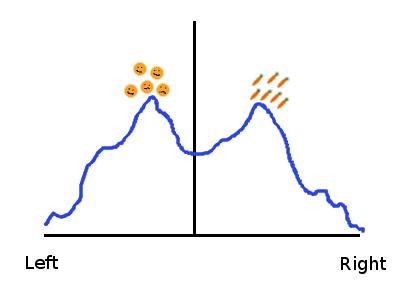
I've drawn this with "left" and "right" because I think the diagram is more readable that way than with "up" and "down". There's not necessarily any connection on this issue with the traditional left-wing and right-wing positions, though, and the argument I'm making will generalise to issues where the options can't be expressed on a linear scale1, or indeed in Euclidean geometry.

Diagram 1
Diagram 1: A distribution of opinion. Somewhere between normal, flat, and lumpy.

Exactly what the distribution looks like doesn't really matter. There are usually going to be more people around the middle than at the edges, and it's not going to be completely smooth - there'll be peaks here and there that represent popular solutions.

Let's also assume that in general people vote for political parties close to their own opinions where possible. There's plenty of room for misinformation about who actually supports what policy to creep in, but since both sides are trying it the net effect is going to be relatively minor.

Let's also assume a 2-party system with a non-proportional2 electoral system that makes it very hard for a third party to break in anywhere, as we have in the UK (even with the rise of the Lib Dems) or in the USA. This is a fair assumption because it's what we have.

So, next picture: two of the big peaks of opinion distribution near the centre are occupied by the major political parties - the Oranges and the Carrots.

Diagram 2
Diagram 2: Same as the first, but with the Orange party occupying the peak to the left of the centre, and the Carrot party occupying the peak to the right of it.

There's then a general election. The Orange party loses the election, and the Carrots party enters government.

Why running to the centre works in the short-term

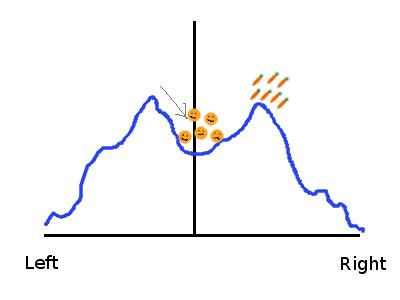
This is the point where the "principles or power" argument comes in to play. Obviously, it's really bad for the Carrot party to be in power. There's no real hope of another party coming out of nowhere to save the day, at least not by next election, so to get the Carrots out, the Oranges have to get in. But the electorate has just been presented with the Oranges, and didn't like them - it preferred the Carrot policies3.

So, to "be more electable", the Oranges move their policy along a bit towards the centre.

Diagram 3
Diagram 3: The Carrot party is still on the right peak, but the Oranges have moved their position into the valley between the two peaks.

At the next election, the centre point between the Orange policy and the Carrot policy is in a different place. The key swing voters in between the two parties are now going to cast their votes a bit differently, with the Oranges picking up more of their votes than before. They might lose a few votes from the left-most end of the distribution, too, but they can afford to: votes they lose from the left go to an inconsequential rival or abstentions. Votes they take from the right come off their major opponent's totals. They can afford to lose almost twice as many votes from the left as they gain from the right and still come out ahead.

For instance, if there are 100 voters in all, and 53 voted Carrot and 47 voted Orange, then by convincing 10 Carrot voters to vote Orange, the scores become 43-57. A 6 vote margin has been changed to a 14 vote margin in the other direction. If Orange loses 12 voters from their left as a result, they're still 2 votes ahead of the Carrots at 43-45, despite losing more voters than they gained.

So, by following this strategy, the Oranges are able to regain power at the next election.

So why doesn't everyone just end up in the centre?

Over in a formerly-smoke-filled but now nicely air-conditioned room at Carrot Headquarters, the party green-wigs need to decide on a strategy. They have two choices.

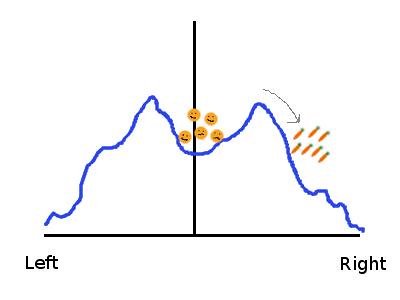
  1. They can do what the Oranges did to them, and move closer to the centre, to try to retake power. There's not a lot of spare space to move into, though, without dropping this as an election issue at all, which won't actually do them much good. And you need to have some space to manouevre for the 2:1 multiplier you get from winning swing voters to actually be possible.
  2. They can take a longer-term view, and move their own position to the right. That's probably closer to where they wanted it to be anyway, before an earlier pragmatic Carrot leader decided that on top of the peak was a good place to be.
Diagram 4
Diagram 4: The Carrot party has also moved off its peak to the right, re-opening a wider gap between the two parties.

The Carrots pick option 2, and lose the next election too. There's probably some internal squabbles at this point, but they wait them out.

... and then, the plan pays off.

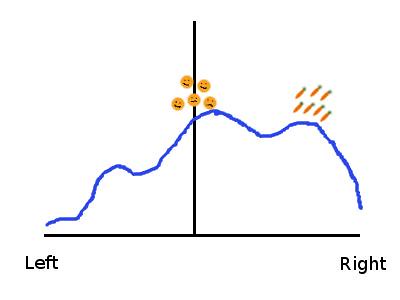
Because public opinion is not static. It's fluid, and on some issues it can change really quickly in the right circumstances. Like advertising, if you say something for long enough to enough people, some of them will listen, and change their minds. If a party states a particular policy, its supporters become more likely to support that policy.

Consider, for instance, at this YouGov poll (PDF) from December. On page 7, there's a question about whether short prison sentences or community sentences are more effective.

In general, imprisonment is the stereotypical Conservative policy. They have the reputation for being "tougher on crime". So it was in some ways an unexpected announcement of Conservative policy that they would want to go for community sentences. In the poll, though, Conservative voters split 36:44 in favour of community sentences.

Perhaps the stereotypes are wrong? Public opinion often isn't what it's claimed to be. Are the Conservatives playing to their base after all?

This time, though, there's something else at work: compare that poll to this other poll (PDF), also carried out by YouGov, only a month earlier.

In this poll, Conservative voters are split 57:35 against the use of community sentences. In a month, there has been a 30 point swing in Conservative voter opinion. Additionally, there has been a 19 point swing in general voter opinion (which includes the Conservatives). From being a policy that had the weight of public opinion against it - and think tanks warning the government away from it - it's now one that the public is roughly split on.

There are differences of question wording between the two polls, but these mainly consist of the later poll having a tiny neutral summary of the purported advantages of each choice (which I don't think is particularly significant), and the later poll attributing the community sentences policy to the current government (which may well be a significant wording difference, but one that strengthens my point if it is)

I don't think public opinion is quite that fluid on most issues - sentencing policy is in general not an issue of major importance to most voters - and in general that sort of change takes years or decades rather than weeks, but it definitely happens over time.

So, how does this affect the diagram?

Diagram 5
Diagram 5: The distribution of public opinion has shifted, with the peaks moved towards the parties' new positions.

The next election, the Carrots win it, by about the same margin as they won the election back in Diagram 1.

So, the Oranges have to do something. It worked last time, so they move their policy off the peak, and closer to the Carrots.

After a couple of cycles of this, what happens is of course that the Oranges have ended up fairly close to where the Carrots were originally. At this point, the Carrots can start moving slowly back towards the Oranges, both picking up votes themselves, and trying to make the new consensus one that sticks so that they don't have to defend it in future. The result: the Carrots have spent a fair proportion of the time in power, the Oranges will be implementing their policies anyway while the Carrots are out of power, and the Carrots can direct their energies to winning the next argument.

It took a little more than a single election cycle, but the Carrots have most definitely - by sticking to their principles - won. This is why, as Broadsnark said:

The people whose power lasts are those whose power comes from their principles, not from selling their principles out. It’s not naive to think that people shouldn’t sell their principles to power. It’s naive to think that someone in power who has sold their principles can do us any good.

So, the Oranges have power - and are using it to implement Carrot policy. Whether they count this as a success depends entirely on whether they went into politics to get power or to advance their principles. Meanwhile, the people who liked the Oranges' initial policy are stuck out on their own, without any formal representation, and now have to work hard to draw the Oranges (and ideally the Carrots, too) back towards them.

I've given this example with political parties, but it really works for anyone trying to make a difference to anything - in the long term, the successful people are people who've convinced opinion to follow them.

What if the Carrots are really bad?

Some governments are so bad that even letting them be in power for one term is going to be disastrous, and it's worth paying a high price to keep them out. The problem with this argument is that you can't keep them out forever.

Governments in the UK lose an average of 3 points of popular vote between elections. Virtually none have actually gained popularity between elections. Sooner or later, the accumulated frustrations of the population are going to kick them out no matter how well they're doing.

The opposition will be back in power eventually and you can't stop this. It's not worth delaying it a few years if the cost is implementing their policies anyway.

There are in a democracy ways other than being the official opposition to make it politically unviable for the government to do something, anyway.

(This only applies if you trust the opposition to hold another fair election, of course, but if you don't there are bigger problems)

Wouldn't this just lead to no-one compromising on anything, and nothing getting done?

Maybe.

In practice, though, no. There's a major difference between compromising on what gets implemented now, and compromising on your underlying principles.

To illustrate this, say there are two issues (A and B), with three possible policies (A0, A1 and A2, with A1 being 'between' the other two policies, and similarly for B).

If A2 is the current situation, a supporter of A0 could team up and compromise with supporters of A1 to get A1. It's not what they actually want, but it's closer to it. And if between them they can make A1 stick, then maybe in a few years it'll be possible to get mass support for moving to A0.

This is a good compromise, and isn't inconsistent with having principles and keeping them.

Suppose, then, that this support of A0 also supports B0. The current situation is A1 and B1. A supporter of A2 and B0 offers to help with getting B0 in exchange for help in getting A2.

Assuming that A and B are both major issues - if A is "who pays for lunch?" and B is "should we invade Norway?", this doesn't hold - this is a bad compromise. To take it, the principle of A0 will have to be sacrificed.

In between the two is an offer to support B0 if you don't campaign for A0 and accept A1 as sufficient (assuming A1 is currently true) - at least in public.

I think this is still generally a bad deal - both sides of the deal want (or at least, aren't opposed to) B0 already. So you could probably get B0 another way without giving up the possibility of A0. There might be cases where it's worth taking, though, if B0 is likely to be the sticky position, and so you can go back to working towards A0 relatively quickly once B0 is done.

The reason that the good compromises are good is that they don't stop you working on moving mass opinion towards your position. The reason the bad compromises are bad is that you have to shut up and contribute towards making things worse, which means that when you decide you've had enough, you've been digging your own hole for the last few years and have to fill that in first.

Only making good compromises means that political alliances on one issue aren't necessarily going to be the same as the political alliances on a different issue. There's nothing wrong with that, either, though it can take some getting used to.

Conclusion

The way to win, in the long-term, is to have principles, to stick to them, and to argue for them consistently and convincingly. There are plenty of situations where the short-term gain is from abandoning some principles to help others: beware.

Having short-term political power, in the way the default thinks of "political" and "power" is not necessarily useful, and may in some cases be actively counter-productive to principled success because the costs of getting it are too high.

Footnotes

1 If I was better at drawing, there would be a picture of an opinion surface in two dimensions to demonstrate this. Please imagine your own.

2 In a proportional system, the incentives are different, and the advantages to sticking to your principles are much clearer. It's the main reason that I want one.

3 Not necessarily true in a non-proportional system, but let's assume that like the UK and USA, the tendency is to expand differences in the popular vote, rather than reduce them. Elections where the winner of the most seats and the winner of the popular vote differ will result in a very different - and generally messier - political dynamic anyway.

Thursday, 28 October 2010

Suffrage and successes that stick

At the Museum of Edinburgh is an exhibition commemorating the women's suffrage campaigns in the UK.

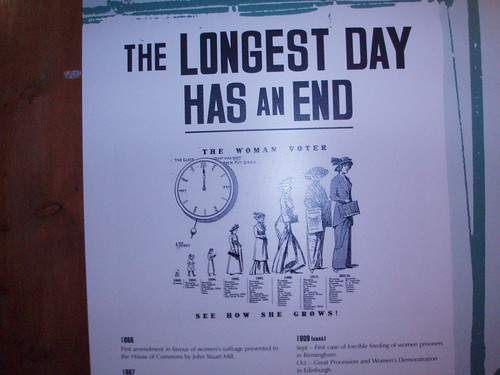
There was this interesting poster there:

The Longest Day has an End

Here's a photo of the detail

The poster has the slogan "The longest day has an end" prominently at the top. Below that on the left is a clock set to midnight. Below that, and rising to the right of the clock, is a timeline running from 1869 to 1913, detailing the countries and sub-national regions that allowed at least some women to vote, graphically illustrated by sketches of a woman growing older and taller from a tiny baby (waving a flag) in 1869 to a full-height woman in 1913.

Reformatted for the web, here's the timeline:

YearCountries/Regions with at least some women allowed to vote
1869Wyoming
1893Wyoming, New Zealand, Colorado
1896Wyoming, New Zealand, Colorado, S. Australia, Utah, Idaho
1902Wyoming, New Zealand, Colorado, S. Australia, Utah, Idaho, W. Australia, New South Wales
1907Wyoming, New Zealand, Colorado, S. Australia, Utah, Idaho, W. Australia, New South Wales, Tasmania, Queensland, Finland
1908Wyoming, New Zealand, Colorado, S. Australia, Utah, Idaho, W. Australia, New South Wales, Tasmania, Queensland, Finland, Victoria, Norway
1911Wyoming, New Zealand, Colorado, S. Australia, Utah, Idaho, W. Australia, New South Wales, Tasmania, Queensland, Finland, Victoria, Norway, Washington, California
1912-1913Wyoming, New Zealand, Colorado, S. Australia, Utah, Idaho, W. Australia, New South Wales, Tasmania, Queensland, Finland, Victoria, Norway, Washington, California, Oregon, Kansas, Arizona, Alaska

Below the timeline is the second slogan "See how she grows!"

The whole exhibition - if you happen to be able to get there before it closes, and find it in the museum (accessibility is not universal) - is worth seeing.

One of the points being made by the timeline is that no area that granted women the right to vote had since revoked it, and I think this point provides a useful division of social justice issues.

For some issues, like suffrage, or the right of LGB people to serve in the military, there is a clear point. It may take decades or centuries of difficult struggle to argue up to that point, but once there the gains are relatively safe - once the critical threshold has been passed in a particular democratic jurisdiction, the idea fairly rapidly passes into general acceptance, to the extent that even those who opposed it before move to support it, at least in public.

The gains are reversible - any violent or otherwise sudden overthrow of the system of government, from within or without, might reverse them - and that they're otherwise unlikely to be reversed of course doesn't imply that there doesn't remain a significant minority of people who believe that they're nevertheless wrong. There are still people in the UK who believe that women shouldn't have the right to vote.

For other issues, there's no such critical threshold. The level of rights available can go backwards and forwards across a wide range over the decades, as different opinions gain and lose dominance in governments and in the wider population. Access to abortion has changed back and forth quite a bit in many countries. It's still, just about, a fringe view in the UK Parliament that it should be outlawed entirely - but of course that's a fringe that will grow as erosions are made to the existing rights. Attitudes - and legislation - towards immigration has also varied back and forth a lot. Any gain made with this sort of issue needs to be heavily defended just to make it into a new baseline against the counter-attempts of privilege.

What's not at all clear to me is why an issue falls into one or other type. It's not just about it being a binary divide or not - in the UK women's suffrage proceeded in stages, while the binary issue of defendant anonymity in rape cases has changed back and forth and remains contentious today.

It's also not, as far as I can tell, about differentials between public opinion and government opinion. Sometimes the government lags far behind public opinion on the matter - as the UK government is doing on same-sex marriage - and sometimes it introduces legislation that leads the way and public opinion follows (as happened with the abolition of the death penalty).

It seems like it would be useful to know why some successes stick and others don't, and perhaps how a success could be made to stick when it otherwise wouldn't, but I don't know of much that's been said on that.